

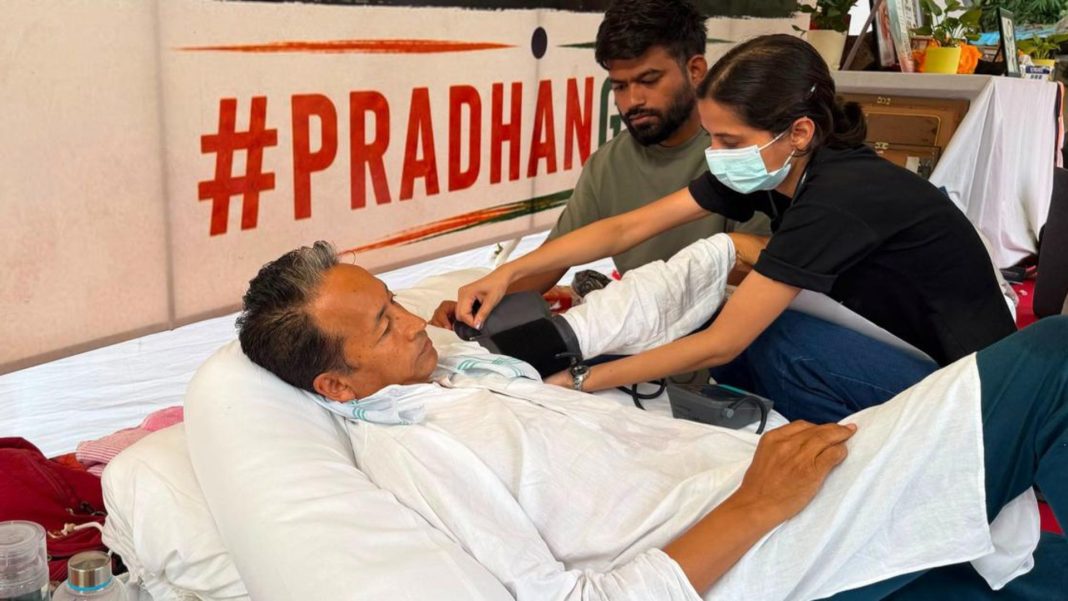

Sonam Wangchuk Shifted to Hospital: In a major development amid escalating tensions over national educational reforms, Delhi Police on Saturday shifted noted climate activist and social reformer Sonam Wangchuk to Safdarjung Hospital.
The administrative action concluded his 20-day-long indefinite hunger strike at Jantar Mantar, following severe medical evaluations and strict statutory directives from the Delhi High Court.
The shifting process, however, triggered a massive political and civil demonstration at the site. Activists from the Cockroach Janata Party (CJP) along with various student unions strongly protested the police intervention, culminating in a fresh hunger strike announcement by a prominent opposition leader.
The Legal Mandate: Delhi High Court Prioritizes Human Life
Sonam Wangchuk Shifted to Hospital: According to official updates, the administrative action followed directly from recent observations made by the Delhi High Court.
A bench handling a plea regarding the activist’s declining health had explicitly directed state authorities to conduct mandatory daily clinical examinations. The court noted that “the life of any citizen is precious” and ordered regular medical intervention if a crisis arose.
Following a highly critical medical report on Saturday morning, the Delhi Police decided to execute the hospital transfer.
“As per orders of the Hon’ble High Court and on expert medical advice due to the deteriorating health condition of Sh. Sonam Wangchuk, he has been shifted to the hospital for essential medical care,” stated the Delhi Police DCP in an official social media briefing.
While the police maintained that they exercised maximum restraint during the process, local media reports indicated that slight commotions and brief physical standoffs broke out as protesters attempted to form a human chain around the leader.
Critical Health Metrics: What Prompted the Shifting?
Sonam Wangchuk Shifted to Hospital: Medical bulletins released prior to the intervention painted a deeply concerning picture of the activist’s biological vitals. Having commenced his indefinite fast on June 28, 2026, the 20-day deprivation resulted in severe physiological deterioration.
Key Health Metrics Reported:
Weight Loss: Medical staff confirmed that the activist lost between 8 to 9 kilograms during the fast.
Muscle Degeneration: In a video message released before the police action, the leader disclosed that he had lost nearly 20% of his muscle mass.
Organ Stress: Doctors warned that a combination of extreme dehydration and prolonged fasting posed an immediate risk of vital organ failure, constituting a legitimate medical emergency.
Safdarjung Hospital authorities have since issued an update stating that while the activist remains extremely weak, his condition has been stabilized under the strict supervision of a specialized medical team.
Family Intervenes: Strict Demands on Medical Protocols
The situation took a complex turn when Geetanjali J. Angmo, the wife of the activist, reached Safdarjung Hospital to lay down strict parameters regarding his treatment.
Media reports indicate that she has issued a clear warning to the hospital administration regarding personal autonomy and human rights.
According to sources close to the family, she explicitly demanded that no forced medical procedures, intravenous (IV) fluids, or oral feedings be administered without her clear, written consent.
The family maintains that a private medical team had been continuously monitoring him, and any intervention forced against his explicit will would place the legal and ethical liability squarely on the hospital administration and local authorities.
Why is Sonam Wangchuk Fasting? Core Demands Explained
The indefinite fast was launched to highlight systematic grievances within India’s apex testing frameworks. The primary motivations driving the agitation include:
Accountability for Examination Leaks: The core demand centers around the high-profile alleged NEET paper leak controversy that impacted millions of students nationwide.
Ministerial Resignation: Protesters are demanding the immediate resignation of Union Education Minister Dharmendra Pradhan over the alleged administrative failure.
Institutional Overhaul: Activists are calling for deep-seated transparency, independent audits, and structural changes within the national examination system.
Jantar Mantar Erupts: Allegations of Force and a New Hunger Strike
Following the eviction of the primary leader, the protest site witnessed significant unrest. Local student groups and political workers accused the Delhi Police of using heavy-handed tactics to clear the area.
Abhijit Dipke, the founder of the Cockroach Janata Party, leveled serious allegations against the police department.
According to media reports, Dipke claimed he was unlawfully restrained at his residence, detained, and physically assaulted by security personnel.
Party spokesperson Saurabh Das further alleged that police forces used mild lathi-charge tactics to disperse the students gathered at Jantar Mantar claims that the Delhi Police have not officially verified.
In a dramatic turn of events, Dipke later addressed the crowd at Jantar Mantar. Visibly emotional and breaking into tears on stage, he announced that the movement would not die down. He declared the commencement of his own indefinite hunger strike to carry forward the agitation.
What Lies Ahead: The July 20 ‘Chalo Sansad’ March
Despite the primary activist being hospitalized and police personnel initiating steps to clear the Jantar Mantar grounds, student organizations have vowed to intensify their campaign.
Before being shifted by the authorities, the activist had released a poignant video message urging citizens from all walks of life to gather in massive numbers for a scheduled “Chalo Sansad” (March to Parliament) on July 20.
Political analysts suggest that with opposition leaders like Pawan Khera, Dimple Yadav, and Arvind Kejriwal previously visiting the site to express solidarity, the issue is bound to spark a stormy session in the parliament in the coming days.