


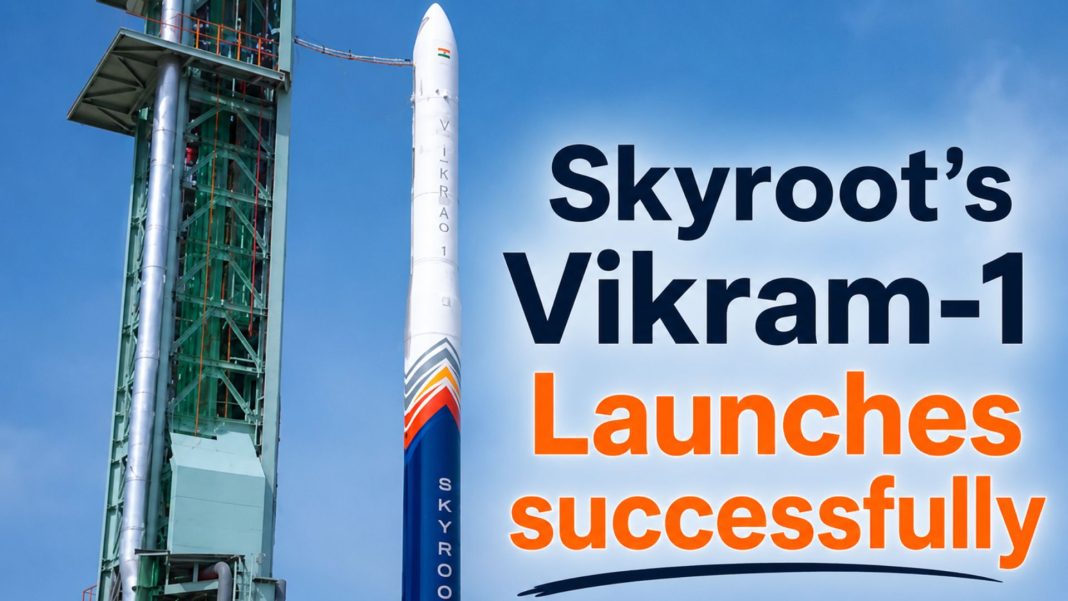

Vikram-1 Launched: In a historic milestone that fundamentally reshapes the global space commercial market, Hyderabad-based space technology startup Skyroot Aerospace successfully executed the maiden orbital flight of its indigenously developed rocket, Vikram-1.
Named “Mission Aagaman” (meaning ‘Arrival’), the flight officially marks the entry of India’s private sector into the competitive global orbital launch business.
The seven-storey-tall vehicle blasted off from the First Launch Pad at the Indian Space Research Organisation’s (ISRO) Satish Dhawan Space Centre (SDSC) in Sriharikota, putting an end to decades of an exclusive state-led monopoly and opening a new era of private commercial spaceflight.
High Drama at the Launchpad: Navigating a “Planned Hold”
Vikram-1 Launched: According to ground mission control reports, the countdown on Saturday morning was not without intense moments.
Originally scheduled for a liftoff at 11:30 AM, the automatic launch sequence encountered a brief hurdle when engineers called for a “planned hold” just five minutes before the clock ran out. Media reports indicated that the pause was initiated to clear critical navigation and system checks.
The brief pause heightened the palpable anxiety inside the control center. However, after necessary technical clearances, the countdown safely resumed.
At exactly 12:05 PM, the solid boosters ignited with a deafening roar, propelling the multi-stage launch vehicle into a cloudy afternoon sky.
Approximately 16 minutes into the flight, the rocket successfully deployed all its target payloads into a 450 km Low Earth Orbit (LEO) at a 60-degree inclination, triggering widespread celebrations at the spaceport.
Deep Cutting-Edge Tech: Inside the All-Carbon Vikram-1
Vikram-1 Launched: The execution of Mission Aagaman serves as a major validation of Skyroot’s proprietary technology. Vikram-1 is engineered specifically to cater to the booming global small-satellite market much like an on-demand “cab service to space”.
Structural & Propulsion Highlights:
All-Carbon Composite Frame: Unlike traditional metallic structures, the entire airframe of the rocket is built using high-strength carbon composites, greatly reducing the dead weight of the vehicle.
3D-Printed Liquid Engines: The upper stages utilize advanced, in-house developed 3D-printed liquid fuel engines designed for precise payload insertion.
Solid-Fuel Boosters: Heavy high-thrust solid-fuel stages power the initial liftoff sequence, showcasing complex multi-stage ignition stability.
The vehicle is built to carry payloads weighing up to 350 kg to Low Earth Orbit, filling a vital niche as global communication networks and internet providers look for rapid, flexible launch windows.
From Scientific Pioneers to Fine Art: A Diverse Payload
Media reports confirmed that the maiden flight carried an eclectic mix of functional technology demonstrators and symbolic cultural artifacts.
| Payload Category | Details / Deliverables |
|---|---|
| Commercial Tech Demonstrators | Satellites from Grahaa Space, Cosmoserve, DCubed, and Skyroot’s native SCOPE platform will collect critical flight environment data and demonstrate commercial space technologies. |
| Cultural & Space Art | “Cosmic Bloom”—an 18-karat gold, floral-shaped artwork commissioned by Cosmos Diamonds, symbolizing the fusion of art, luxury, and space exploration. |
| Micro-Sculpture Tributes | Microscopic sculptures honoring Indian scientific legends Sir C.V. Raman, Dr. Vikram Sarabhai, and Dr. A.P.J. Abdul Kalam, each crafted to be smaller than a single grain of rice. |
Furthermore, the rocket carried a deeply sentimental artifact: a handwritten postcard from Prime Minister Narendra Modi bearing the words “Vande Mataram”.
In a celebratory call to Skyroot’s founders, Pawan Kumar Chandana and Naga Bharath Daka, the Prime Minister noted the beautiful timing of the launch, aligning with the historical milestone of the nation’s patriotic anthem.
Geopolitical Weight: A 46-Year Historic Alignment
The success of Mission Aagaman holds historical poetry for India’s space program.
Space analysts quickly pointed out that the July 18 launch fell exactly 46 years to the day after ISRO successfully launched the legendary SLV-3 rocket in 1980 under the guidance of Dr. A.P.J. Abdul Kalam, which initially made India an independent spacefaring nation.
While SLV-3 established the prowess of the state, Vikram-1 cements the capabilities of India’s commercial sector. With this success, India enters a hyper-elite circle of a very few global nations possessing fully functional private orbital launch providers.
The triumph highlights the tangible real-world impact of the Indian Space Policy 2023, which systematically unbundled ISRO’s infrastructure to allow private space startups (Non-Government Entities) to thrive.
According to data from official sources, India’s private space tech ecosystem has aggressively expanded from a singular startup in 2014 to well over 400 active enterprises today.
Led by a young team with an average age of just 28 years, Skyroot’s successful mission sets a soaring precedent for the future of commercial aerospace innovation in South Asia.
Also Read: India’s First Urban Night Safari: Supreme Court Greenlights UP’s ₹1,500-Crore Kukrail Project