


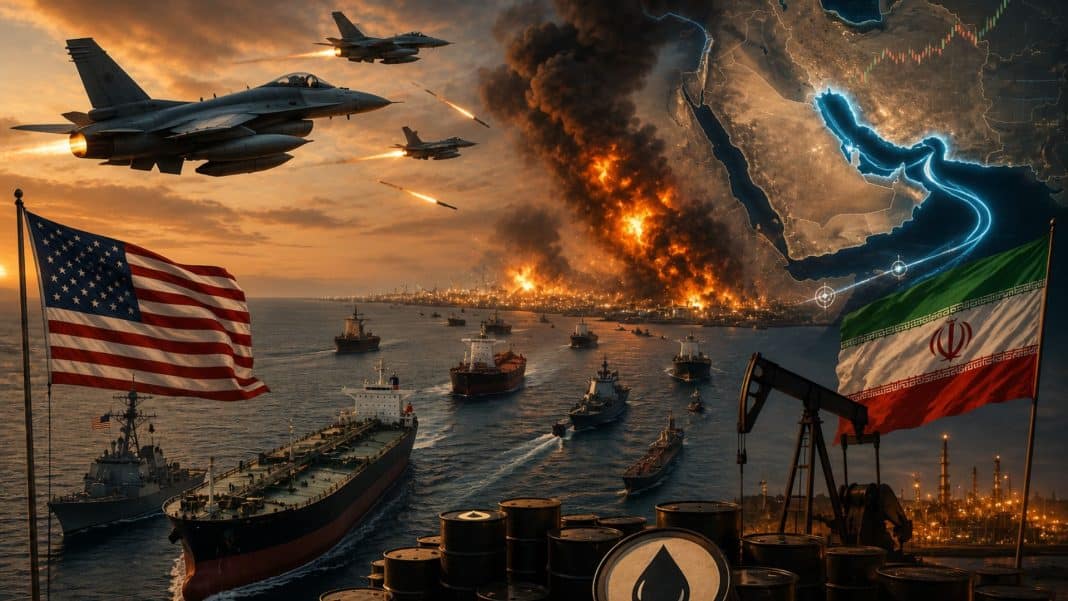

Strait of Hormuz Crisis : The United States military launched a sweeping new wave of airstrikes against military targets inside Iran early Wednesday morning.
Washington officials stated the targeted strikes specifically focused on degrading military capabilities that have recently been deployed to disrupt and attack commercial shipping vessels navigating through the highly sensitive Strait of Hormuz.
The operation marks a significant escalation in regional tensions, focusing directly on securing a maritime corridor that remains absolutely vital to the stability of the global energy supply chain.
Zeroing In: US Central Command Confirms Dawn Operation
Strait of Hormuz Crisis : Confirming the details of the military response, United States Central Command (CENTCOM) released an official statement on the social media platform X (formerly Twitter). According to the military command, the precision operation commenced at exactly 6:00 AM Eastern Time (ET) on Wednesday.
CENTCOM emphasized that the mission’s primary objective was to immediately degrade and systematically reduce Iran’s capability to threaten international maritime traffic.
“This operation was specifically designed to neutralize assets used to target commercial vessels and to ensure that freedom of navigation is maintained across this critical global trade artery,” the military command noted in its public brief.
At 6 a.m. ET today, U.S. Central Command forces began launching a wave of strikes against Iran. The strikes are designed to further degrade military capabilities Iranian forces have used to attack commercial shipping in the Strait of Hormuz.
— U.S. Central Command (@CENTCOM) July 15, 2026
A Crucial Chokepoint: Why the Strait of Hormuz Matters to the World
Strait of Hormuz Crisis : The location of the conflict is no coincidence. The Strait of Hormuz is widely recognized by global economists and defense analysts as the world’s most critical maritime oil chokepoint.
The Lifeline of Global Energy
Volume: Vast quantities of the world’s crude oil, petroleum products, and liquefied natural gas (LNG) pass through this narrow strip of water every single day.
Geographic Sensitivity: Flanked by Iran on one side and Oman and the United Arab Emirates on the other, the strait is the only sea lane connecting the energy-rich Persian Gulf to the open ocean.
Any disruption, threat, or active hostility inside this corridor sends immediate shockwaves through global energy markets, threatening to spike inflation and disrupt fuel supplies across Europe, Asia, and North America.
By launching these preemptive and retaliatory strikes, Washington is sending a clear signal that it will aggressively defend the free flow of commerce against state-sponsored interference.
The Catalyst for Conflict: Escalating Threats on Commercial Ships
The pre-dawn airstrikes did not happen in a vacuum. Over the past several weeks, Washington and its international allies have grown increasingly alarmed by a series of aggressive maneuvers, drone deployments, and missile threats directed at neutral commercial tankers operating in international waters.
US intelligence reports indicated that specialized Iranian military units had set up advanced tracking systems, coastal missile batteries, and rapid-deployment drone launch pads specifically aimed at commercial shipping lanes.
White House and Pentagon officials repeatedly warned that continued harassment of global merchant fleets would met with direct kinetic consequences. Wednesday’s strikes represent the realization of those warnings.
The Aftermath and Global Fallout: What Happens Next?
The Pentagon has not yet released a definitive battle damage assessment, but initial reports suggest that multiple radar installations, drone storage facilities, and coastal command centers were successfully neutralized during the coordinated dawn raids.
As the situation develops, international maritime agencies are advising all commercial vessels transiting the Persian Gulf and the Gulf of Oman to exercise extreme caution, maintain high alert status, and coordinate closely with international naval coalitions operating in the area. Meanwhile, global diplomatic channels are bracing for Iran’s formal response, as the risk of a broader regional conflict looms over the strategic waterway.
Also Read : The “Gold Standard” Shift: India-UK Free Trade Agreement Officially Takes Off Today