


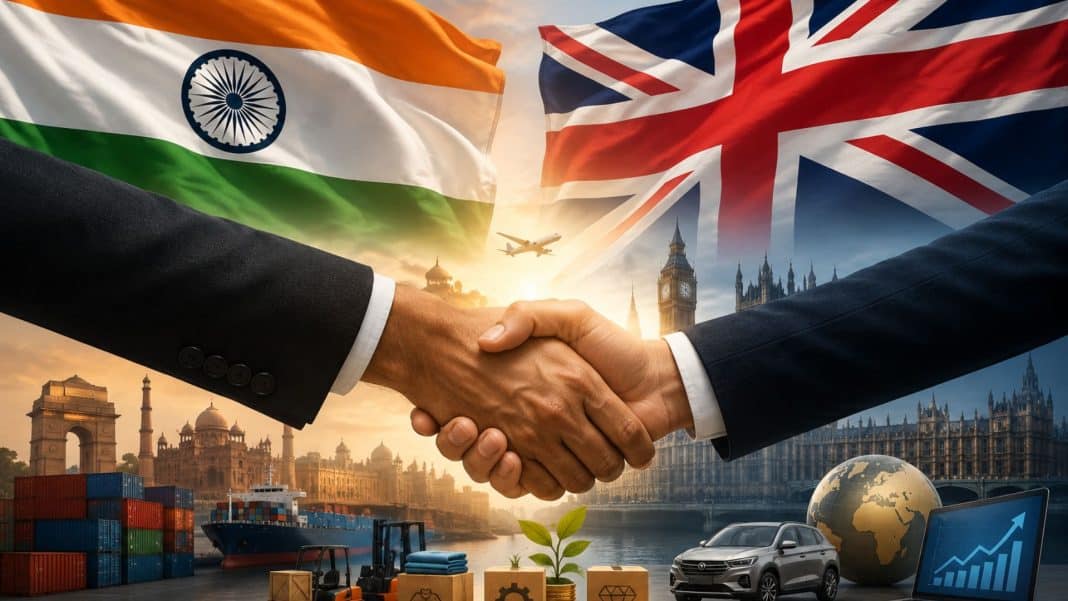

The “Gold Standard” Shift: The wait is officially over. After three years of intensive negotiations, the landmark Free Trade Agreement (FTA) between India and the United Kingdom has legally kicked into effect today, July 15, 2026.
Officially named the India-UK Comprehensive Economic and Trade Agreement (CETA), this historic deal opens up one of the most massive export corridors for Indian manufacturers in recent decades, providing preferential, lower-tariff access to the world’s sixth-largest economy.
Speaking on the eve of the rollout, Commerce Secretary Rajesh Agrawal called the pact a “gold standard” and described it as one of the most ambitious and aspirational trade agreements India has ever operationalized. According to Agrawal, the deal establishes a highly modernized, future-oriented economic architecture between two global giants.
For the average citizen, the immediate question is simple: What does a cross-continental trade treaty actually mean for the common man, the daily consumer, and the local business owner in India? Let’s break down exactly how this sweeping deal changes the economic landscape.
The Big Picture: Slashing Tariffs Between Global Giants
The “Gold Standard” Shift: At its core, the India-UK FTA is engineered to dramatically dismantle trade barriers between the world’s fifth and sixth largest economies. The scale of the tariff cuts is unprecedented:
Indian Exports: The UK is removing or significantly reducing tariffs on 99% of all goods entering from India.
UK Imports: India is reciprocating by cutting or eliminating tariffs on 90% of British products coming into the country.
For the UK, this marks its largest and most economically significant bilateral trade pact since its exit from the European Union (Brexit). The economic ripples will be felt on both sides, with the UK’s GDP projected to climb by 0.13%, and India’s GDP estimated to see a stable lift of 0.06%.
However, this 30-chapter agreement stretches far beyond simple customs duties. It lays down a modernized framework for digital trade, telecommunications, intellectual property rights, innovation, financial services, transparency, government procurement, and dedicated support for Small and Medium Enterprises (SMEs).
Global Runway for Indian Factories: The Sectors Winning Big
The “Gold Standard” Shift: Until today, Indian manufacturers looking to sell their goods in the UK faced steep import taxes ranging anywhere from 4% to 16%. With those barriers falling away today, a diverse cluster of domestic industries is gearing up for an export boom.
The Apparel and Home Textile Surge
Indian garments and home textiles previously carried a heavy UK tariff burden of 8% to 12%. The complete elimination of these taxes instantly levels the playing field for Indian mills against fierce regional competitors like Bangladesh, Pakistan, and Vietnam, which have historically enjoyed duty-free access. Experts project that Indian textile exports to the UK could skyrocket by up to 40% over the next three years.
“If you look at just home textiles, Pakistan’s share of UK exports is around 55%, whereas India’s is just 6% to 7%,” notes Dipali Goenka, CEO of Welspun Living, the prominent Indian company behind the famous Wimbledon tennis towels. “That is the massive market gap we can finally step in to cover.”
A Spark for MSMEs: Gems, Jewelry, and Leather
For small-to-medium enterprises (MSMEs) specializing in luxury goods, handcrafted leather, gold ornaments, and diamond jewelry, the transition to zero tariffs provides a direct financial boost. By stripping away extra costs at the British border, small-scale Indian exporters can price their premium products far more competitively in London and beyond.
Kitchen to the World: Agrifood and Farm Exports
The European nation is systematically lowering import duties on classic Indian agricultural outputs. Basmati rice, premium marine products like shrimp, regional tea leaves, processed packaged foods, and aromatic spices will see enhanced market access. This particular clause promises a direct financial fillip to farming communities and processing hubs across states like Assam, West Bengal, Gujarat, and Kerala.
Heavy Industry: Chemicals, Automotive, and Steel
Chemicals & Plastics: With tariffs disappearing on industrial chemicals, plastics, and agrochemicals, trade analysts predict India’s chemical exports to the UK could easily double by the year 2030.
Electric Vehicles (EVs): Indian automakers manufacturing hybrid and fully electric vehicles will receive specialized, preferential entry into the UK market under a newly established quota system.
Steel Sector: India has successfully secured a guaranteed tariff-rate quota worth roughly $350 million—well above its historical average UK steel export value of $200 million. This structural safety net is expected to propel India’s steel export revenues toward the $1 billion milestone by the end of the 2027 fiscal year.
The Talent Victory: Major Relief for Indian Techies and Professionals
One of the most human-centric victories in this bilateral pact comes via the concurrent implementation of the Double Contribution Convention (DCC), which also goes live today.
Historically, Indian white-collar professionals, particularly software engineers, financial analysts, and corporate managers sent on temporary assignments to the UK, faced a double taxation dilemma. They were legally obligated to contribute to social security systems in both India and the UK, despite not staying long enough in Britain to ever claim those retirement benefits.
Under the new DCC rules, eligible temporary Indian workers will be fully exempt from paying the UK’s National Insurance contributions for an agreed five-year window.
According to data compiled by India’s Commerce Ministry, this single immigration and labor reform will directly protect over 75,000 Indian corporate workers and roughly 900 domestic employers. The policy translates into immediate, tangible annual savings of more than $600 million for the industry, drastically lowering operational costs and making Indian tech and consulting firms far more competitive on British soil.
The Consumer Jackpot: What Gets Cheaper for the Common Man?
While exporters cheer the new market access, the domestic Indian consumer stands to gain significantly right at the retail counter. As India systematically scales down its steep import walls on choice British goods, a luxury shopping basket is about to become notably lighter on the wallet.
Premium Spirits and Scotch Whisky
For decades, India maintained a massive 150% protective import tariff on foreign spirits. Under the new FTA terms, India has agreed to instantly slash tariffs on premium British Scotch whisky and gin down to 75% on Day 1. Furthermore, these duties will gradually glide downward to a modest 40% over the next decade, promising a steady price correction for connoisseurs across the domestic market.
British Cars and Commercial Trucks
In a historic first, New Delhi has agreed to lower its steep import walls on fully assembled British automotive vehicles.
Passenger Cars: The baseline tariff on fully built passenger cars will be phased down from a staggering 110% all the way to a flat 10%. Concessional lower rates for traditional petrol and diesel models kick off immediately today, while high-end electric, hybrid, and hydrogen-powered British passenger vehicles will begin receiving their phased tariff concessions starting in year six of the agreement.
Commercial Trucks: Fully built freight trucks imported from the UK will see their existing 44% customs duty reduced down to just 8.8% by the fifth year, keeping within strictly defined annual import quotas.
Everyday Luxuries: Cosmetics, Chocolates, and Biscuits
British consumer goods, high-street beauty products, and everyday treats are lined up for price cuts. Imported British cosmetics, which previously carried import duties as high as 22%, will see those taxes entirely wiped out immediately or systematically reduced to zero over a 10-year transition period. Similarly, popular British confectionery, sweet biscuits, and soft drinks will become cheaper on supermarket shelves as import duties face the axe.
Industrial Silver and Healthcare Systems
Silver Bars: High-purity (99.9%) silver bars imported from Great Britain will see their customs levies systematically phased out over 10 years. However, to keep a close eye on precious metal flows, the government mandates that all such silver imports must still secure an official import license from the Directorate General of Foreign Trade (DGFT).
Advanced Healthcare: Vital medical items manufactured in the UK, including diagnostic imaging equipment, specialized surgical instruments, X-ray systems, and ECG machines, will enjoy lower tariffs, effectively reducing capital expenditure for domestic hospitals and making advanced diagnostic healthcare more accessible for patients.
Empowering the Grassroots: A Deal Designed for All
Summing up the expansive socio-economic reach of the historic pact, Commerce and Industry Minister Piyush Goyal emphasized that the deal’s benefits will trickle deep into the roots of the domestic economy rather than just padding corporate balances.
“This ambitious agreement will empower every section of society,” Goyal stated. “Women, farmers, youth, MSMEs, innovators, professionals, and fisherfolk, all stand to gain from the immense, borderless opportunities it creates.”
With the regulatory switch flipped today, the economic bridges between India and the UK have been fundamentally rebuilt. As lower prices begin registering at consumer billing counters and container ships depart Indian ports with minimal duties, this comprehensive trade pact sets a powerful precedent for how modern, balanced, and future-ready trade agreements will look in the decade to come.
Also Read : GLOBAL RECOGNITION: Udaipur, Jaipur, and Mumbai Named Among World’s 25 Best Cities in 2026