


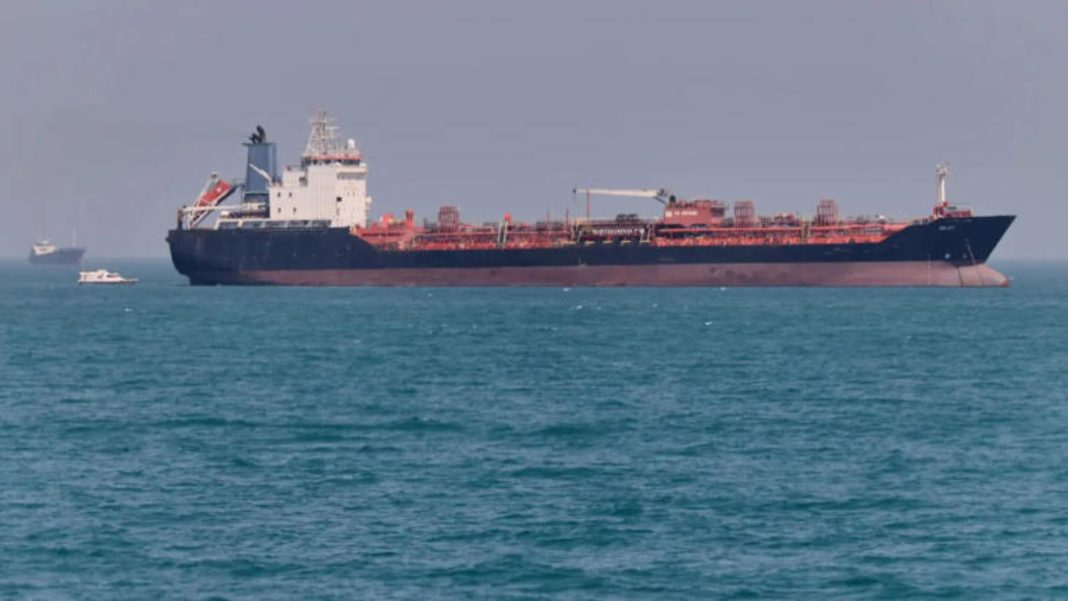

Tension in the Gulf of Oman: In a dramatic escalation of maritime enforcement, US military forces intercepted and completely disabled a Gambia-flagged commercial vessel in the international waters of the Gulf of Oman.
The ship, identified as the MV Lian Star, was aggressively moving toward an Iranian port, directly violating the active naval blockade enforced in the region.
Despite an ongoing ceasefire with Iran, the high-seas interception highlights the razor-thin margin for error in one of the world’s most volatile shipping lanes. US Central Command has re-emphasized that while the ceasefire holds on land, the maritime blockade remains absolute and non-negotiable.
20+ WARNINGS IGNORED: THE DEFIANT RUN
Tension in the Gulf of Oman: According to military sources, the confrontation did not escalate instantly. US naval and aerial surveillance systems flagged the MV Lian Star as it altered its course toward Iranian territory.
The US forces issued more than 20 consecutive radio warnings to the ship’s crew. The crew was repeatedly informed via international maritime channels that their trajectory constituted a direct violation of the standing blockade.
Ignoring the barrage of warnings, the vessel maintained its speed and direction, refusing to communicate or alter its course, heading straight into forbidden waters.
THE KINETIC RESPONSE: HELLFIRE STRIKES ENGINE ROOM
Tension in the Gulf of Oman: With the commercial vessel refusing to comply, the US military shifted from verbal warnings to kinetic action. A US Air Force fighter jet was scrambled to neutralize the threat.
Operation Objective: The mission parameters were strictly defined, neutralize the vessel’s mobility without sinking it.
To achieve this, the fighter jet deployed a precision-guided Hellfire missile, targeting the ship’s vulnerable engine room. The tactical strike was highly successful.
The missile ripped through the propulsion compartment, instantly killing the ship’s power and leaving the MV Lian Star dead in the water. The vessel is now entirely immobilized but remains afloat, avoiding a catastrophic environmental or humanitarian disaster in international waters.
THE SCALE OF THE CRACKDOWN: BY THE NUMBERS
This latest strike is part of a much larger, aggressive campaign by the United States to choke off illicit supply lines to Iran. The scale of the operation reveals an airtight security net across the primary zone of operations in the Gulf of Oman and the Persian Gulf.
So far, 5 commercial vessels have been completely disabled via direct military strikes after refusing to cooperate. In addition to these strikes, a staggering 116 vessels attempting to break the blockade have been successfully intercepted and rerouted away from Iranian waters by American forces.
THE BROADER PICTURE: CEASEFIRE BUT NO COMPROMISE
The incident comes at a sensitive time when a fragile ceasefire is technically in place with Iran. However, Washington has made it clear that a ceasefire does not equal a free pass at sea.
US maritime surveillance has been drastically intensified across the Gulf of Oman. Every commercial vessel moving through these transit corridors is being rigorously vetted.
Any ship deviating toward Iranian ports faces immediate scrutiny, interception, and, as the MV Lian Star discovered, kinetic military action.
DECODING THE STRATEGY: AMERICA’S NO-TOLERANCE POLICY
This bold military action sends a loud, unmistakable message to global shipping companies and insurance underwriters: The US blockade is not a diplomatic bluff.
By using targeted missile strikes on commercial entities that break the rules, the US is proving it will use maximum economic and military deterrence.
The Gulf of Oman remains a highly sensitive powder keg, and for any vessel planning to bypass the blockade, the price of admission might just be a Hellfire missile.