


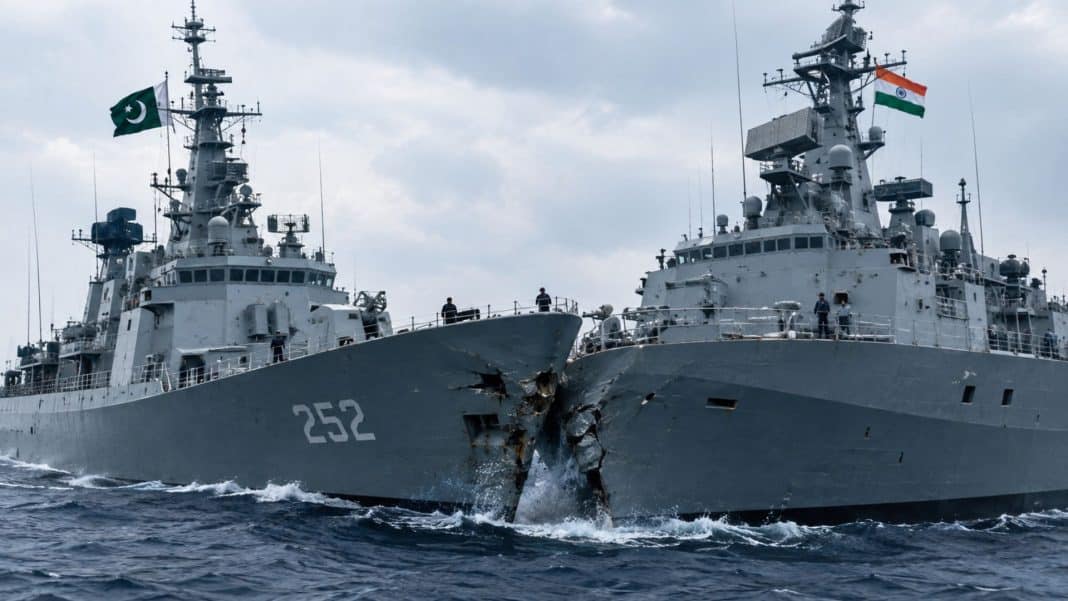

Tensions at Sea: A dangerous maritime escalation unfolded in the international waters of the North Arabian Sea when a Pakistani naval ship collided with an Indian Navy warship during a routine surveillance mission. The Indian Ministry of External Affairs (MEA) registered a strong diplomatic protest, calling the maneuver by the Pakistani vessel highly reckless, unsafe, and completely unprofessional.
High-Speed Maneuver Triggers Mid-Sea Collision
Tensions at Sea: According to sources, the Indian naval vessel was conducting standard patrol and monitoring operations in international waters when the Pakistani ship, identified as PNS Hunain, approached at high speed.
Naval reports indicate that PNS Hunain unexpectedly executed a sudden and erratic directional shift. By veering directly into the path of the oncoming Indian warship, the Pakistani vessel rapidly closed the distance between the two ships, making an impact unavoidable.
The Incident Area: International waters of the North Arabian Sea.
The Pakistani Vessel: PNS Hunain, an offshore patrol vessel primarily used for maritime surveillance and security ops.
Impact & Damage: PNS Hunain suffered noticeable physical damage during the impact.
Indian Navy Status: The exact identity and structural impact on the Indian Navy warship have not yet been officially named by authorities.
Diplomatic Heat: India Summons Pakistani Envoy in New Delhi
Tensions at Sea: Following the mid-sea collision, the Indian government took swift diplomatic action. The Ministry of External Affairs (MEA) summoned the Charge d’Affaires of the Pakistan High Commission in New Delhi to issue a stern demarche.
India expressed deep concern over the operational conduct of the Pakistani crew, emphasizing that maritime security strictly depends on adhering to international standards of seamanship and bilateral protocols.
“The actions of the Pakistani ship were completely unacceptable and highly unprofessional. Military vessels operating in international waters must strictly follow safety regulations and bilateral agreements to prevent such dangerous encounters.”
— Ministry of External Affairs (MEA)
Additionally, India’s Charge d’Affaires in Islamabad was instructed to deliver a matching protest directly to the Pakistani Foreign Ministry.
Echoes of 2011: A History of High-Seas Friction
This incident brings back memories of a similar mid-sea clash between the two neighboring navies over a decade ago.
In the June 2011 incident, PNS Babar was escorting MV Suez, an Egyptian-owned merchant ship freed from Somali pirates after a multi-million dollar ransom payment. During the transit, PNS Babar attempted to overlap INS Godavari from its starboard side, ultimately brushing against the Indian ship’s helicopter deck net and causing structural damage.
India lodged an official protest back in 2011 referencing Article 10 of the 1991 Bilateral Agreement, which dictates guidelines for preventing incidents at sea between both nations.
What India Demanded From Pakistan
During the summons, New Delhi laid down clear expectations to ensure maritime safety moving forward:
Immediate Escalation to Islamabad: The Pakistani Charge d’Affaires was instructed to convey India’s serious objections directly to higher authorities in Pakistan.
Adherence to Bilateral Protocols: Both nations must abide by established maritime safety norms and the 1991 agreement governing military movement at sea.
Preventative Action: Pakistan must take immediate internal measures to train its crews against executing erratic, high-speed maneuvers near foreign warships.
Naval operations in the Arabian Sea remain closely watched as both defense establishments evaluate the operational fallout from this mid-sea collision.
Also Read : UAE VISA CANCELLATION CRISIS: OVER 4,000 BANGLADESHI EXPATRIATES STRANDED AT HOME