


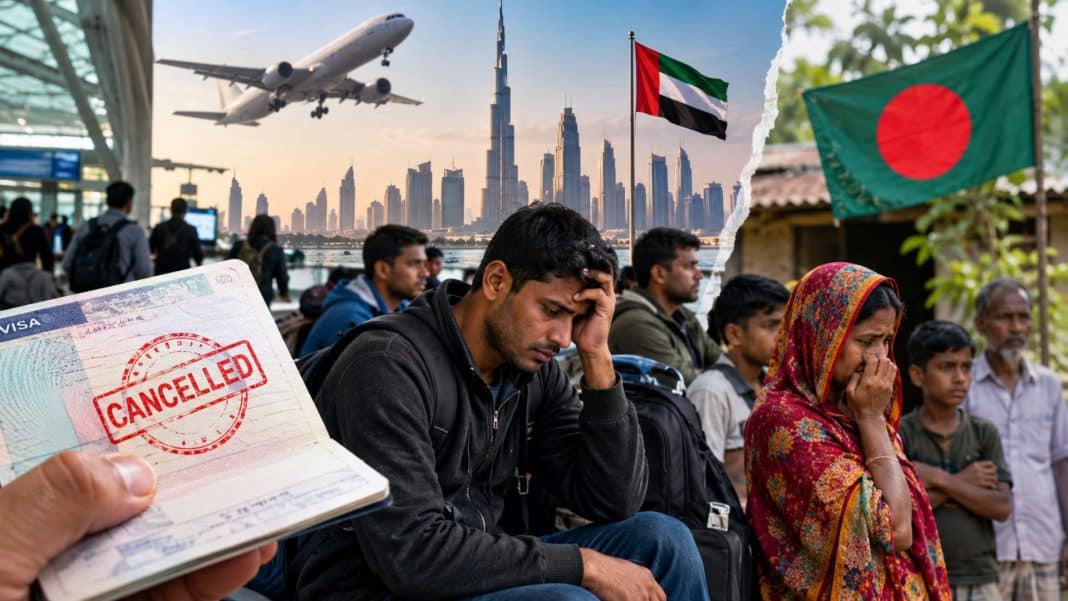

UAE VISA CANCELLATION CRISIS: A massive diplomatic and humanitarian crisis has erupted for thousands of expatriate workers as the United Arab Emirates (UAE) has abruptly cancelled the residence visas of more than 4,000 Bangladeshi nationals.
The decision has left a vast number of gainfully employed workers and business owners stranded in Bangladesh. Most of these individuals had simply traveled back home on short vacation breaks, only to discover through sudden automated emails and text messages that their entry back into the Gulf nation had been barred without any formal justification.
Sudden Blow to Thousands: Returnees Left High and Dry
UAE VISA CANCELLATION CRISIS: What began as routine annual leave for thousands of Bangladeshi expatriates has turned into an alarming nightmare. Official reports and ground estimates indicate that anywhere between 4,000 to nearly 4,800 Bangladeshi nationals have been affected by this sudden wave of visa cancellations.
The majority of those affected were informed between July and September through brief electronic notifications sent either directly to them or to their employer sponsors in the UAE. Because no clear explanations were provided alongside these cancellation notices, returnees have been left in a state of deep distress, unable to resume their jobs, run their registered businesses, or reunite with family members who remain in the UAE.
Decades of Service Wiped Out: Human Toll of the Cancellation Drive
UAE VISA CANCELLATION CRISIS: Among those caught in this bureaucratic web is Abul Kalam Azad, a veteran expatriate who lived and worked in the Gulf nation for 27 years.
Azad returned to Bangladesh on April 7 for a short visit. Three and a half months later, on July 24, he received an email stating that his UAE visa had been cancelled, giving no specific cause or recourse for appeal.
Similarly, another affected businessman revealed that he operates two functional businesses in Dubai and that his wife currently resides there. Despite having a completely clean record with no pending civil or criminal cases in the UAE, his visa was revoked while he was away on leave, forcing him to bounce between local government offices in Dhaka seeking a resolution.
High Stakes for Bangladesh: Remittances and Regional Ties
This wave of cancellations hits one of Bangladesh’s most vital economic arteries. Bangladesh first began sending migrant workers to the UAE back in 1976. Today, over 1.2 million Bangladeshis reside in the UAE, forming one of the largest expatriate communities in the country and serving as a massive driver of foreign remittance.
The unexpected exclusion of thousands of active workers threatens not only individual households but also broader local economic stability, as millions of dollars in monthly remittances hang in the balance.
Government Action and the 5-Point Demand List
On September 7, around 350 stranded workers gathered at the National Press Club in Dhaka to voice their grievances and demand swift state intervention. Bangladesh’s State Minister for Expatriates’ Welfare and Overseas Employment, Nurul Haq Nur, acknowledged that the government is fully aware of at least 4,000 such visa revocations.
While diplomatic channels between Dhaka and Abu Dhabi have been opened to review these individual cases, affected workers have issued a strict September 22 deadline for the government to deliver actionable results.
Key Demands Raised by Stranded Workers:
Diplomatic Reinstatement: Re-engage top UAE officials to secure immediate permission for affected workers and business owners to return to their jobs and enterprises.
Review Mechanism: Establish a formal diplomatic review process with the UAE to investigate individual visa revocations.
Monthly Financial Support: Provide a temporary monthly allowance of 15,000 to 20,000 Bangladeshi Taka (BDT) to support struggling families during the crisis.
Alternative Placement: Secure overseas employment opportunities in alternative destination countries for workers permanently barred from returning to the UAE.
Rehabilitation Plan: Draft a comprehensive government rehabilitation framework to support long-term economic recovery for affected citizens.
Potential Causes Behind the Sudden Crackdown
While the UAE government has not released an official statement explaining the mass cancellations, migration analysts and policy observers point to broader regional developments and heightened security protocols.
MS Shekil Chowdhury, Chairperson of the Centre for Non-Resident Bangladeshi, noted that ongoing geopolitical tensions across the Middle East have prompted UAE authorities to significantly intensify background vetting and surveillance of foreign nationals.
Under standard UAE immigration rules, residence permits are typically subject to cancellation if an individual remains outside the country for more than six consecutive months.
However, almost all affected Bangladeshis emphasize that their visas were revoked after just two to three months abroad, suggesting that routine duration limits were not the triggering factor. Analysts suggest that stricter document audits, employment verification checks, and enhanced scrutiny of social media activity may be driving the policy shift, though no single factor has been officially confirmed.
What Lies Ahead?
The ultimate fate of thousands of workers now hinges on diplomatic negotiations between Dhaka and Abu Dhabi. As the September 22 deadline approaches, stranded expatriates are waiting to see whether the UAE will clarify its position and reopen its doors, or if thousands of families will be forced to rebuild their livelihoods from scratch.
Also Read : BRICS Edge: India Set to Lead as 11-Nation Bloc Eyes Seamless Cross-Border Digital Services Market