


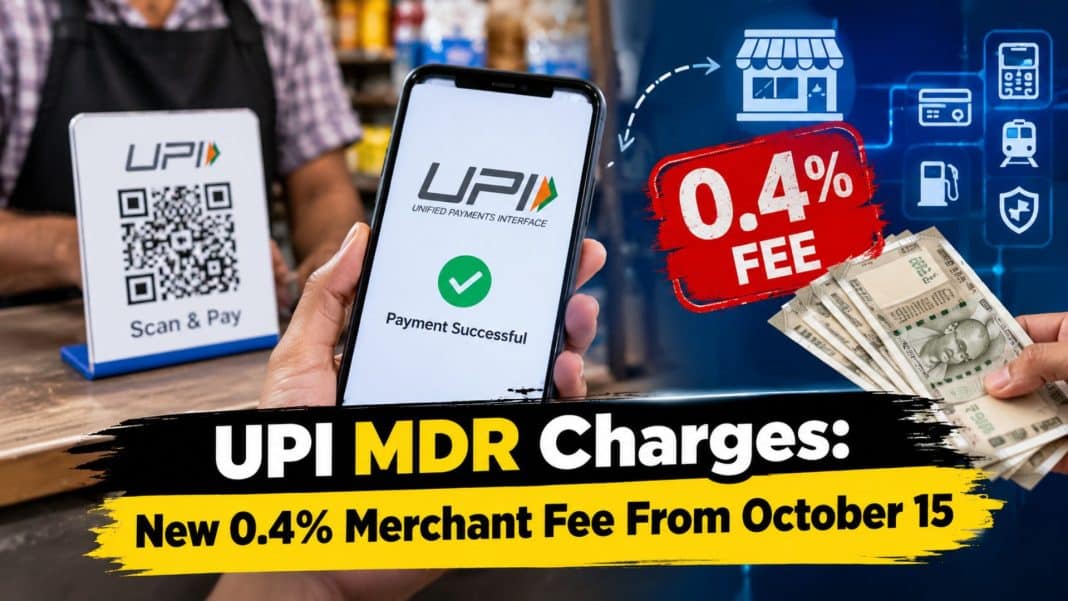

UPI MDR Charges Framework: The Ministry of Finance and the National Payments Corporation of India (NPCI) have introduced a revised Merchant Discount Rate (MDR) framework for digital transactions made through the Unified Payments Interface (UPI).
Effective October 15, 2026, transactions exceeding Rs 2,000 made to commercial sellers will attract a fractional charge of 0.4%.
However, central authorities have explicitly clarified that all peer-to-peer (P2P) transfers and everyday consumer transactions up to Rs 2,000 will remain completely free of cost.
According to media reports, the announcement aims to resolve months of speculation regarding the long-term financial sustainability of India’s digital payments infrastructure, while ensuring that small traders and individual citizens remain protected from additional costs.
Key Rules Of The New UPI MDR Framework
UPI MDR Charges Framework: The updated guidelines lay down specific operational tiers depending on the nature of the transaction, the total amount transferred, and the category of the merchant involved.
Consumer Payments Protected: Individual users transferring money to friends, family members, or personal accounts (P2P) will face zero charges, regardless of the transaction amount.
Low-Value Merchant Threshold: All Person-to-Merchant (P2M) payments equal to or under Rs 2,000 remain entirely exempt from the MDR framework.
Standard Merchant Charge: P2M payments crossing Rs 2,000 will incur a 0.4% MDR, subject to an upper cap of Rs 300 per single transaction.
Special Flat-Rate Categories: Specific high-frequency utility and public service categories will attract a flat Rs 5 charge for transactions exceeding Rs 2,000, rather than the percentage-based fee.
According to media reports, the special flat-rate fee of Rs 5 will apply exclusively to transactions made for Indian Railways, telecommunication services, insurance premium payments, and fuel purchases at petrol pumps.
Impact On Merchants Versus Everyday Consumers
UPI MDR Charges Framework: A central point of concern following the notification was whether shopkeepers would pass on the additional charge to consumers at retail checkout counters.
According to media reports, the Ministry of Finance has advised commercial banks and payment gateway aggregators to strictly monitor merchant compliance and ensure that sellers do not pass the MDR burden onto retail buyers.
For instance, if a consumer purchases goods worth Rs 2,500 at a retail store via UPI, the minimum applicable fee of 0.4% (amounting to Rs 10) must be absorbed by the merchant receiving the digital settlement, keeping the consumer’s out-of-pocket expense capped at Rs 2,500.
The NPCI assured that the revised structure shields approximately 95% of total UPI transaction volume in the country, as low-value transfers under Rs 2,000 constitute the vast majority of daily retail activity.
Why Was The Fee Structure Introduced?
UPI MDR Charges Framework: Since its zero-MDR mandate was introduced, payment aggregators, fintech startups, and partner banks have raised concerns regarding operational maintenance, server upgrades, and rising cybersecurity costs required to maintain high transaction success rates.
According to media reports, official representatives emphasized that the MDR collected under the new framework is neither a government tax nor a revenue stream for the central exchequer.
Instead, the collected funds will be distributed among payment ecosystem stakeholders including remitter banks, beneficiary banks, third-party app providers (TPAPs), and payment system providers (PSPs) to fund technical resiliency and fraud mitigation infrastructure.
Furthermore, the payment body announced that a dedicated fund will be set up to assist small merchants in Tier-3 towns and rural markets, accelerating the deployment of physical QR codes and digital acceptance terminals.
Comparative View Of Payment Gateway Charges
Even with the introduction of the 0.4% merchant fee on high-value transactions, UPI retains a distinct cost advantage over traditional digital settlement mechanisms operating in India.
Credit Cards: Standard commercial credit card MDR typically ranges between 1.5% and 2.5% per transaction.
Debit Cards: Core debit card merchant processing charges generally operate between 0.9% and 1.0% for high-value purchases.
Prepaid Wallets: Interoperable wallet charges often carry interchange fees hovering around 1.1%.
By keeping the baseline fee at 0.4% and capping maximum charges at Rs 300, regulatory authorities aim to strike a balance between maintaining high digital adoption rates among merchants and supporting the financial health of partner banking networks.