


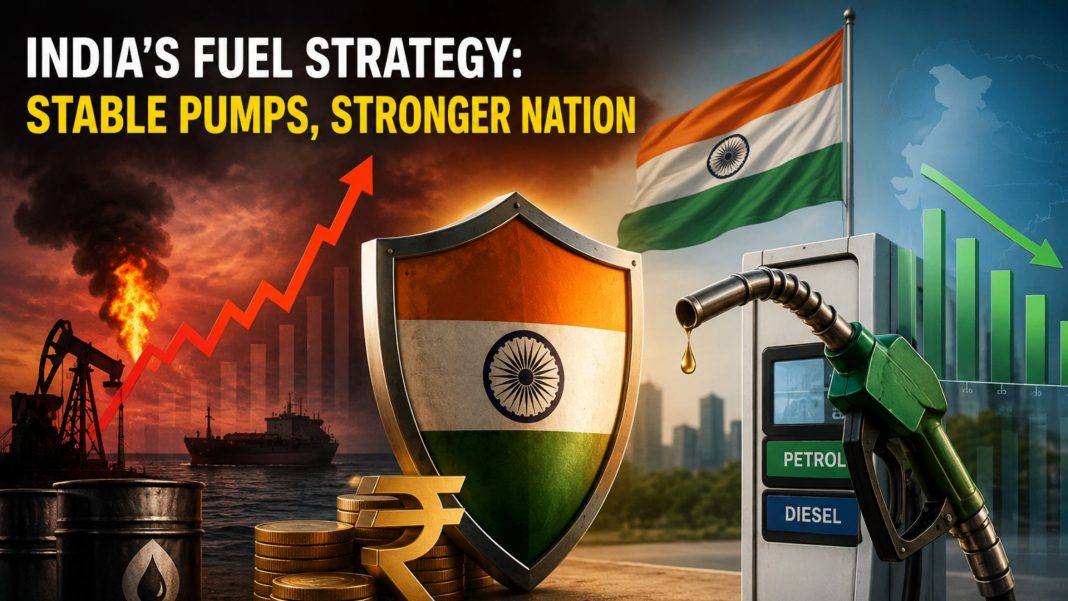

The Secret Math Behind Your Fuel Bill: The international crude oil market has been trapped in an aggressive cycle of volatility for the past four years.
Initiated by the outbreak of the Russia-Ukraine war in February 2022 and heavily intensified by the critical Strait of Hormuz crisis in 2026, global Brent crude prices have repeatedly breached the psychological barrier of $120 per barrel.
Yet, for nearly four years, the retail prices of petrol and diesel at domestic Indian fuel stations remained exceptionally insulated.
As global oil politics threaten fiscal deficits worldwide, an analysis of the Indian government’s financial math reveals a sophisticated strategy of tax manipulations, absorbed corporate losses, and strategic cushioning designed to protect consumers from international shocks.
Shielding Consumers: The Tax Cuts of March 2026
To understand how India kept domestic fuel prices stable while global headlines screamed of a transit crisis, one must look at the fiscal interventions executed by the central government.
The most aggressive move occurred on March 27, 2026, when New Delhi drastically slashed taxes to prevent retail prices from skyrocketing.
The government implemented a massive reduction of ₹10 per liter in the Special Additional Excise Duty (SAED) on petrol, while simultaneously reducing the central excise duty on diesel practically to zero.
This single defensive maneuver in March 2026 alone cost the central exchequer an astronomical ₹30,000 crore in lost revenue.
Furthermore, to keep household kitchens insulated from soaring natural gas rates, the government absorbed an additional fiscal burden of approximately ₹40,000 crore during 2024-25 to subsidize LPG consumers.
Shifting the Burden: Oil Marketing Companies Bear the Brunt
When international crude costs spike but retail prices are kept artificially stable, someone has to pay the difference. In India’s case, Public Sector Oil Marketing Companies (OMCs) such as Indian Oil, BPCL, and HPCL acted as the nation’s primary shock absorbers.
During the peak of the 2026 Strait of Hormuz crisis, the actual market-linked cost of fuel and its retail selling price drifted completely out of sync.
OMCs and the government quietly absorbed an indirect under-recovery margin of nearly ₹24 per liter on petrol and ₹30 per liter on diesel.
Data reveals that between 2021 and 2024, these state-run oil companies incurred massive collective structural damages of about ₹24,500 crore just to maintain price stability at local pumps.
However, this absolute freeze could not last forever. On May 15, 2026, after nearly four years of static pricing, the government allowed a retail price hike of ₹3 per liter.
This was followed by another upward revision of ₹0.91 per liter on May 19, marking a cumulative jump of roughly ₹4 per liter in a single week to relieve the immense financial pressure mounting on OMCs.
India vs. The World: A Comparative Look at Fuel Inflation
Despite the recent May 2026 price revisions, India’s domestic fuel price management stands out significantly when compared to global peers. While international energy supply chains choked under geopolitical pressures, India’s calibrated regulatory mechanism minimized localized inflation.
Between February and May 2026 the peak window of the maritime gridlocks countries like Myanmar, Malaysia, Pakistan, and even the United States witnessed retail fuel prices skyrocketing anywhere between 40% to 100%.
In stark contrast, the net increase in petrol and diesel rates across India was tightly restricted to a mere 4%.
The government defends this variance by drawing a clear policy distinction from past administrations.
Officials argue that instead of issuing controversial “Oil Bonds” that push the financial liability onto future generations (a policy criticized during pre-2014 fiscal reviews), the current strategy prioritizes real-time fiscal sacrifices through immediate tax rollbacks.
The Domestic Disparity: Why Fuel Rates Still Vary Across States
While the central government dictates the base excise architecture, the final price a consumer pays at the pump varies drastically from New Delhi to Mumbai or Chennai. This domestic disparity is rooted in state-level taxation.
Once the central government slashes or hikes its duties, individual state administrations levy their own Value Added Tax (VAT) and local cesses.
Because VAT is calculated either as a percentage of the base cost or as a fixed ad-valorem component determined by state cabinets, states with higher local tax mandates show noticeably higher retail fuel rates.
This decentralized tax framework explains why a single weekly hike of ₹4 per liter translates differently across state borders, remaining a continuous point of fiscal debate between federal and state authorities.
Also Read: Global Oil Lifeline at Stake: Xi Offers Trump Help on Strait of Hormuz Crisis as Iran Tightens Grip