


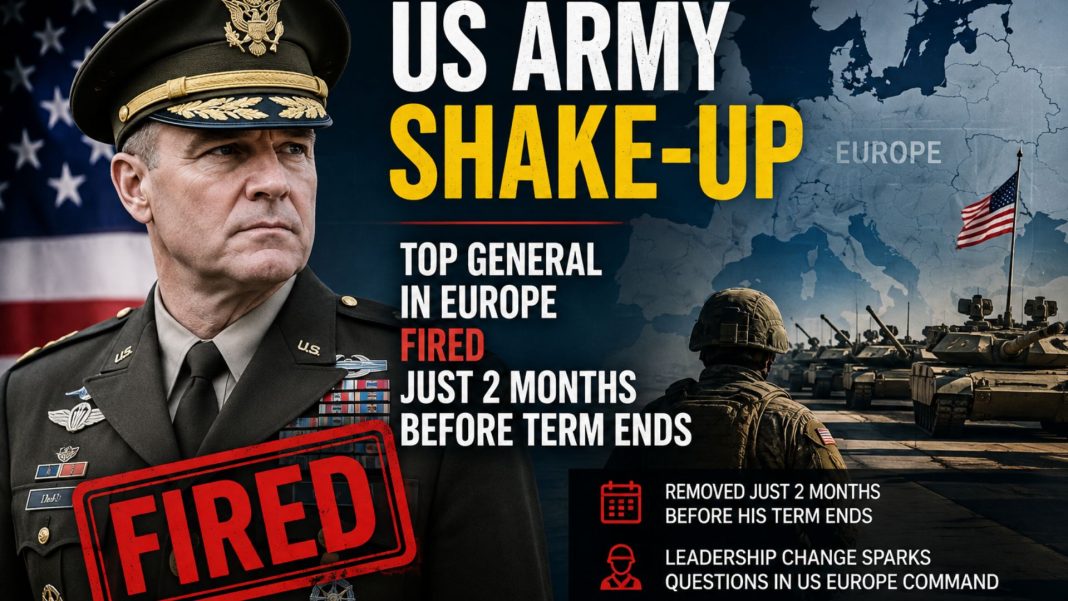

US Army Shake-Up: In a sudden move that has sent ripples through military circles, the U.S. Army has relieved Lt. Gen. Charles Costanza of his duties as the commanding general of the V Corps. What makes the decision particularly striking is the timing: Costanza was ousted just two months before his planned tenure was set to conclude.
The V Corps, headquartered at Fort Knox, Kentucky, with a prominent forward-deployed base at Camp Kościuszko in Poland, serves as the operational backbone for American ground forces across Europe.
The command plays a critical role in managing NATO’s eastern flank and coordinating allied military strategy in the region.
Confirming the development, an Army spokesperson stated that the matter has been officially forwarded to the “appropriate authority” in line with standard military regulations.
Non-Political Ouster Amid Broader Pentagon Leadership Purge
US Army Shake-Up: The timing of Costanza’s removal coincides with a turbulent phase at the Pentagon. Under Defense Secretary Pete Hegseth, more than two dozen high-ranking military leaders have been replaced, sidelined, or dismissed.
Previous high-profile departures include Army Chief of Staff Gen. Randy George and Gen. Chris Donahue, commander of U.S. Army Europe and Africa.
However, military officials clarified that Costanza’s firing was not part of Secretary Hegseth’s political restructuring or executive directives.
“This was driven by conduct that would result in the removal of a commander at any level,” revealed a source familiar with the internal decision.
Additionally, a former defense official indicated that personal conduct issues, specifically related to alcohol misuse, played a major role in the sudden administrative action.
Interim Command Structure: Who Takes the Reins?
US Army Shake-Up: To ensure operational continuity at the V Corps during a delicate security period in Europe, the military has put an interim leadership plan into effect:
Brigadier General John B. Mountford, previously serving as the V Corps Deputy Commanding General for Readiness, has stepped in as the acting commanding general.
Major General Thomas Felty, who was nominated for promotion to lieutenant general last month, is scheduled to formally assume full command of the unit in October.
Prior to leading the V Corps, Costanza, who holds a master’s degree in military studies from American Military University, served as deputy commanding general for U.S. Army Europe-Africa and commanded the 3rd Infantry Division at Fort Stewart.
Deployment Confusion and Strategic Uncertainty in Poland
Costanza’s sudden exit comes against a backdrop of shifting U.S. troop commitments in Eastern Europe.
| Timeline | Key Event / Announcement | Impact / Significance |
|---|---|---|
| May 2026 | Pentagon cancels the planned deployment of the 2nd Armored Brigade Combat Team, 1st Cavalry Division, from Fort Cavazos, Texas, to Poland. | Created immediate uncertainty over the promised U.S. heavy-armour support along NATO’s eastern flank. |
| Late May 2026 | U.S. President Donald Trump announces plans to send 5,000 U.S. troops to Poland. | Intended to reassure European allies and signal continued U.S. commitment to NATO’s eastern flank. |
| June 2026 | Polish Defence Minister Władysław Kosiniak-Kamysz says U.S. troop arrivals are expected within the “coming weeks.” | Suggested that Warsaw and Washington remained aligned on the expected deployment timeline. |
| Late July 2026 | Rep. Don Bacon (R-Neb.) reveals that no U.S. brigade had actually arrived in Poland. | Raised concerns over deployment delays, execution gaps and a lack of operational clarity. |
Speaking on the delays, Representative Don Bacon, a member of the House Armed Services Committee, voiced frustration over the lack of progress:
“They’re sitting. They’re waiting or something. I don’t know what they’re doing,” Bacon noted, pointing out the gap between policy announcements and physical force deployment.
With senior leadership changing hands and key force movements stalled, the U.S. Army’s European footprint faces a critical transitional period as regional security challenges persist.