


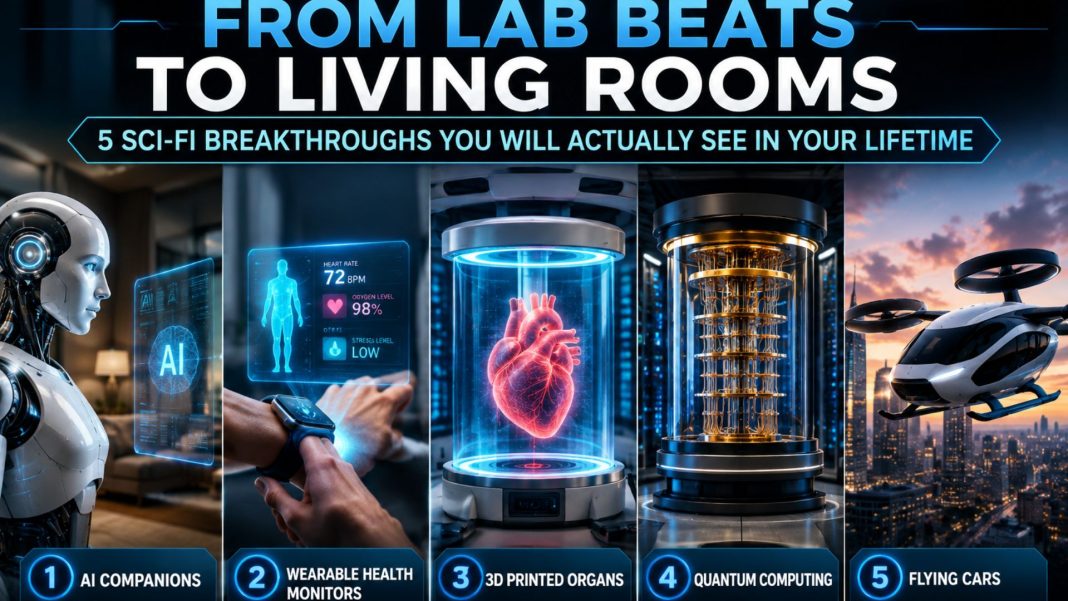

From Lab Beats to Living Rooms: Forget flying cars in distant centuries. The most radical technological shifts aren’t waiting for the next generation, they are unfolding inside research laboratories right now.
Ideas once restricted to paperback science fiction have moved past computer models and theory into successful human trials and working physical prototypes.
From neural bridges restoring mobility to net-positive laser fusion, the real challenge has shifted from “Is it possible?” to “How fast can we make it affordable?”
1.Reconnecting the Human Spine: Digital Bridges Overcoming Paralysis
From Lab Beats to Living Rooms: For decades, spinal cord injuries were viewed by medical science as permanent structural dead ends. When the neural connection between the brain and lower body breaks, signal transmission stops completely. Today, bioengineers are proving that while damaged biological tissue may not heal instantly, digital technology can bridge the gap.
In a landmark clinical trial, researchers successfully integrated a digital bridge, a pair of wireless implants linking the brain directly to the lower spinal cord. When a paralyzed patient simply thought about walking, the brain implant decoded those intentions and beamed instructions past the damaged nerve tissue directly to the spinal implant. The result was immediate: the patient was able to stand, walk naturally, and even navigate steep stairs.
Why this matters: Unlike rigid exoskeletons that force mechanical movement, brain-spine implants restore natural biological intent. As microchips become smaller and neural decoding algorithms improve, this technology will transition from experimental surgical trials into standard neuro-rehabilitation care worldwide.
2. Abundant Clean Power: Nuclear Fusion Moves Out of the Theoretical Realm
Clean, virtually unlimited power has long been the holy grail of global energy policy. Nuclear fusion, the same process that powers the sun, produces no long-lived radioactive waste and zero carbon emissions. For decades, the running joke was that “fusion is always 30 years away.” That narrative has officially changed.
Scientists at Lawrence Livermore National Laboratory achieved a historic milestone when their fusion experiment generated 8.6 megajoules of energy, more than four times the laser energy delivered to the target. Proving net energy gain repeatedly establishes that controlled fusion isn’t just theoretically sound; it is physically achievable.
FeatureFossil FuelsTraditional NuclearNuclear FusionFuel SourceFinite (Coal/Gas)UraniumAbundant (Isotopes from Water)EmissionsHigh CarbonZero CarbonZero CarbonWaste RiskAir Pollution / SmogLong-lived WasteShort-lived, Minimal RiskMeltdown RiskN/APossiblePhysically Impossible
The primary obstacle is no longer basic physics, but engineering scalability: building power plants capable of firing these laser reactions multiple times per second and transferring that continuous heat to the electrical grid safely and cheaply.
3.The New Lunar Economy: Building the Stepping Stones to Mars
From Lab Beats to Living Rooms: Humanity’s return to deep space looks completely different from the 1960s space race. NASA’s Artemis program, alongside global aerospace partners, isn’t planning a short visit to leave footprints. The target is a sustained, permanent human presence on the lunar surface.
Current missions are rigorously testing life-support hardware, autonomous surface rovers, and specialized radiation shielding designed to protect astronauts during prolonged stays. The Moon will serve as a living laboratory and refueling hub.
In-situ Resource Utilization: Extracting water ice from deep lunar craters to create oxygen and rocket fuel.
Low-Gravity Manufacturing: Testing specialized materials and pharmaceuticals that cannot be built under Earth’s gravity.
The Mars Gateway: Using the Moon’s low gravitational pull as a launching pad for crewed missions deeper into the solar system.
Within our lifetime, living and working off-planet will shift from astronaut expeditions to an active industrial sector.
4. Personalized Genomic Medicine: Custom Medical Treatments for All
Traditional medicine often operates on averages: a pill is designed because it works for most people in a clinical trial, even if it causes side effects or fails for others. Gene editing and mRNA platforms are dismantling this approach entirely.
Instead of treating symptoms after illness sets in, molecular diagnostics can now pinpoint an individual’s specific genetic vulnerabilities long before a disease manifests. Tools like CRISPR and targeted RNA therapies allow doctors to edit faulty genetic sequences directly, potentially curing rare inherited conditions, custom-tailoring cancer therapies, and turning chronic life-threatening diseases into manageable or extinct conditions.
As computational biology lowers sequencing costs, personal genetic health profiles will become standard medical records from birth.
5. Ambient Intelligence: AI Merging Quietly into Daily Physical Infrastructure
While artificial intelligence currently dominates screens and conversational interfaces, its ultimate destination is far less intrusive and much more functional. The next major phase is ambient intelligence, smart systems woven directly into physical environments like homes, transportation networks, and power grids.
Instead of typing prompts into an application, ambient systems anticipate practical physical needs:
Smart Traffic & Transit: Urban networks adjusting lights and public transit schedules in real-time to eliminate congestion entirely.
Predictive Diagnostics: Home sensors monitoring subtle changes in speech patterns or physical movement to catch early signs of illness or physical decline.
Automated Logistics: Micro-fulfillment centers delivering household necessities autonomously based on usage trends rather than manual shopping lists.
The Path Ahead: From Laboratory Breakthrough to Mass Adoption
Scientific breakthroughs are only the first half of the equation. History proves that turning a miraculous laboratory experiment into something every family can access requires overcoming major real-world hurdles:
Manufacturing at Scale: Transitioning from bespoke, million-dollar laboratory setups to standardized factory production lines.
Regulatory Approval: Ensuring rigorous, transparent safety protocols without stalling essential innovation.
Equitable Access: Preventing a technological divide where life-changing treatments or clean power are restricted to wealthy nations.
The foundation has already been laid. The science fiction of yesterday is officially the engineering project of today, and its arrival in our daily lives will happen far sooner than most expect.
Also Read : India’s New Address in Space: How ‘India’s Own Space Station’ Will Change the Nation’s Destiny!