


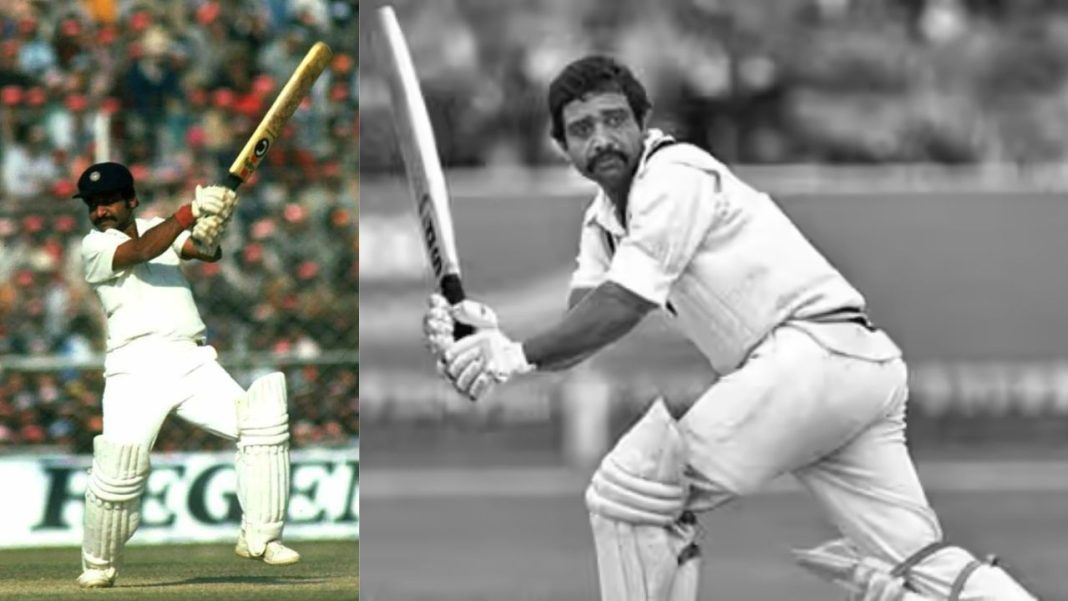

Gundappa Viswanath Biography: The Quiet Genius of Cricket’s Most Elegant Artistis rated as one of India’s finest batsmen throughout the 1970s.
Viswanath played Test cricket for India from 1969 to 1983, making 91 appearances and scoring more than 6,000 runs.
He is the only cricketer to score a double century on debut in a first-class match (against Andhra Pradesh in 1967) and a century on debut in a Test match.
Personal Overview
| Field | Details |
|---|---|
| Full Name | Gundappa Ranganath Viswanath |
| Date of Birth | 12 February 1949 |
| Birthplace | Bhadravathi, Mysore State, India |
| Age (2026) | 77 years |
| Height | 160 cm (5 ft 3 in) |
| Role | Right-handed Batter |
| Education | St. Joseph’s College |
| Estimated Net Worth | ₹8–40 crore |
| Teams | Karnataka cricket team, India national cricket team |
Early Life
Born on February 12, 1949, in Bhadravathi and raised in Bangalore, Gundappa Vishwanath grew up in a modest South Indian household where discipline and simplicity shaped his early years.
Cricket entered his life not through grand ambition, but as a natural passion nurtured in school grounds and local maidans.
From a young age, Vishwanath’s slight frame set him apart not as a disadvantage, but as a defining feature of his playing style.
Without the physical power of some of his contemporaries, he relied on timing, balance, and wristwork.
These traits would later become his signature, but they were forged during countless hours of practice on the dusty pitches of Bangalore.
His formal cricketing journey took shape at St. Joseph’s College, a cradle for several talented cricketers.
It was here that his natural flair began to attract attention. Coaches quickly noticed his ability to read the game early and place the ball with precision rather than force.
A key influence during his formative years was the legendary coach Keki Tarapore, who recognized Vishwanath’s potential and refined his technique.
Under Tarapore’s guidance, he focused on developing patience, footwork, and shot selection qualities that would define his batting at the highest level.
Vishwanath also honed his skills in domestic cricket, representing Karnataka cricket team.
Facing seasoned bowlers in the domestic circuit toughened his temperament and prepared him for international challenges.
His performances in the Ranji Trophy were instrumental in fast-tracking his rise.
These early years were not marked by flamboyance or instant fame, but by quiet persistence and a deep understanding of the game.
By the time he stepped onto the international stage, Vishwanath was already a craftsman his elegant style shaped by discipline, guidance, and an unwavering love for batting.
International Career
On his Test match debut, Viswanath scored a century against Australia at Kanpur in 1969 in a drawn match.
He also recorded a duck in the same game, one of only four batsmen to have done this in their first match.
Viswanath is the first and only player to score a double century on first-class debut as well as a century on Test debut.
His best performances tended to come on challenging pitches, and while some of his best innings did not result in centuries, they were still important to the team’s success.
Against Australia and the West Indies, both known for their strong pace attacks, he had a batting average of over 50.
He was at his peak in the mid-1970s.
Against the West Indies at Madras in 1974–75 he scored 97 not out out of a total of 190 against a bowling attack containing Andy Roberts.
Despite not being a century, it was regarded as one of the finest performances by an Indian and it led to an Indian victory.
The Wisden 100 ranked it the 38th best innings of all time, and the second best non-century.
He scored a match-winning century in the previous Test at Calcutta, but despite a 95 in the final Test at Bombay the series was lost 3–2.
In 1975–76, Viswanath again produced some strong performances against the West Indies, the most notable of which was his 112 at Port of Spain which helped India to reach the victory target of 403.
At the time, this was the highest successful run-chase in Test cricket.
In 1978–79 at Madras he again top scored with 124 out of a total of 255.
India went on to win the match which ultimately led to a 1–0 series victory in the 6-match series.
Although this West Indian side was considerably weaker than in previous series after many players opted to play in World Series Cricket instead.
Personal Life
In March 1978, Gundappa Viswanath married Kavita, the sister of teammate Sunil Gavaskar.They have a son named Daivik and live in Bengaluru.
Viswanath was awarded Col. C. K. Nayudu Lifetime Achievement Award in 2009 by BCCI which is one of the highest awards given in Indian cricket.
He also received the Padma Shri award by Government of India in 1971, and Arjuna award in the year 1977–78.
Fun and Interesting Facts
Vishwanath was dismissed for a duck in the first innings of his Test debut but bounced back with a stunning 137 in the second innings against Australia national cricket team. Talk about resilience.
His square cut shot was so precise and elegant that it became his trademark. Many consider it one of the finest in cricket history.
Despite his small build, he rarely relied on strength. His batting was all about timing and placement proof that technique can outshine brute force.
In a famous incident, Vishwanath once called back a batsman after an appeal was wrongly upheld an act of sportsmanship that earned widespread respect.
He captained India national cricket team in a few matches, though leadership was never his defining role.
He is related by marriage to another Indian cricket legend, Sunil Gavaskar his brother-in-law. Together, they were part of a golden era of Indian batting.
Vishwanath was known for playing his best innings when India was in trouble. He thrived under pressure and often rescued the team from difficult situations.
Even rival players admired his style and temperament. His graceful batting earned applause across countries, not just in India.
He was a consistent performer for Karnataka cricket team in the Ranji Trophy, helping establish the team as a powerhouse.
While his numbers are impressive, Vishwanath is remembered more for how he scored runs than how many a rare honor in modern sport.
Records
Vishwanath scored 6,080 runs in Test cricket, making him one of India’s leading batsmen of his era.
He maintained a strong Test average of over 41, remarkable for a middle-order batsman in challenging conditions of the 1970s–80s.
He scored 14 Test hundreds, many of them coming in difficult situations against top bowling attacks.
One of the few cricketers to score a century (137) in the second innings of his debut Test after a first-innings duck.
He was often among the top run-scorers for India national cricket team in major Test series during his career.
He represented India in 91 Test matches, a significant achievement during a time when fewer matches were played annually.
While not a numerical record, his square cut is widely regarded as one of the finest shots ever played in cricket history.
Written by Nishchay Malhotra
ALSO READ: PM Modi in Lok Sabha: Decoding Every Word of His Speech on the West Asia War