


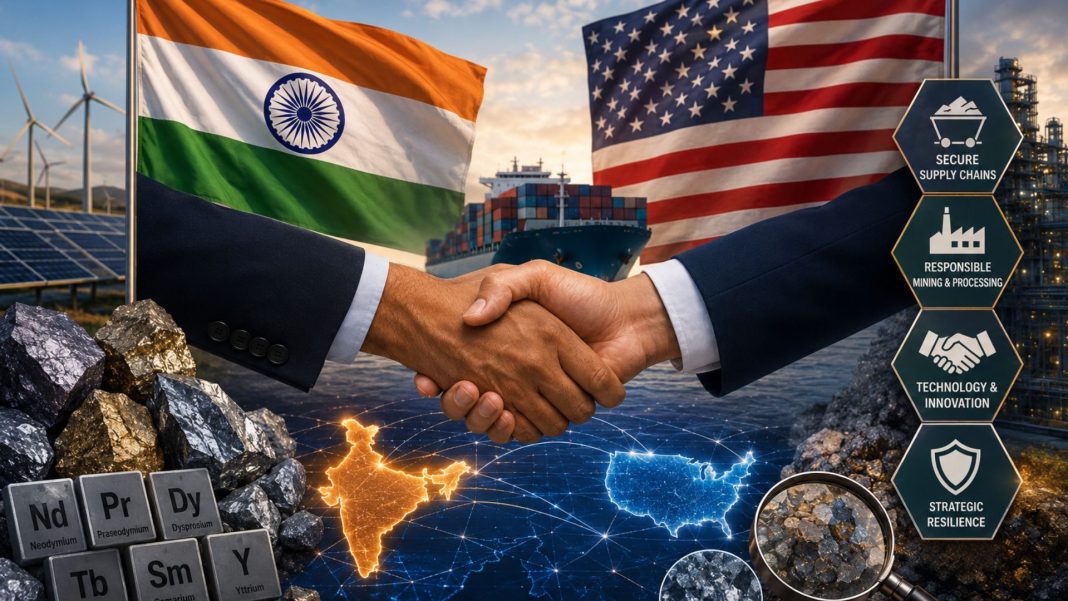

India-US Bilateral Agreement: In a major geopolitical shift, New Delhi and Washington sign a massive framework agreement to secure rare earth elements, as President Trump realizes America cannot fight Beijing’s trade war alone.
In a direct challenge to Beijing’s economic stranglehold, India and the United States have officially signed a landmark framework agreement to secure the supply of critical minerals and rare earth elements
The deal, finalized on Tuesday, focuses not just on sourcing these precious materials, but also on building the massive infrastructure required for processing them, a sector currently dominated almost entirely by China.
The signing took place during the high-profile Quad Ministerial Meeting, signaling a unified front by democratic powers to insulate global technology and defense supply chains from Chinese political leverage.
The Quad Alliance Steps Up: Two Back-to-Back Deals
India-US Bilateral Agreement: The diplomatic breakthrough unfolded in two major steps aimed at creating a watertight supply chain network:
The Bilateral Pact: Indian External Affairs Minister S. Jaishankar and US Secretary of State Marco Rubio first signed the bilateral framework agreement between India and the US.
The Quad Framework: Immediately following the bilateral pact, Jaishankar and Rubio joined Australian Foreign Minister Penny Wong and Japanese Foreign Minister Toshimitsu Motegi to sign the broader Quad Critical Minerals Framework.
According to officials, these two agreements are designed to complement each other. Speaking after the ceremony, US Secretary of State Marco Rubio highlighted that the deals would guide member nations to leverage economic policies and coordinate multi-billion-dollar investments in mining, processing, and recycling critical minerals.
Why Rare Earth Elements Matter: From Smartphones to Fighter Jets
India-US Bilateral Agreement: Rare earth elements and the advanced magnets made from them are the invisible backbone of the modern world. They are indispensable components in a vast array of technologies:
Everyday Electronics: Smartphones, refrigerators, electric vehicles (EVs), and laptops.
Military Hardware: Fighter jets, precision-guided missiles, night-vision goggles, and advanced radar systems.
Currently, China controls the lion’s share of both the mining and, more importantly, the highly toxic and complex processing of these minerals. This monopoly gives Beijing the power to cripple global tech and defense industries by simply cutting off exports.
The Trump Turnaround: Why the US Abandoned the “Lone Ranger” Approach
This development marks a fascinating shift in the foreign policy of US President Donald Trump during his second term. While Trump has frequently sidelined traditional allies and marginalized established groups like NATO and even the Quad in favor of unilateral “America First” policies, critical minerals have proven to be the exception.
“Analysts note that after Chinese Leader Xi Jinping decisively defeated Trump in a recent trade war by weaponizing China’s rare earth monopoly, the US President faced a harsh reality check. He realized that the US cannot secure its supply chains entirely on its own.”
To combat this vulnerability, Trump had already secured a rare earth agreement with Quad ally Australia, and is now aggressively expanding that partnership to India.
The Japan Model: A Decade Ahead of the Curve
As the US and India scramble to build infrastructure, fellow Quad member Japan stands out as a success story.
Japan is already largely independent of China’s rare earth dominance. A decade ago, when Beijing first attempted to use export controls as a political weapon against Tokyo, Japan responded by immediately investing heavily in overseas mining and independent processing infrastructure. This foresight insulated Japan from the recent trade war shocks that ultimately forced Trump to negotiate.
What This Means for India
For India, this agreement is a massive win. It positions New Delhi as a vital global hub for mineral processing and tech manufacturing, attracting heavy American and alliance investments. It also secures the raw materials India desperately needs for its own booming domestic electric vehicle and defense manufacturing sectors.
Moving Toward a New Economic Era
With the signing of the Quad Critical Minerals Framework, the blueprint for a China-free supply chain has been officially laid down. The focus now shifts from diplomatic paperwork to ground-level execution, as India, the US, Japan, and Australia begin the massive task of building an alternative industrial ecosystem to rival Beijing.