


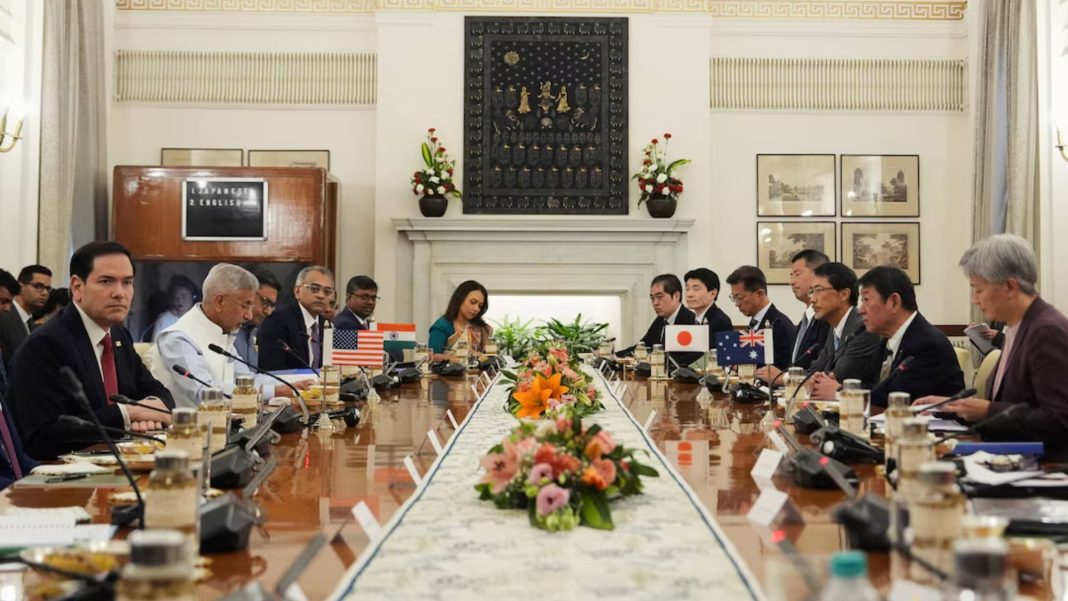

Quad Summit 2026: Facing down the Iran crisis, supply chain bottlenecks, and South China Sea militarization, the four-nation bloc launches a massive maritime surveillance network and seals key partnerships to secure the Indo-Pacific.
In a high-stakes response to fracturing global security, the Foreign Ministers of the Quadrilateral Security Dialogue (Quad) convened in New Delhi for their crucial 2026 summit. Hosted by Indian External Affairs Minister Dr. S. Jaishankar, the high-profile meeting brought together US Secretary of State Marco Rubio, Australian Foreign Minister Penny Wong, and Japanese Foreign Minister Toshimitsu Motegi.
Against the backdrop of a worsening geopolitical crisis in West Asia, the ongoing conflict in Ukraine, and mounting flashpoints in the Indo-Pacific, the leaders unveiled a series of sweeping maritime, technological, and economic initiatives. This pivotal meeting serves as the first interaction between the ministers in 2026, following two crucial rounds of discussions held in 2025.
Key Agenda Items: What the Quad Ministers Discussed
Quad Summit 2026: The New Delhi summit moved past mere diplomatic rhetoric to address urgent global vulnerabilities. The core discussions focused on the following 10 key areas:
- Defending the Strait of Hormuz and Resisting Illegal Shipping Tolls
The shadow of the conflict involving Iran and potential disruptions at the Strait of Hormuz dominated the geopolitical agenda. Quad ministers issued a fierce, coordinated warning against any attempts to choke global trade or monetize international waterways.
Rubio Blasts “Illegal” Threats: US Secretary of State Marco Rubio took a hard line on the Strait of Hormuz, declaring threats to shut down or impose arbitrary tolls on the vital passage as “unlawful, illegal, unsustainable, and unacceptable.” He insisted the strategic corridor must remain fully open and free.
Wong Warns of Regional Fallout: Australian Foreign Minister Penny Wong noted that any disruption by Iran at the Hormuz Strait would deal a devastating blow to energy security and cause immense economic stress across the Indo-Pacific.
(Safety of Commercial Shipping): In a powerful formal joint statement, the Quad explicitly condemned ongoing attacks on commercial shipping. The bloc vowed to resist any future measures inconsistent with the UN Convention on the Law of the Sea (UNCLOS), explicitly taking a stand against international tolling propositions.
- The US-India Critical Minerals Pact and High-Tech Supply Chains
Quad Summit 2026: With global manufacturing heavily reliant on centralized resources, the Quad made an aggressive push toward economic decoupling from single-source dependencies, prioritizing what Dr. Jaishankar called “economic resilience.”
A Strategic Milestone: A major highlight on the sidelines was the new Critical Minerals Agreement signed between India and the United States. Secretary Rubio hailed the pact as a tangible reflection of a deepening strategic alliance, noting both nations share a vital interest in securing long-term, reliable access to the minerals required for innovation-driven economies and green energy.
Dismantling Manufacturing Monopolies: Japanese Foreign Minister Toshimitsu Motegi strongly backed this agenda, marking critical minerals as a primary framework item necessary for high-tech industries like Electric Vehicles (EVs). Dr. Jaishankar urged the member states to tackle systemic vulnerabilities, noting that democracies must proactively resolve connectivity bottlenecks, the centralization of manufacturing, and resource manipulation.
- Launching the Indo-Pacific Surveillance Network and Fiji Port Project
To counter aggressive territorial maneuvers and the ongoing militarization of disputed areas in the South China Sea, the Quad turned words into structural defense initiatives.
Real-Time Intelligence Sharing: The bloc unveiled a groundbreaking Indo-Pacific Maritime Surveillance Initiative. This system fuses the tracking capabilities of India, the US, Japan, and Australia into a shared, real-time operational network to secure vital shipping lanes and monitor unlawful naval movements.
The Fiji Port Infrastructure Project: To support regional connectivity and shield small nations from economic coercion, the ministers announced a major joint port development project in Fiji. This gives developing island nations high-quality maritime alternatives to protect their own sovereign interests.
- Economic Resilience: Energy, Fertilizers, and Open Societies
Recognizing how global uncertainties hit the common citizen, Dr. Jaishankar highlighted that the ministerial talks specifically addressed the current availability of essential commodities like energy and fertilizers. The ministers emphasized that as open societies that foster innovation and creativity, building economic resilience is fundamental to shielding the Indo-Pacific region from external shocks.
- Zero Tolerance Against Terrorism
Injecting a strong national and regional security message into the joint dialogue, Dr. Jaishankar (reiterated) that democratic nations must maintain an absolute “zero tolerance policy against terrorism.” He emphasized that nations have an undeniable, fundamental right to defend themselves against unlawful aggression.
The Expert Perspective: Driven by Shared Concerns Over China
Strategic analysts view the timing of this meeting as highly symbolic. Dr. Sana Hashmi, a fellow at the Taiwan-Asia Exchange Foundation, observed that the Quad has steadily evolved into a highly aligned strategic platform driven by shared concerns over China’s maritime assertiveness in the Indo-Pacific.
Hashmi noted that coming shortly after the US President’s recent visit to China, the New Delhi summit signals that Indo-Pacific security remains the absolute apex priority for all four nations.
Interestingly, Hashmi pointed out certain internal dynamics within the bloc:
Desire for US Consistency: Quad members continue to look for a highly active and consistent US role, occasionally experiencing minor frustrations with American domestic fluctuations.
Strategic Alignment: Japan and Australia appear to align very closely with India’s specific tone and regional priorities.
The Verdict: Despite the slow implementation of past initiatives, the four nations have successfully maintained momentum and continuity. The consensus remains clear: The Quad is here to stay and will continue to grow into a formidable, strategically aligned group.
Delivering “Freedom of Choice”
Ultimately, the 2026 New Delhi summit successfully pushed back against critics who label the Quad a slow-moving talk shop. Australian Foreign Minister Penny Wong summarized the collective mission by thanking Dr. Jaishankar and praising India as a critical global power shaping the century.
Wong stated that the Quad’s core responsibility is to offer real, viable choices to Indo-Pacific nations, ensuring they can preserve their “freedom of choice” and maintain their sovereign interests even as regional strategic environments deteriorate.
Concluding the summit, Minister Motegi reinforced that the Quad stands as an essential framework, sending a “firm message” to the world that these four democracies remain fiercely committed to a free, open, and legally bound international order.
Also Read : Strait of Hormuz Tensions Rise Again: US Launches “Self-Defense” Strikes on Iran During Ceasefire Talks