

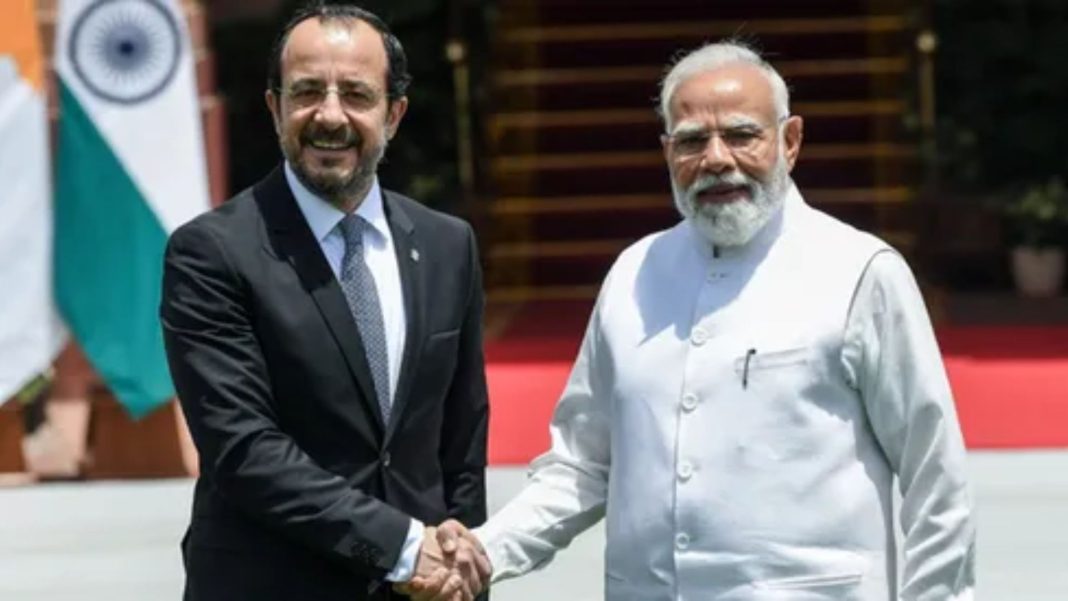

PM Modi-Christodoulides Meet: In a major geopolitical move, India and Cyprus have officially upgraded their bilateral relations to a “Strategic Partnership.” The landmark announcement was made by Prime Minister Narendra Modi during a joint press conference at Hyderabad House, following high-level delegation talks with visiting Cypriot President Nikos Christodoulides.
The four-day state visit by President Christodoulides marks his first official trip to India since taking office. Backed by a high-powered delegation, including Foreign Minister Constantinos Kombos and Transport Minister Alexis Vafeades, the visit has infused “new ambition and new momentum” into a relationship that is rapidly evolving from a traditional friendship into a robust economic and security alliance.
The Blueprint: Doubling Dollars and Connecting Hubs
PM Modi-Christodoulides Meet: A major centerpiece of the bilateral breakthrough is a bold economic blueprint. Pointing out that Cypriot investments into India have nearly doubled over the past decade, PM Modi linked this success to the shifting landscape of the India-European Union Free Trade Agreement (FTA).
“Our goal is to double this investment again over the next five years,” (PM Modi declared).
To turn this ambition into reality, the two countries announced the creation of a Joint Task Force aimed at boosting cooperation in critical sectors:
Infrastructure & Shipping: Capitalizing on Cyprus’s maritime strengths and India’s massive logistical expansion.
Financial Synergy: Connecting the financial and services hubs of both nations, with a specialized focus on positioning Gujarat’s GIFT City as a global financial nerve center.
Beyond Business: From Cyber Shields to Mobility Pacts
PM Modi-Christodoulides Meet: Recognizing Cyprus’s critical geographical position in the Eastern Mediterranean and its current Presidency of the Council of the European Union, defence ties received a major upgrade. The two democracies formally established a Joint Working Group on Counter-Terrorism to tackle radicalisation and cross-border threats. Furthermore, PM Modi announced targeted defence expansions focusing on cyber security, maritime domain awareness, and counter-terrorism operational networks.
Simultaneously, the leaders prioritized people-to-people ties by carving out agreements on:
Migration and Mobility: To streamline legal migration channels for students and professionals.
Social Security & Higher Education: Ensuring welfare protections for expats and establishing deeper academic and cultural exchanges.
The Geopolitical Chessboard: Signaling Ankara
While the public statements focused heavily on trade and security, diplomatic observers note that the growing proximity between New Delhi and Nicosia carries a sharp geopolitical message. The relationship is increasingly viewed through the lens of shifting global alignments, particularly involving Turkey and Pakistan.
Given Turkey’s consistent anti-India stance on the Kashmir issue and its ongoing military occupation of Northern Cyprus, India’s tightening embrace of Nicosia is being seen as a subtle but firm strategic signal to Ankara. These concerns were compounded during India’s recent Operation Sindoor, launched in response to the cross-border terror attack in Pahalgam, when reports surfaced that Pakistan deployed Turkish-supplied drones and utilized Turkish advisors to coordinate hostile maneuvers.
By upgrading ties with Cyprus, India is strengthening its foothold in the Mediterranean while aligning with a partner that firmly backs New Delhi on global platforms. In a reciprocal gesture of solidarity, President Christodoulides strongly reiterated Cyprus’s support for India’s permanent seat on a reformed UN Security Council and praised the India-Middle East-Europe Economic Corridor (IMEC) as a vital initiative for trusted global connectivity.
Grounded in Peace, Sealed with a Selfie
The talks also ventured into broader global instability, with both leaders exchanging views on the ongoing conflicts in Ukraine and West Asia. PM Modi reaffirmed India’s stance, noting that both nations remain fully aligned on the urgent need for a cessation of hostilities and a swift return to diplomacy.
Despite the heavy geopolitical undertones, the atmosphere at Hyderabad House remained warm and personal. In a moment capturing the genuine camaraderie between the two leaders, President Christodoulides paused to take a selfie with PM Modi, a casual moment that symbolized the deep mutual trust driving this new era of diplomacy.
As India and Cyprus prepare to celebrate 65 years of formal diplomatic relations next February, this visit firmly establishes a futuristic roadmap, transforming a Mediterranean island nation into one of India’s vital European anchors.
Also Read : The End of Pulwama Mastermind: From India’s Painful Wounds to the Death of Hamza Burhan