


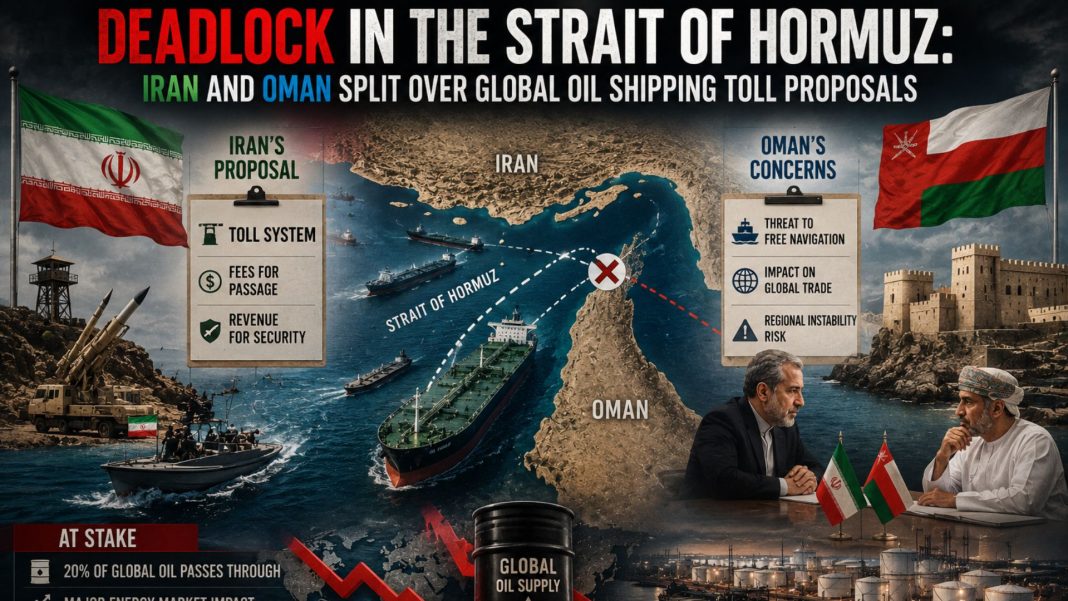

Deadlock in the Strait of Hormuz: The world’s most critical energy artery, the Strait of Hormuz, is facing a massive, unprecedented shift. Following a devastating war triggered in late February by US-Israeli airstrikes and subsequent Iranian retaliatory missile strikes, Tehran is now looking to turn its military presence into permanent control.
Reports confirm that Iran is actively negotiating with Oman to establish a permanent toll system (a transit fee) for commercial vessels passing through the narrow waterway. This news has sent shockwaves through global markets, causing energy prices to skyrocket and triggering a massive selloff of global government bonds as inflation fears grip the world.
“Pay Your Share”: Iran’s Justification for the Toll
Deadlock in the Strait of Hormuz: In an interview in Paris, the Iranian Ambassador to France, Mohammad Amin-Nejad, strongly defended the proposal. He explained that keeping the heavily disrupted waterway safe and managed requires massive resources, and the world needs to help pay for it.
“Iran and Oman must mobilize all their resources both to provide security services and to manage navigation in the most appropriate manner. This will entail costs, and it goes without saying that those who wish to benefit from this traffic must also pay their share.“
(Mohammad Amin-Nejad, Iranian Ambassador to France )
While Iran promises the system will be “transparent,” the situation on the water is pure chaos. Shipping lines report that they are being forced to deal with a new entity called the Persian Gulf Strait Authority. Even worse, some vessels are allegedly facing jaw-dropping safe-passage demands as high as $2 million.
“We Don’t Want Tolls” : Trump and Global Leaders Push Back
Deadlock in the Strait of Hormuz: The international response to Iran’s proposal has been swift and fierce. Speaking from the White House, US President Donald Trump completely rejected the idea of a toll booth at one of the world’s most vital maritime intersections.
“We want it open, we want it free, we don’t want tolls. They better not be thinking about it.”
(President Donald Trump)
The United Arab Emirates (UAE) has also raised severe alarms, warning that this sets a dangerous and illegal precedent for international maritime law. Sultan Al Jaber, head of the UAE’s main state oil company, warned of a catastrophic future for global trade:
“Once you accept that a single country can hold the world’s most important waterway hostage, freedom of navigation as we know it is finished.”
Ghost Town at Sea: Shipping Paralyzed Despite a Fragile Ceasefire
Though a fragile, Pakistan-mediated ceasefire between the US and Iran took effect on April 8, the Strait of Hormuz remains a highly volatile danger zone.
The Traffic Collapse: Before the war, the strait handled a bustling 135 ships a day. Today, traffic has slowed to a crawl. While Iran claims its Islamic Revolutionary Guard Corps (IRGC) recently helped 26 tankers transit safely, independent shipping companies remain too terrified to enter.
The Threat Matrix: Iran blames the drop in shipping on skyrocketing insurance premiums. However, maritime companies tell a different story, they are avoiding the route entirely due to the active risk of drones, missile strikes, and sea mines.
A Strategic Stranglehold
With the US Navy maintaining a strict blockade on Iranian ports since April 13, Tehran looks at the 24-mile-wide chokepoint as its ultimate leverage. Iran has signaled that it plans to keep permanent control over the strait even after the war ends, viewing it as a revenue stream for its shattered economy and a shield against future Western aggression.
The New Era of Global Trade: A Permanent Shift in World Power
This is no longer just a temporary wartime disruption; it is a fundamental rewriting of the rules of global commerce. The Strait of Hormuz handles 20% (one-fifth) of the world’s petroleum and liquefied natural gas (LNG), making it the primary artery for global energy.
If Iran succeeds in formalizing this toll system, it will alter the geopolitical landscape permanently:
The End of Free Oceans: For decades, international trade has relied on the absolute law of free navigation. Allowing a single nation to commercialize a global chokepoint could trigger a dangerous chain reaction, prompting other nations to demand tolls on vital waterways like the Malacca Strait or the English Channel.
A New Economic Cold War: With the US Navy maintaining its strict blockade since April 13 and Iran refusing to yield control of the 24-mile-wide passage, the world economy faces a prolonged stalemate. This high-stakes standoff will force global superpowers to permanently reroute supply lines, accelerating a split into rival economic blocs.
Also Read : The End of Pulwama Mastermind: From India’s Painful Wounds to the Death of Hamza Burhan