


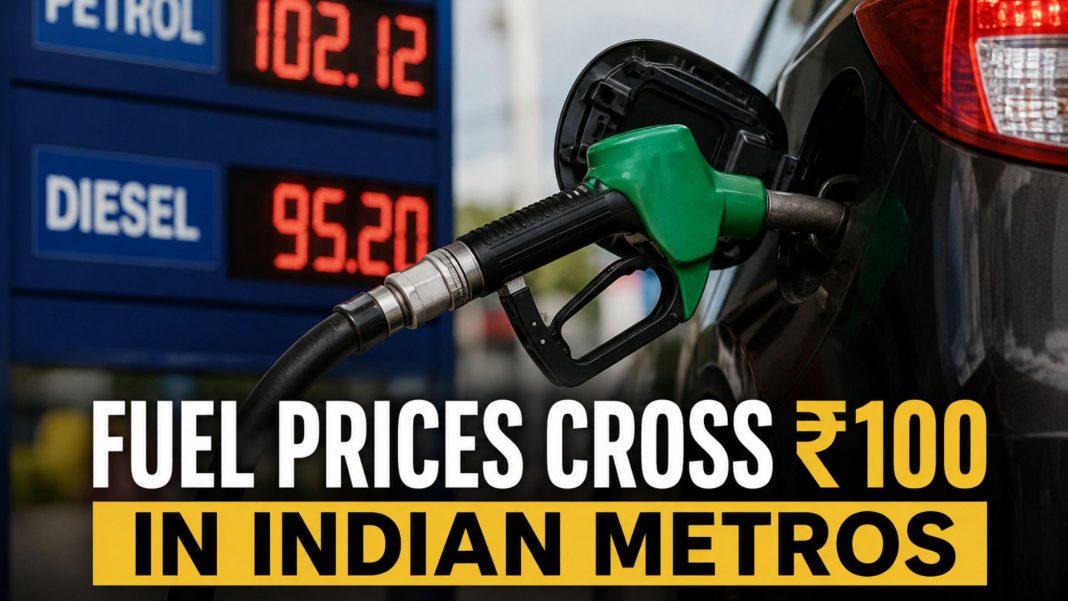

Fuel Prices Cross ₹100: Indian consumers are facing a tough economic challenge as retail fuel prices in Indian metros have broken through historical barriers.
On Monday, state-run Oil Marketing Companies (OMCs) announced a major hike, raising petrol prices by ₹2.61 per litre and diesel by ₹2.71 per litre.
This marks the fourth consecutive fuel price hike in less than two weeks, pushing petrol past the dreaded ₹100 mark in the national capital of Delhi for the first time in four years.
Metro-Wise Retail Fuel Rates Today
Fuel Prices Cross ₹100:The impact of the latest price revision is highly visible across all major metropolitan cities, with fuel prices in Indian metros showing significant variation due to local state-level taxes.
In the national capital of Delhi, petrol is now retailing at ₹102.12 per litre while diesel stands at ₹95.20 per litre. Financial hub Mumbai has seen some of the highest spikes, pushing its petrol price up to ₹111.21 per litre and diesel to ₹97.83 per litre.
Moving to eastern India, consumers in Kolkata are paying ₹113.51 per litre for petrol and ₹99.82 per litre for diesel. In the southern metros, Bengaluru recorded a retail price of ₹110.93 per litre for petrol and ₹98.80 per litre for diesel, while Chennai is retailing petrol at ₹107.77 per litre and diesel at ₹99.55 per litre.
The Catalyst: How the US-Iran War Strained India’s Fuel Market
Fuel Prices Cross ₹100: The ongoing price surge is rooted in geopolitical tensions in West Asia. Following the eruption of the US-Iran conflict, global crude oil supply chains have experienced unprecedented volatility.
The primary chokepoint affecting fuel prices in Indian metros is the Strait of Hormuz, a narrow shipping channel located between Oman and Iran. This strategic waterway handles nearly one-fifth of the world’s total crude oil and liquefied natural gas (LNG) traffic.
Because India imports more than 85% of its total crude oil requirements, any supply blockade or security threat in the Strait of Hormuz directly exposes domestic fuel prices to international pricing pressures.
When Brent crude soared past $110 per barrel during the peak phase of the conflict, India’s import costs mounted instantly.
The Financial Strain on State-Run Oil Marketing Companies
While citizens are feeling the immediate pinch at the pump, state-run energy companies (IOCL, BPCL, and HPCL) have been absorbing heavy financial losses for months.
Prior to May 15, fuel prices in India remained completely frozen for over 74 days, coinciding with regional assembly elections and the early weeks of the geopolitical crisis.
During this freeze, OMCs were purchasing expensive international oil but selling it domestically at older, lower rates. Industry estimates reveal that OMCs collectively suffered revenue losses of nearly ₹1,000 crore every single day during the height of the crude oil rally.
Though the recent sequence of four hikes has raised petrol and diesel prices by over ₹7.30 per litre, analysts warn that the underlying mathematical deficit has not been erased.
According to financial market data, OMCs would theoretically need an additional price hike of ₹20 to ₹33 per litre to fully recover past losses and offset historical under-recoveries.
Rising Inflation Worries Creep into Indian Households
The ongoing upward trajectory of fuel prices in Indian metros is triggering wider inflation anxieties across the nation. Diesel is the primary fuel powering India’s vast commercial freight and logistics networks.
A steady rise in diesel rates inflates the cost of transporting consumer goods, which rapidly leaks into household budgets. Daily kitchen essentials like milk, fresh vegetables, bread, and cooking oils are already witnessing upward price pressure due to rising freight charges.
Will There Be a Fifth Price Hike?
While diplomatic backchannel peace talks between Washington and Tehran have recently offered minor relief causing Brent crude to temporarily cool down under the $100 per barrel mark market specialists remain deeply cautious.
Even if a stable geopolitical agreement reopens the Strait of Hormuz, structural factors like elevated maritime insurance premiums and higher freight rates will take months to normalize.
Energy analysts indicate that unless international crude prices display sustained stability well below $100 per barrel, Indian policymakers and OMCs may have no option but to roll out more calibrated retail price corrections in the coming weeks.
Also Read: The Secret Math Behind Your Fuel Bill: How India Fights Global Oil Crises to Keep Local Pumps Stable