


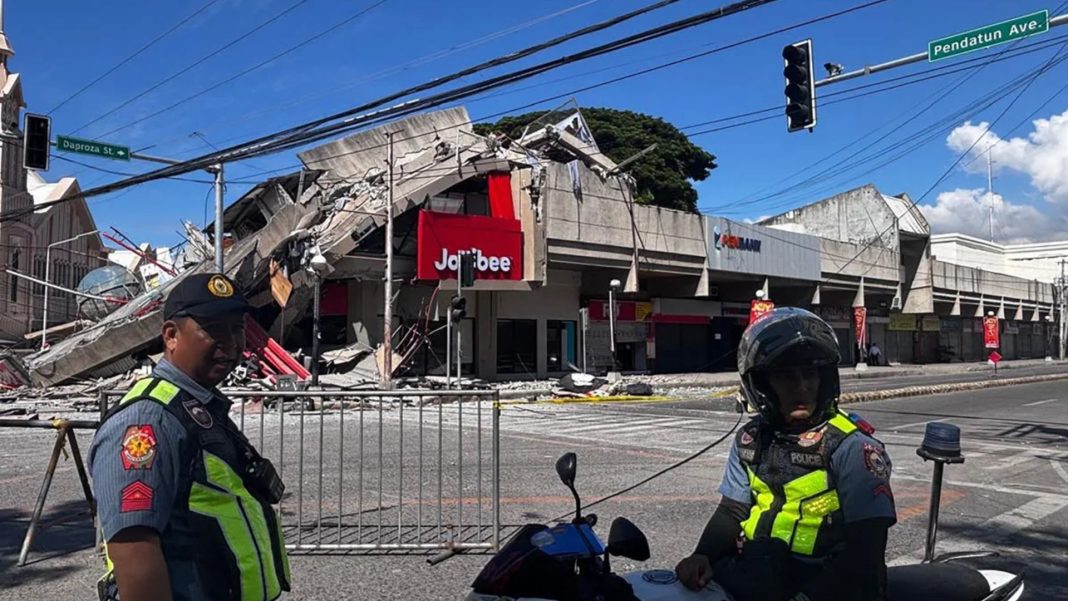

Earthquake in Philippines: A powerful offshore magnitude 7.8 earthquake rocked the southern Philippines early Monday morning, June 8, 2026, leaving a trail of collapsed buildings, severed infrastructure, and a 1-meter (3-foot) tsunami that washed ashore on nearby coastlines.
The violent tremor, the strongest to strike the country this year, hit just as millions of students nationwide were returning to classrooms for the first day of the new school year.
At least 15 deaths have been officially confirmed, with the toll expected to rise as search and rescue teams dig through rubble. More than 100 people have been reported injured, and at least 12 individuals remain missing.
Dawn Terror on the Back-to-School Rush
Earthquake in Philippines: The earthquake struck at 7:37 AM local time, centered at sea off Mindanao, the second most populous island in the Philippines.
According to the Philippine Institute of Volcanology and Seismology (PHIVOLCS), the quake occurred at a depth of 33 kilometers (20 miles), roughly 32 kilometers southwest of Maasim town in Sarangani province.
The U.S. Geological Survey (USGS) measured the depth at 55 kilometers (34 miles), a common variance in early data modeling.
The timing magnified the panic. Public schools had just reopened across the nation on Monday following the April–May summer vacation. In the Soccksargen region of Mindanao, morning flag-raising ceremonies turned into scenes of chaos.
Regional disaster-response official Ednar Dayanghirang reported that more than 100 students sustained bruises and several fainted as panic swept through school grounds during the shaking.
Casualties Rise Amid Structural Collapses
Earthquake in Philippines: The Soccksargen region bore the brunt of the tragedy, accounting for 12 of the confirmed fatalities and 129 injuries.
In General Santos City, a major commercial hub, the devastation was highly visible. A popular multi-story fast-food restaurant and a small commercial office building partially collapsed.
“Authorities are currently checking urgent reports of students trapped inside a two-story school building that crumpled in General Santos,” said Rodrigo Sosmeña, regional civil defense director.
The national police confirmed that at least 12 people are missing in the city. The Bureau of Fire and Protection has deployed specialized search and rescue teams to a heavily damaged warehouse and office spaces in the downtown area.
Outside of the city centers, the devastation took different forms:
Landslides and Debris: Fatalities were reported across Sarangani, South Cotabato, and Davao Occidental due to falling concrete and triggered landslides.
Religious Sites: A local mosque sustained severe structural failure, resulting in casualties.
Remote Islands: Deaths were reported as far as Balut Island, a remote southern outpost.
Tsunami Waves Hit Regional Coasts
Immediately following the main shock, which triggered powerful aftershocks reaching up to magnitude 6.5, the Pacific Tsunami Warning Center (PTWC) and local authorities issued emergency coastal evacuation alerts.
Waves averaging 1 meter (3 feet) were monitored across the coastlines of Sultan Kudarat and Sarangani provinces. The highest localized surge was recorded in Kiamba town, Sarangani, where a 1.4-meter (4.6-foot) wave pushed inland. In Zamboanga del Sur, a coastal village reported that six stilt houses were wrecked by the sudden surge of water.
The tsunami energy rippled across international borders:
Indonesia: An 83-centimeter wave triggered tide gauges on Sulawesi island.
Palau: Coastal sensors picked up 30-centimeter waves.
Japan: Minor waves up to 20 centimeters reached the remote island of Chichijima and Kushimoto town.
By mid-afternoon, five hours after the initial shock, Philippine seismologists and the PTWC officially lifted all tsunami warnings, confirming the immediate ocean threat had passed.
“We Will Not Leave Mindanao Behind”
Philippine President Ferdinand Marcos Jr. immediately ordered the indefinite cancellation of classes across affected provinces and mobilized the country’s full disaster-response apparatus.
“The national government is moving, and we will not leave Mindanao behind,” President Marcos Jr. said in a national statement, directing emergency teams to prioritize clearing blocked roads and providing medical aid to overwhelmed provincial hospitals.
The disaster has severely crippled regional transport. The civil aviation authority temporarily shut down General Santos International Airport, forcing the cancellation of 17 domestic flights. Ground travel was also disrupted after a vital access bridge in a major southern city suffered severe structural damage.
Living on the Fault Line
The Philippines is historically prone to volatile seismic events. Straddling the Pacific “Ring of Fire”, an intense loop of underwater fault lines and active volcanoes, the archipelago frequently experiences earthquakes.
Coupled with an average of 20 typhoons per year, it remains one of the world’s most vulnerable disaster zones.
As night falls on Mindanao, emergency workers are racing against time, using heavy equipment and canine units to search the rubble for survivors. Authorities have strongly warned displaced villagers to remain in open-air evacuation zones and avoid re-entering cracked or compromised buildings due to the continuous threat of strong aftershocks.
Also Read : Oman Ship Attack: 24 Indian Sailors Stranded in Distress, Indian Embassy Springs into Action