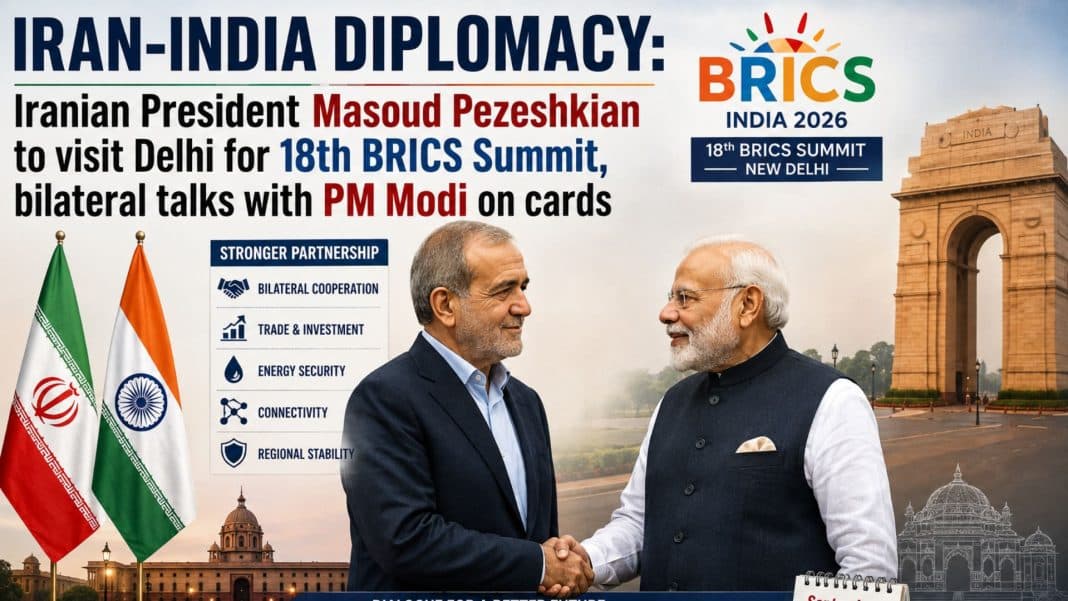

IRAN-INDIA DIPLOMACY: In a major diplomatic development, Iranian President Masoud Pezeshkian is expected to visit India on September 12–13 to attend the 18th BRICS Summit, according to sources.
The visit is set to provide a strong platform for bilateral talks between President Pezeshkian and Indian Prime Minister Narendra Modi, offering both nations an opportunity to review their strategic ties and navigate pressing global challenges.
High-Stakes Modi-Pezeshkian Bilateral Talks on the Cards
IRAN-INDIA DIPLOMACY: The impending summit setting offers a natural backdrop for a one-on-one meeting between the two leaders. Central to their agenda will be:
Strengthening Bilateral Ties: Enhancing economic cooperation, energy partnership, and connectivity initiatives such as the Chabahar Port.
Regional & Global Security: Addressing joint concerns regarding trade security and global instability.
West Asia Crisis: Brainstorming constructive pathways toward de-escalation in the Middle East.
This interaction comes on the heels of their previous meeting in Kazan, Russia, during the BRICS Summit in October 2024, where both leaders discussed key bilateral and regional developments.
Expanding Horizons: BRICS Welcomes New Members
IRAN-INDIA DIPLOMACY: The summit highlights the rapid evolution of the BRICS grouping as a significant geopolitical counterweight.
2024 Expansion: Iran formally became a full member of BRICS alongside Egypt, Ethiopia, and the United Arab Emirates (UAE).
2025 Addition: Indonesia joined the bloc, taking the total tally of full members to 11.
With these expansions, the grouping has steadily broadened its Global South footprint, fostering deeper economic and political collaboration among non-Western economies.
Tehran Eyes a Bigger Role for India in West Asian Peace
Pezeshkian’s upcoming visit follows closely after Iranian Foreign Minister Abbas Araghchi’s trip to India in June for the BRICS Foreign Ministers’ Meeting.
During his New Delhi visit, Araghchi emphasized India’s growing stature as a global peacemaker. Speaking to reporters, the Iranian Foreign Minister noted that New Delhi could play a “major role” in cooling down mounting tensions across West Asia.
Highlighting Tehran’s stance, Araghchi reiterated that Iran sees no military solution to the current regional hostilities, maintaining that a negotiated, dialogue-driven settlement remains the only realistic way forward.
“We would welcome any constructive role played by India,” Araghchi stated, signaling Iran’s readiness to cooperate with New Delhi on de-escalation efforts.
Focus on Maritime Security and Free Trade Routes
During his June visit, Foreign Minister Araghchi also held comprehensive bilateral discussions with India’s External Affairs Minister, S. Jaishankar. The discussions focused on shared security concerns, maritime safety, and regional stability.
Key outcomes and statements from those talks included:
Strait of Hormuz Security: Araghchi reaffirmed Iran’s commitment to maintaining security in the strategic Strait of Hormuz.
Reliable Partnership: Tehran framed itself as a dependable partner for friendly nations seeking safe, uninterrupted commercial shipping routes.
Resistance to Political Manipulation: Official statements from the Iranian government noted that Araghchi’s address at the BRICS meeting underscored the need to counter Western hegemony and safeguard international institutions from political bias.
Taking to social media platform X, Araghchi affirmed that Iran would continue fulfilling its “historical duty” as a guardian of maritime security in the Strait of Hormuz, assuring friendly countries that their trade interests remain safe.
Geopolitical Friction: The Context of Pezeshkian’s Visit
The timing of President Pezeshkian’s expected arrival in New Delhi carries immense geopolitical weight. West Asia remains caught in a volatile, fragile standoff following military escalations that began on February 28, involving military actions by the United States and Israel targeting Iranian interests.
Against this backdrop of heightened hostility, India’s balanced diplomatic stance and strong ties with both Iran and Western nations position it as a uniquely placed mediator capable of facilitating constructive dialogue.
Also Read : Raging Storms in Japan: Chiba Devastated by Record Rain, 4 Dead as Level-5 Alert Issued