


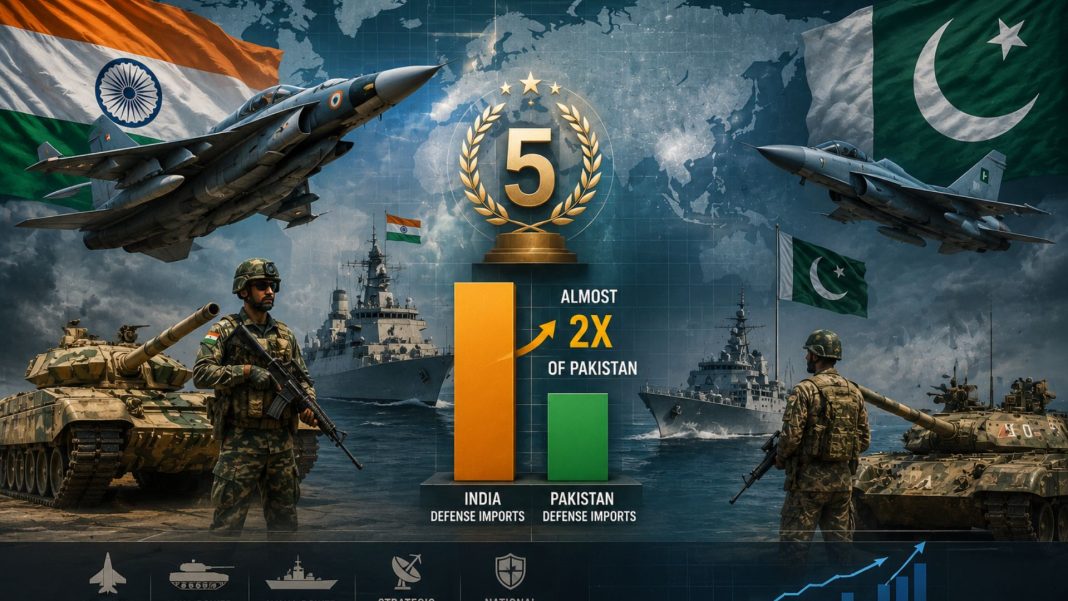

GLOBAL ARMS RACE: Despite New Delhi’s aggressive push for Atmanirbharta (self-reliance) in defense, India remains firmly anchored as a dominant player in the global arms market.
According to the latest findings released by the Stockholm International Peace Research Institute (SIPRI) in its Yearbook 2026, India has retained its position as the world’s fifth-largest military spender and the second-largest importer of major arms in 2025.
The report highlights a complex dual-strategy: India is rapidly pumping billions into its military modernization to counter regional threats, while simultaneously navigating a steep uphill climb toward absolute defense independence.
The $92 Billion Defense Shield
Massive 8.9% Hike Drives India’s Military Modernization
GLOBAL ARMS RACE: SIPRI’s latest data reveals that India’s military expenditure skyrocketed to a staggering $92.1 billion in 2025, marking a sharp 8.9% increase from the previous year. This massive surge places India just behind the world’s leading military powers: the United States, China, Russia, and Germany.
This assessment follows the Indian government’s record-breaking defense allocation of approximately $85 billion in the Union Budget. Defense Minister Rajnath Singh previously termed this budget hike as “unprecedented,” emphasizing that the additional funds are critical for upgrading the tri-services. The capital is being actively deployed to acquire advanced fighter jets, drones, submarines, warships, and other high-tech surveillance platforms.
The Import Paradox
High Spending vs. The Self-Reliance Goal
GLOBAL ARMS RACE: While domestic manufacturing is scaling up, India still relies heavily on foreign original equipment manufacturers (OEMs) to maintain operational readiness. During the 2021–25 period, India accounted for a significant 8.2% of total global arms imports, securing its spot as the world’s second-largest buyer of foreign weaponry.
In stark contrast, neighboring Pakistan accounted for 4.2% of global imports. These statistics indicate that India’s appetite for foreign military hardware remains nearly double that of its neighbor, driven by the strategic need to secure a volatile two-front border with both Pakistan and China.
Cyber Warfare & AI: The Changing Face of South Asian Conflict
Lessons from ‘Operation Sindoor’
SIPRI warns that the strategic landscape of South Asia is undergoing a radical shift. The traditional reliance on conventional infantry and armor is rapidly giving way to emerging technologies. The region is now heavily driven by:
Long-range precision missiles
Armed drone swarms
Artificial Intelligence (AI)-enabled military systems
Sophisticated cyber warfare tools
The report specifically analyzed the May 2025 military standoff between India and Pakistan, dubbed ‘Operation Sindoor’. SIPRI classified this event as an “exceptionally serious military crisis.” Crucially, it marked the first documented instance where both nuclear-armed nations integrated active cyber operations into a live military conflict, signaling a dangerous new frontier in regional warfare.
The Silver Lining: A Record $4 Billion Export Surge
India as an Emerging Global Defense Hub
“India is moving fast towards becoming a global defense manufacturing hub.”
Rajnath Singh, Defense Minister
Despite high import figures, New Delhi is successfully executing a pivot toward becoming an exporter. The government recently announced that India’s defense exports crossed a historic $4 billion milestone in the fiscal year 2025-26, registering a massive 60% growth over the previous year.
Indian-made defense equipment, ranging from advanced missile systems, artillery guns, and rocket launchers to patrol vessels and complex electronic components, is now being shipped to over 100 countries, including technologically advanced nations like the United States and France, alongside strategic partners like Armenia
.
The Global Outlook: A World in Deep Confrontation
SIPRI’s broader global assessment paints a grim picture of international security, warning of an era of intense militarization.
SIPRI Director Karim Haggag noted that rising geopolitical rivalries and rapid technological breakthroughs are destabilizing international orders. Haggag pointed to two defining disruptions:
The return of active warfare between technologically advanced states.
The visible weakening of traditional US-led alliance frameworks.
Also Read : Big Blow to Iran: Israel Destroys Iran’s Air Defense System in Aerial Strike