


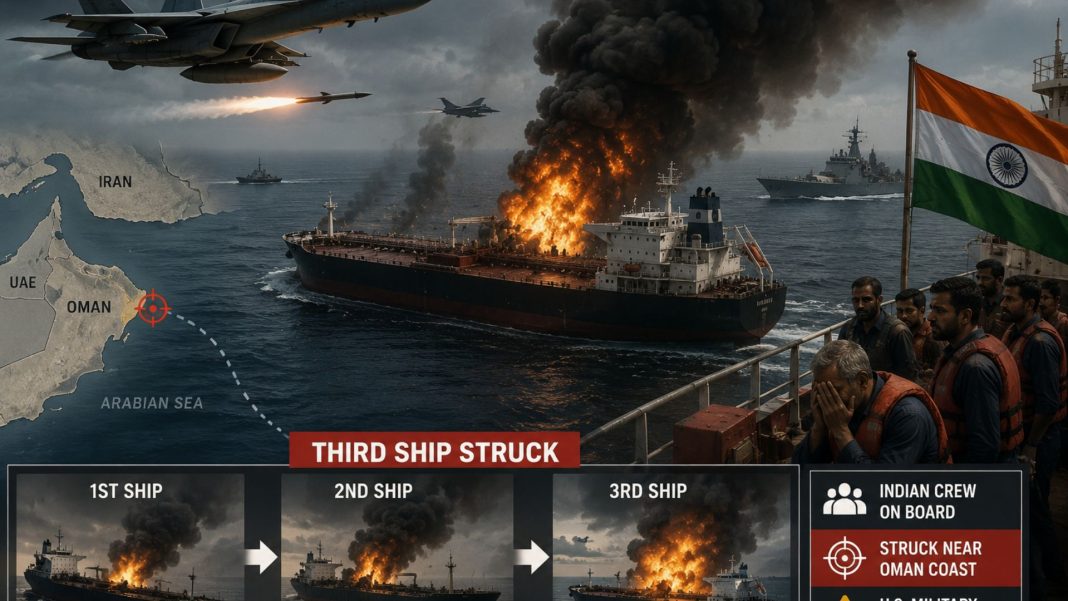

HAT-TRICK OF HORROR: Tensions in the Arabian Sea have reached a boiling point following a suspected third American military strike this week on a commercial vessel carrying Indian crew members.
According to global news agency Reuters and Indian maritime authorities, the Guinea-Bissau-flagged vessel, Jaalveer, was carrying 20 Indian seafarers when it caught fire and issued an urgent distress call near the Shinas port off the coast of Oman.
While all 20 Indian nationals on board the Jaalveer have been reported safe, the incident has triggered intense alarm in New Delhi, marking an unprecedented and highly dangerous pattern of collateral damage involving Indian civilian sailors.
Third Strike in Four Days: A Dangerous Pattern Emerges
HAT-TRICK OF HORROR: If confirmed, this latest bombardment marks the third time in less than a week that U.S. military operations have directly hit or endangered ships manned by Indian crews. The timeline of the crisis highlights the rapidly deteriorating safety of global shipping lanes:
Monday: The oil tanker Marivex, carrying an Indian crew, was targeted, forcing the sailors to send an emergency message for immediate assistance.
Tuesday: In the most tragic escalation, the Palau-flagged oil tanker MT Settebello was hit by a U.S. military strike, resulting in the tragic deaths of three Indian seafarers.
Fresh Incident: The vessel Jaalveer becomes the latest target, sending distress signals after a fire broke out on board following military engagement.
New Delhi Points the Finger: Ministry Blames U.S. Navy for the Fire
HAT-TRICK OF HORROR: Unlike previous incidents where details emerged slowly, Indian officials have moved quickly to identify the source of the attack.
External Affairs Ministry Spokesperson Randhir Jaiswal confirmed to reporters that the vessel Jaalveer was indeed fired upon by the U.S. Navy. According to India’s Ministry of Shipping, the strike caused a sudden fire on board the vessel, forcing the captain to broadcast an immediate emergency SOS while operating near Oman’s Shinas port.
Fortunately, quick emergency responses ensured that none of the 20 Indian crew members sustained fatal injuries, a rare silver lining in an otherwise darkening diplomatic sky.
The Pentagon’s Silence and the “Iran Blockade” Justification
While the U.S. Central Command (CENTCOM) has not yet issued an official statement regarding the specific strike on the Jaalveer, Washington’s underlying military motives in the region are clear.
In earlier statements defending its aggressive strikes on the Marivex and MT Settebello, CENTCOM firmly justified its actions. The U.S. military claimed both vessels had openly violated maritime orders and failed to comply with direct instructions from American naval forces.
The Geopolitical Context: The United States military is currently enforcing a strict, aggressive maritime blockade against Iranian ports to cut off illegal oil exports and trade.
However, this blockade is now heavily impacting commercial vessels manned by innocent international crews, particularly from India.
Rising Diplomatic Tensions Between New Delhi and Washington
This third consecutive incident is expected to severely strain diplomatic ties between India and the United States. Just 24 hours prior to this attack, New Delhi took the aggressive step of summoning the U.S. Chargé d’Affaires in New Delhi to lodge a strong, formal diplomatic protest (démarche) over the deaths of the three sailors on the MT Settebello.
With a third ship targeted almost immediately after that diplomatic warning, Indian policymakers are facing a critical challenge. India is one of the world’s largest suppliers of merchant navy seafarers, and the current U.S. rules of engagement in the Arabian Sea are actively placing hundreds of Indian lives directly in the crossfire.
As maritime operations continue near the Strait of Hormuz, India is expected to demand immediate, ironclad assurances from Washington to ensure that commercial ships carrying civilian crews are not subjected to sudden military bombardment.
Also Read : Oman to Gujarat Undersea Pipeline: Can India Protect Its Energy from Middle East Crisis?