

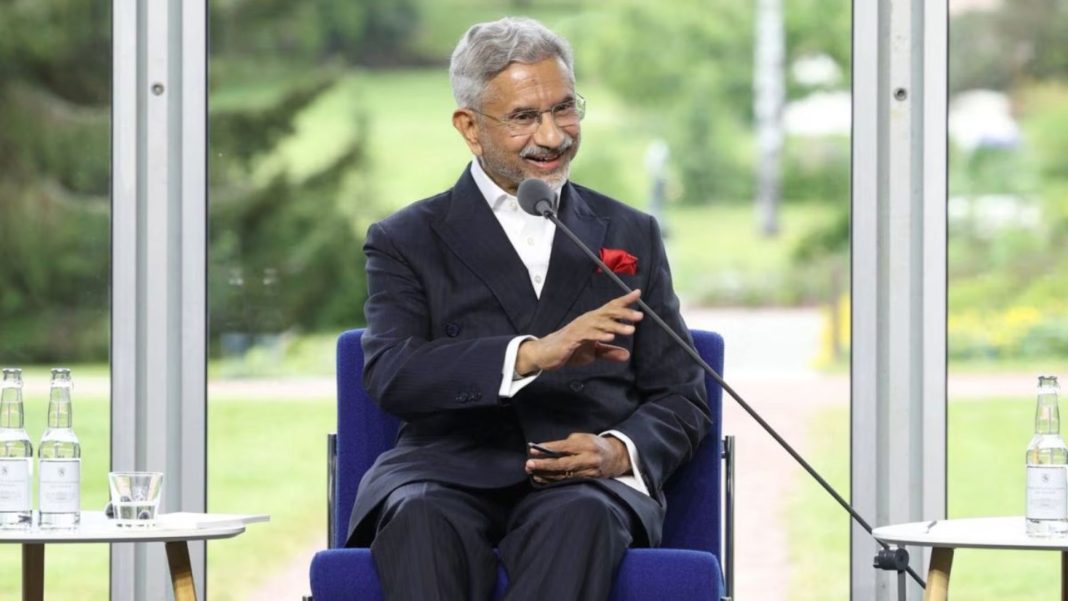

Kultaranta Talks 2026: India’s External Affairs Minister, Dr. S. Jaishankar, has strongly defended the country’s energy and foreign policy choices during the Kultaranta Talks in Finland.
Speaking at a panel discussion titled ‘Emerging Powers and New Geopolitical Competition’ alongside Finnish President Alexander Stubb, Jaishankar highlighted the sharp policy contradictions in Western sanctions.
When a foreign journalist questioned India’s continued purchase of Russian crude oil, the minister did not offer a standard diplomatic reply. Instead, he presented real market data from the 2022 energy crisis to show that practical economic interests often override public political statements.
The Market Reality: “The US Requested Purchases to Stabilize Markets”
Kultaranta Talks 2026: Addressing the panel, Dr. Jaishankar shared a key geopolitical detail, revealing that the US administration had actually asked India to keep importing Russian oil during the initial phase of the Ukraine conflict in 2022.
“I want people to remember this history,” Dr. Jaishankar stated. “At that time, the United States specifically requested India to buy Russian oil to keep global energy markets stable.
If India had completely exited the market, global crude prices could have shot up to $150 or $200 a barrel, severely damaging the global economy.”
He emphasized that during a period of extreme global uncertainty, India’s oil purchases acted as a vital safety valve for the entire world.
Shifting Targets: “We Are All Adults in the Room”
Kultaranta Talks 2026: Jaishankar openly criticized the frequent changes in Western sanctions policies, pointing out how Washington alters its rules whenever domestic conditions change.
Initially, in 2022, the US requested India to absorb Russian crude to prevent a global supply crash. However, by 2025, new tariffs and duties were placed on Indian refined imports. Most recently, in 2026, those same tariffs were rolled back due to rising inflation concerns in the West.
“Let us not pretend there are deep moral principles involved here,” Jaishankar remarked regarding Western criticism. “They enforce sanctions when it suits them, and they remove them when it doesn’t. We are all adults in this room, and we know how this game works. There is no need for moral hypocrisy here.”
Defense Relations: A Reality Check on European Weapon Sales
Kultaranta Talks 2026: The discussion turned tense when European delegates questioned India’s long-standing defense relationship with Russia. In response, the minister brought up Europe’s own history of exporting arms to volatile regions, contrasting the two track records:
India’s Peaceful History: Jaishankar noted that no European nation has ever faced a security threat or a military strike from an Indian-made weapon, reflecting New Delhi’s responsible global policy.
Europe’s Export Legacy: On the other hand, he reminded the audience that European nations have spent decades selling advanced military hardware to aggressive regimes in Asia, weapons that were used directly against India.
He argued that before lecturing India on defense partnerships, European nations must look at how their own historic arms exports have disrupted regional stability.
Energy Diversification and the Upcoming G7 Summit
The minister also provided hard data regarding India’s current energy security layout, which becomes even more critical given the current shipping tensions in the Strait of Hormuz.
Currently, India secures nearly 40% of its total crude oil needs from Russia. At the same time, alongside suppliers like the UAE and Qatar, the United States has actually become India’s single largest supplier of liquefied natural gas (LNG).
From the stage in Finland, India has made it clear that its foreign policy will not be dictated by outside pressure. Instead, it will always prioritize the economic security of its 1.4 billion citizens.
Coming just days before Prime Minister Narendra Modi arrives in France for the G7 Summit, Jaishankar’s statements signal that India will maintain its strict strategic autonomy on the global stage.
Also Read : Indian Mariners Killed: Will IMO Investigate US Ship Attacks After Iran’s Outrage?