


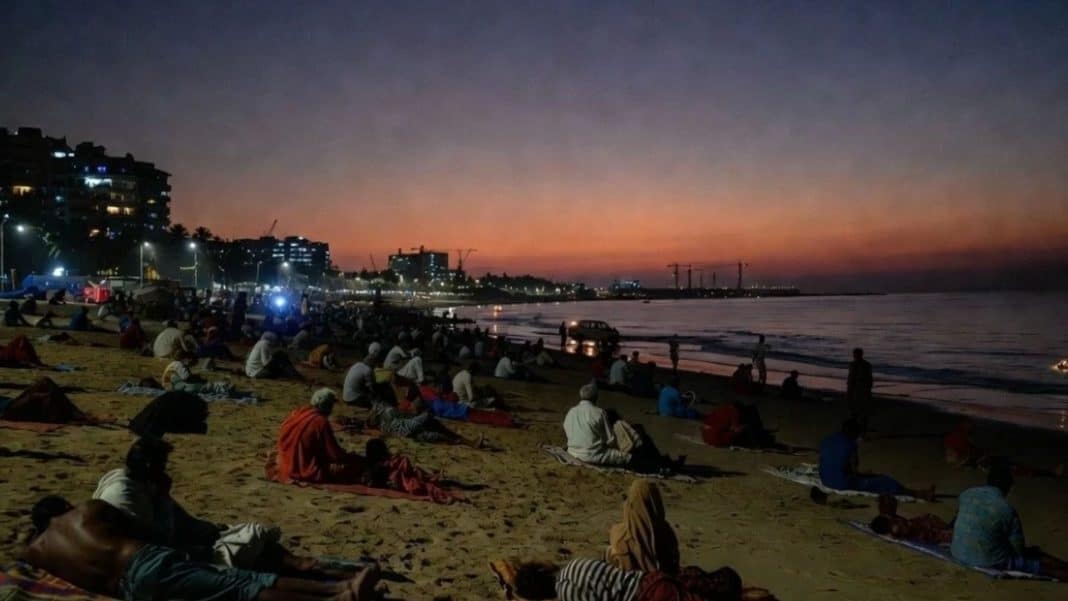

Mumbai: A viral social media video showing hundreds of families laying out mattresses and sleeping overnight on Mumbai’s Versova beach has ignited a fierce public debate.
To the disconnected online observer, the image was quickly labeled as an eyesore, a nuisance, or an unauthorized encroachment on public spaces. However, looking at this phenomenon through a lens of privilege completely misses the devastating truth.
The distressing scene at Versova beach is not a casual choice or a lack of civic discipline; it is a direct, damning symptom of systemic administrative failure, broken urban infrastructure, and the utter abandonment of Mumbai’s working-class population by the local municipal authorities.
When Slum Housing Meets Severe Power Grid Failure
Mumbai: The families seen huddled together on the sandy shores are primarily residents from the nearby Sagar Kutir informal settlement.
During Mumbai’s brutal summer months, the combination of soaring temperatures and suffocating humidity levels turns informal housing into a death trap.
Most of these dwellings are tightly packed, poorly ventilated structures topped with tin or asbestos sheets.
These materials absorb and trap immense heat throughout the day, transforming the interiors into literal ovens by nightfall.
What transformed an already difficult situation into an unlivable crisis was a series of severe, unannounced power cuts and frequent voltage fluctuations. Stripped of electricity, residents were left without even a basic ceiling fan to circulate the stifling air.
For elderly citizens, infants, and pregnant women trapped inside these dark, unventilated rooms, the indoor climate became a profound health hazard.
Moving to the open, breeze-swept beach was an act of sheer desperation a final, grueling resort to escape suffocating indoor temperatures and avoid severe heat exhaustion.
The Cost of Exposure: Safety Hazards, Exploitation, and Fatal Precedents
Mumbai: While the coastline provides temporary relief from the indoor heat, it strips these families of basic human dignity and exposes them to severe physical dangers.
Transitioning from the safety of a home to an unmonitored, dark public beach overnight introduces terrifying vulnerabilities.
Women and young children are left exposed to the risk of harassment and physical assault in areas lacking adequate lighting or security patrolling.
Furthermore, this desperate coping mechanism carries life-threatening physical risks. Mumbai’s beaches have a dangerous history of illegal vehicle entry during the dark, early morning hours.
A horrifying precedent already exists on this very coastline, where an SUV illegally driven onto the sand ran over and killed sleeping citizens.
By failing to provide stable electricity and reliable infrastructure, the civic administration is effectively driving its most vulnerable workforce the auto-drivers, domestic helpers, and daily wage laborers who keep the city running into highly hazardous, unpredictable environments just so they can sleep.
A Stark Indictment of Mumbai’s Broken Civic Infrastructure
The viral footage of Versova beach has completely exposed the myth of Mumbai as a world-class, glittering financial superpower.
It is a profound failure of governance when a city that generates trillions in revenue cannot guarantee continuous power supply and basic livable conditions for its citizens during predictable summer peaks.
Instead of addressing the root cause the failure to upgrade local electrical transformers, fix the overloaded power grid, and implement localized heat-action plans the public discourse has shamefully shifted toward policing the victims.
The debate should not be focused on whether the poor are “spoiling” public spaces. Instead, the focus must be directed squarely at the Brihanmumbai Municipal Corporation (BMC) and state power distribution companies.
Their failure to modernize infrastructure in densely populated pockets has left thousands of taxpayers to fend for themselves like climate refugees in their own city.
The Immediate Need for Accountability and Structural Reform
The sight of hundreds of citizens sleeping on a public beach is a visual indictment of a city that exploits its working class while denying them basic dignities.
It highlights a massive, growing gap in urban planning where climate resilience is treated as a luxury reserved only for the wealthy in air-conditioned high-rises.
If the local authorities continue to ignore the systemic neglect of electricity grids and fail to build heat-resilient infrastructure in informal settlements, this crisis will only deepen.
The Versova beach incident must not be dismissed as a temporary social media trend or handled with aggressive police evictions.
It requires immediate structural accountability, urgent grid upgrades, and an acknowledgment that basic shelter, electricity, and safety are fundamental human rights, not privileges.