


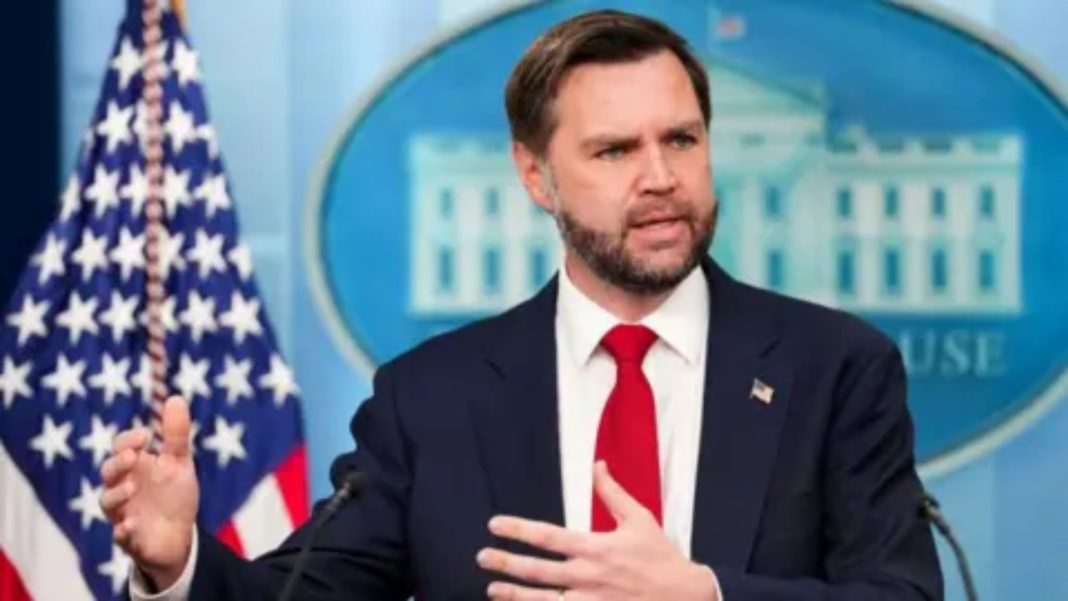

JD Vance cancels Switzerland trip: In a sudden twist to the newly minted diplomatic breakthrough, the highly anticipated first round of technical talks between the United States and Iran has been postponed.
US Vice President JD Vance will no longer be traveling to the Swiss city of Lucerne, where negotiators from both nations were scheduled to convene on Friday to flesh out a historic, war-ending peace pact.
The White House officially attributed the last-minute cancellation to complex logistical hurdles. However, the abrupt delay highlights the extreme volatility and deep-seated mistrust that continue to cloud relations between Washington and Tehran, even after their leaders put pen to paper.
A 14-Point Pact Under Sudden Strain
JD Vance cancels Switzerland trip: The setback comes less than 24 hours after US President Donald Trump and Iranian President Masoud Pezeshkian virtually signed a landmark 14-point Memorandum of Understanding (MoU).
The preliminary accord was designed to bring an immediate halt to months of devastating military conflict, lift the naval blockade on Iranian ports, and reopen the economically vital Strait of Hormuz.
The planned Swiss summit was meant to serve as the operational launchpad for the agreement. Representatives were tasked with translating the broad political framework into actionable, technical steps.
“Never Simple or Predictable”
JD Vance cancels Switzerland trip: Addressing the delay, a White House spokesperson confirmed that Vice President Vance would remain in Washington for the time being, underscoring the inherently erratic nature of such high-stakes diplomacy.
“As the Vice President stated previously, the definitive plans for the technical talks have not been finalized,” the spokesperson said late Thursday.
“While the US delegation remains packed and ready to depart at a moment’s notice, the logistics of these negotiations have never been simple or predictable.”
The administration stressed that the delay is not a collapse of the peace process, promising that updates on a rescheduled timeline would be provided as soon as a concrete roadmap is locked in.
Hints of this friction were visible earlier in the week, when Vance himself noted his travel plans were tentative, and Iranian negotiators echoed that a firm date had never been mutually locked down.
The 60-Day Clock is Ticking
Despite the initial hiccup in Lucerne, the White House maintains that the overarching peace process remains firmly on track. During a press conference, VP Vance reiterated that the United States is fully committed to implementing the first phase of the agreement.
Critically, the postponement does not pause the timeline. The rigorous 60-day negotiation window officially commenced on Thursday. Over the next two months, both administrations must resolve highly sensitive issues, including:
Establishing permanent verification protocols for the ceasefire.
Enforcing nuclear restrictions and checking uranium stockpiles.
Finalizing the multi-billion-dollar regional reconstruction frameworks.
While the diplomatic machinery has stalled on its first outing, the pressure on Washington and Tehran is mounting. With the 60-day clock ticking down, both sides must swiftly iron out their logistical friction if they hope to transform a fragile ceasefire into a lasting global peace.