


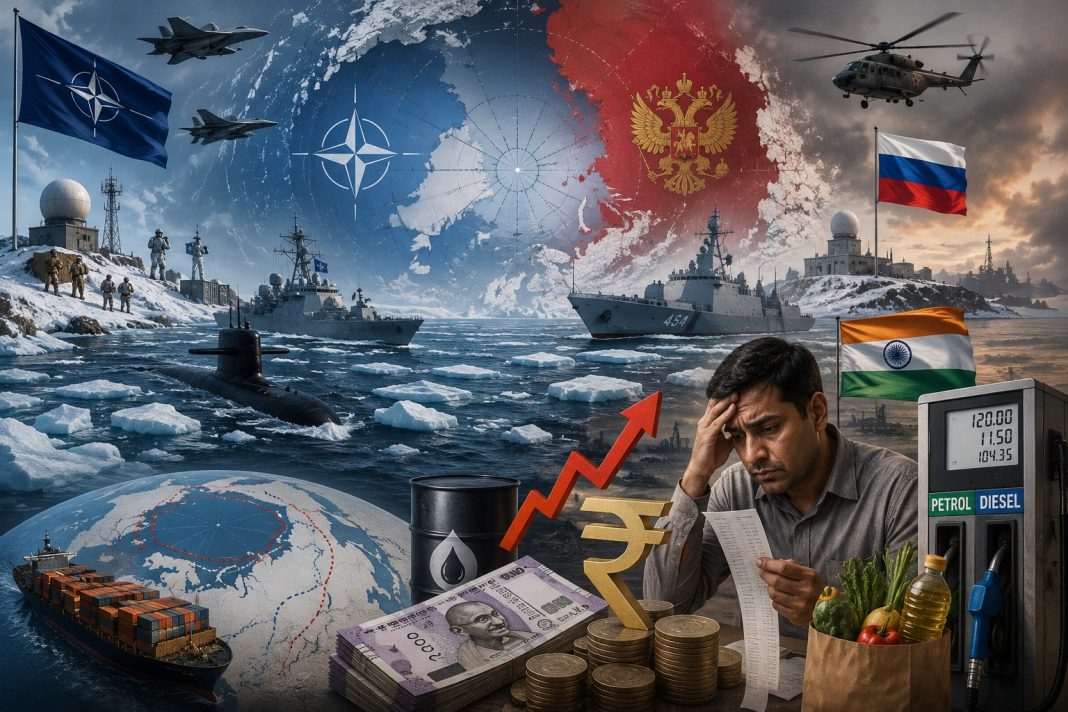

Echoes of World War at the North Pole: The frozen landscapes of the High North are no longer a buffer of geopolitical peace. Driven by rapid climate change, the Arctic is transforming into one of the world’s most volatile military flashpoints.
With the ice retreating at unprecedented rates, newly accessible shipping lanes and vast hydrocarbon reserves have triggered an aggressive scramble for dominance.
Reports indicate that NATO, now expanded to 32 nations with the integration of Finland and Sweden, is actively locking horns with the Russian Federation in a tense underwater and surface standoff.
The Ice Thaw: Opening a New Front of Global Conflict
Echoes of World War at the North Pole: For decades, the Arctic was governed under a spirit of scientific cooperation, famously encapsulated by the phrase “High North, Low Tension.” However, global warming has altered the physical and strategic geography of the region.
The Arctic is warming up to four times faster than the global average, a phenomenon known as Arctic amplification.
As seasonal ice sheets disappear, the Northern Sea Route (NSR), which cuts maritime transit time between Europe and Asia by up to 40% compared to the traditional Suez Canal route, is becoming commercially viable.
This environmental shift has effectively transformed a frozen natural barrier into an open maritime frontier, bringing long-standing structural rivalries to the surface.
Submarines and Strategic Bastions: The Military Build-up
Echoes of World War at the North Pole: The scale of militarization across the Arctic Circle has escalated rapidly, with both sides reinforcing their postures to protect perceived national interests.
Russia’s Polar Fortress
Russia commands roughly 53% of the Arctic coastline and views the region as a vital economic engine and defensive shield. Moscow has systematically refurbished Soviet-era airfields, deep-water ports, and radar installations across its northern frontier.
Crucially, the Arctic serves as the home base for Russia’s Northern Fleet on the Kola Peninsula. This fleet hosts a critical portion of the Kremlin’s second-strike maritime nuclear deterrent.
To secure this bastion and police the NSR, Russia has deployed specialized Arctic warfare units, advanced anti-ship missile batteries, and maintains the world’s largest fleet of conventional and nuclear-powered icebreakers.
NATO’s Combined Response
Alarmed by Russia’s expanding military footprint and potential coordination with China, NATO has significantly intensified its focus on its northern flank. Under recent initiatives like Arctic Sentry, the alliance is integrating its newest Nordic members into an overarching operational approach designed to streamline regional decision-making.
Large-scale exercises, such as the recent iterations of Cold Response, have seen roughly 30,000 NATO troops rehearse defensive maneuvers in the challenging terrain of Arctic Norway.
Furthermore, allies like the United Kingdom and the United States are increasing their rotational deployment of marines, expanding anti-submarine warfare capabilities, and launching advanced surveillance assets, such as Task Force X-Arctic, to track underwater movements through critical North Atlantic chokepoints.
The Ripple Effect: Why India Cannot Ignore the High North
While the geopolitical standoff unfolds thousands of miles away from New Delhi, its structural consequences directly intersect with India’s long-term economic and energy security frameworks.
- Energy Supply Vulnerabilities
India is the world’s third-largest consumer of crude oil, relying on imports for over 80% of its domestic requirements. In recent years, India has significantly diversified its energy basket by substantially increasing its imports of discounted Russian crude.
A portion of these energy trade architectures is tied to emerging maritime networks, including the Northern Sea Route and joint investments in Arctic liquid natural gas (LNG) projects like Vankor and Arctic LNG 2.
Any active kinetic friction or blockade in polar shipping lanes would severely restrict supply flows, trigger sharp spikes in global Brent crude benchmarks, and exert immense inflationary pressure on the Indian economy.
- Disruption of Global Trade Vectors
The modern global economy relies heavily on tightly synchronized supply chains. If a miscalculation in the Arctic prompts broad-scale maritime interdictions, global commercial shipping would face severe cascading delays.
Insurance premiums for commercial vessels would surge overnight, and shipping lines would be forced to reroute cargo. For India, this translates directly to increased freight costs for both vital imports and manufacturing exports, impacting everything from industrial raw materials to domestic fuel prices.
India’s Strategic Dilemma: Alliance vs. Autonomy
The intensifying polarization between NATO and Russia forces a critical foreign policy question: Should New Delhi explicitly align with its traditional partner, Moscow, or maintain its stance of strategic neutrality?
Historically, India’s geopolitical doctrine has rejected binary bloc politics in favor of strategic autonomy, a policy calculated to preserve independent decision-making based on national interest rather than treaty obligations.
The Case for Deepening the Russian Partnership
Proponents of a more pronounced alignment with Moscow highlight decades of reliable defense cooperation, technology transfers, and deep energy synergies. Russia remains a foundational pillar of India’s military hardware supply chain.
Furthermore, an active Indian presence in the Arctic via Russian joint ventures ensures New Delhi retains a seat at the table in a resource-rich geography, serving as a counterweight to China’s expanding influence along its self-proclaimed “Polar Silk Road.”
The Imperative of Strategic Neutrality
Conversely, mainstream diplomatic consensus argues that open alignment with Russia would carry severe strategic liabilities. India’s contemporary foreign policy is carefully balanced across multiple vectors:
It maintains a robust, expanding security and technology partnership with Western powers via platforms like the Quad (comprising India, the US, Japan, and Australia) to manage Indo-Pacific security dynamics.
Explicitly backing Russia in a distant theater like the Arctic could alienate key Western economic partners, risk secondary sanctions, and complicate India’s standing in global financial architectures.
The Path Forward: Calibrated Neutrality
The structural reality of 2026 suggests that India’s optimal approach is not a binary choice, but a policy of calibrated neutrality mixed with active scientific engagement.
India’s official Arctic Policy, formalized in recent years, appropriately frames its interests through the lens of scientific research, climate monitoring (specifically analyzing how Arctic melt impacts the Indian Monsoons via teleconnections), and adherence to international maritime law under the UN Convention on the Law of the Sea (UNCLOS).
By maintaining functional commercial and energy ties with Russia while simultaneously deepening its scientific and diplomatic engagement with the broader international community, including Nordic council states like Norway and Finland, India can best safeguard its economic interests without becoming entangled in a high-stakes polar confrontation.
Also Read : Jaishankar in the Dragon’s Den: How India Neutralized China’s Game Plan at SCO