


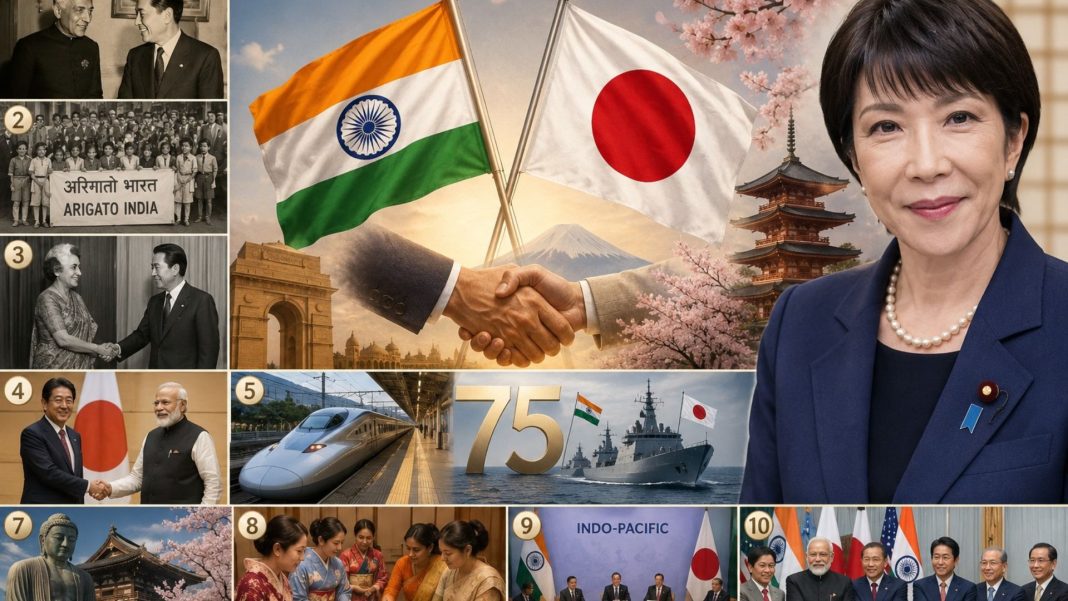

India-Japan Relations: The arrival of Japanese Prime Minister Sanae Takaichi in New Delhi marks a critical new milestone in Asian geopolitics. Embarking on a three-day official visit, Prime Minister Takaichi’s discussions with Indian Prime Minister Narendra Modi centered heavily on trade, investment, and deep defense cooperation.
This high-level dialogue directly advances the “Japan-India Joint Vision for the Next Decade,” a comprehensive strategic roadmap established during Prime Minister Modi’s visit to Tokyo in August 2025.
As Prime Minister Takaichi participates in the 16th Japan-India Annual Summit, her first official visit to India as head of government, the meeting underscores a partnership that has evolved far beyond bilateral trade.
With both nations preparing to celebrate the 75th anniversary of their official diplomatic relations next year, this summit highlights a shared commitment to stabilizing the Indo-Pacific region.
To understand how this bond became a cornerstone of modern global politics, we look back at the 10 defining moments that shaped India-Japan relations.
1949: The Elephant in the Zoo, A Gift of Healing
In the grim aftermath of World War II, as Japan struggled to recover from immense physical and psychological devastation, an unexpected gesture of kindness arrived from New Delhi. On May 5, 1949, Japan’s National Children’s Day, Indian Prime Minister Jawaharlal Nehru gifted an Indian elephant named ‘Indira’ to Tokyo’s Ueno Zoo.
Sent in response to touching letters from lonely Japanese school children, Indira became an overnight symbol of hope, joy, and peace for a generation of youth recovering from the trauma of war. When Indira passed away in 1983, the entire nation of Japan mourned. This unique chapter of “elephant diplomacy” laid a deep emotional foundation of mutual affection, which India later reinforced by sending two more elephants, Asha (Hope) and Daya (Kindness).
1952: The Peace Treaty, Choosing Dignity Over Retribution
India’s approach to post-war reconciliation with Japan was deeply principled. In 1951, New Delhi formally refused to attend the San Francisco Peace Conference. Prime Minister Nehru strongly objected to the draft treaty, arguing that it placed unfair limitations on Japan’s sovereignty and failed to offer the island nation a position of “honor, equality, and contentment” among independent states.
Instead, India chose an independent path, signing a separate bilateral India-Japan Peace Treaty on April 28, 1952. Article 1 of this historic document firmly declared a “firm and enduring peace and friendship” between the two peoples. By establishing official diplomatic ties without demanding war reparations, India earned lasting respect and goodwill within the Japanese political consciousness.
1958: The First Yen Loan, Building India’s Infrastructure
Following a historic visit to New Delhi by Japanese Prime Minister Nobusuke Kishi in 1957, Tokyo made a landmark financial decision. In 1958, Japan extended its very first Official Development Assistance (ODA) Yen Loan to India.
This marked the beginning of a massive economic partnership. Over the decades, Japanese ODA became a critical engine for India’s economic modernization, focusing heavily on poverty alleviation, environmental conservation, and heavy infrastructure. This long-term financial collaboration continues to power major modern urban networks, including Phase 3 of the Bengaluru Metro, the Mumbai Metro Line 11 project, and sustainable agricultural initiatives across Punjab.
2000: The Global Partnership, Expanding Beyond Mere Trade
For nearly half a century, India-Japan relations were warm but remained focused almost entirely on commercial trade and development aid. A major geopolitical shift occurred in August 2000 during the state visit of Japanese Prime Minister Yoshiro Mori to India.
Prime Minister Mori and Indian Prime Minister Atal Bihari Vajpayee signed an agreement establishing the Japan-India Global Partnership. This framework fundamentally transformed the relationship, moving it beyond basic economic exchanges. For the first time, both nations began actively aligning their foreign policies on global issues like information technology, nuclear non-proliferation, and structural reforms within the United Nations Security Council (UNSC).
2005: Anchoring the Relationship with Annual Summits
In April 2005, Japanese Prime Minister Junichiro Koizumi visited India to deepen this emerging alliance. Koizumi and Indian Prime Minister Dr. Manmohan Singh signed a landmark joint statement titled ‘Japan-India Partnership in a New Asian Era’ and rolled out an ambitious ‘Eight-Point Initiative’ action plan.
Most importantly, this meeting institutionalized the Japan-India Annual Summits, alternating hosts between New Delhi and Tokyo each year. This regular, top-tier diplomatic access ensured that the bilateral relationship would remain insulated from domestic political changes, leading directly to the 16th Annual Summit led by Prime Minister Takaichi today.
2006: Elevating to a Strategic and Global Partnership
The momentum accelerated in December 2006 when Prime Minister Dr. Manmohan Singh traveled to Tokyo. Meeting with Japanese Prime Minister Shinzo Abe, a leader who would become a passionate champion of India-Japan ties—the two nations formally upgraded their status to a Strategic and Global Partnership.
This upgrade led to the creation of a joint task force to negotiate a Comprehensive Economic Partnership Agreement (CEPA), which unlocked new flows of goods, services, and investments. Furthermore, 2007 was designated as the India-Japan Tourism Exchange Year, setting aggressive multi-year targets to boost people-to-people connections and cultural tourism.
2014: The Special Strategic Partnership and the Bullet Train
When Prime Minister Narendra Modi took office, his very first bilateral visit outside the Indian subcontinent was to Japan in September 2014. Meeting with Prime Minister Shinzo Abe, the two leaders issued the historic Tokyo Declaration, elevating their ties to a Special Strategic and Global Partnership, the highest diplomatic tier.
The summit yielded major outcomes across multiple fronts:
Defense Cooperation: A Memorandum of Cooperation was signed to deepen naval and military collaboration.
Cultural Exchange: The koto-Varanasi Partner City Agreement was launched to preserve and celebrate shared historical and spiritual heritage.
The Shinkansen Project: Prime Minister Abe offered Japan’s iconic Shinkansen bullet train technology for India’s high-speed rail corridor. This multi-billion-dollar project connecting Ahmedabad and Mumbai was officially greenlit in 2017, transforming Indian rail infrastructure.
2016: The Civil Nuclear Agreement, Breaking Historic Protocol
In November 2016, during another bilateral visit by Prime Minister Modi to Japan, the two nations signed a historic Civil Nuclear Cooperation Agreement. This deal allowed Japan, a nation with deep, understandable sensitivities regarding nuclear technology—to export nuclear energy technology, materials, and safety equipment to India.
This was a groundbreaking shift in international diplomacy. India became the first country in history that is not a signatory to the Nuclear Non-Proliferation Treaty (NPT) to successfully conclude a civil nuclear agreement with Japan, demonstrating Tokyo’s absolute trust in India’s responsible nuclear track record.
2017: Resurrecting the Quad to Counter Regional Challenges
In November 2017, senior officials from India, Japan, the United States, and Australia met on the sidelines of the ASEAN summit, marking the official revival of the Quadrilateral Security Dialogue (Quad) after a ten-year hiatus. The four democracies reaffirmed their shared commitment to a “free, open, prosperous, and inclusive” Indo-Pacific region.
Originally formed as an ad-hoc humanitarian core group after the devastating 2004 Indian Ocean Tsunami, the Quad faded in 2008 when Australia temporarily withdrew. Its revival in 2017 created a powerful strategic counterweight to China’s increasing military assertiveness and sweeping infrastructure networks across critical Asian sea lanes.
2025: The Joint Vision for the Next Decade
During the 15th Japan-India Annual Summit in Tokyo in August 2025, Prime Minister Modi and his Japanese counterpart officially adopted the ‘Japan-India Joint Vision for the Next Decade.’ This forward-looking document outlines eight core national efforts designed to address emerging technological and economic challenges:
Next-Generation Economic Partnership: Modernizing bilateral trade and building resilient supply chains.
Next-Generation Economic Security Partnership: Safeguarding critical mineral access and semiconductor supply lines.
Next-Generation Mobility: Collaborating on advanced automotive tech, electric vehicles, and green transit systems.
Next-Generation Ecological Heritages: Driving joint green energy transitions and climate mitigation strategies.
Next-Generation Technology and Innovation Partnership: Deepening joint research in Artificial Intelligence (AI), quantum computing, and 6G telecom networks.
Investment in Next-Generation Health: Strengthening pharmaceutical supply lines and healthcare delivery systems.
Next-Generation People-to-People Partnership: Expanding educational exchanges, professional talent corridors, and skill development programs.
Next-Generation State-Prefecture Partnership: Connecting Indian states directly with Japanese prefectures to boost regional business and cultural ties.
The Analytical Verdict: A Partnership Anchoring the Indo-Pacific
Prime Minister Sanae Takaichi’s current visit to New Delhi is far more than a routine diplomatic meeting; it represents a major continuation of a deeply trusted alliance.
Over the course of 75 years, India and Japan have systematically transformed an emotional, post-war friendship into an exceptionally stable, multi-layered strategic partnership.
In an era defined by deep geopolitical fragmentation, fracturing supply chains, and rising polarization, the steady alignment between New Delhi and Tokyo serves as a vital anchor of stability.
Built on a foundation of shared democratic values, mutual trust, and a unified vision for a free and open Indo-Pacific, the India-Japan alliance stands out as one of the most consequential bilateral relationships of the twenty-first century.
Also Read : Red Sea Crisis: Breaking Foreign Monopolies! India Launches ₹12,980 Crore ‘Bharat Maritime Insurance Pool