


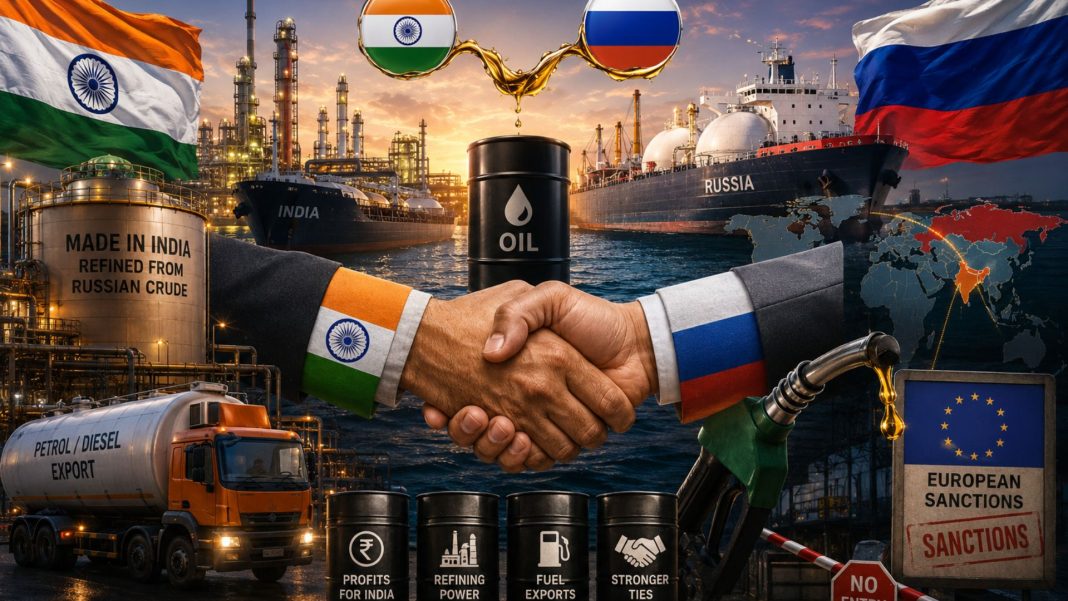

Russia-India Oil Trade: A massive geopolitical script is playing out across the global energy map, creating intense ripples from Brussels to New Delhi. For India, a country that has strategically capitalized on discounted Russian crude oil, recent policy shifts in Europe initially threatened to disrupt domestic fuel pricing.
European nations deployed a fresh wave of indirect sanctions alongside aggressive shipping insurance regulations specifically targeting Russia’s flagship ‘Urals Crude’.
Defense and economic analysts initially warned that these tight Western maneuvers, combined with escalating Middle East conflicts threatening the critical Strait of Hormuz, could choke India’s supply lines, sending domestic petrol and diesel prices through the roof.
However, a recent tracking report by Reuters reveals that New Delhi did not retreat. Instead, India executed an unprecedented counter-strategy. During June and July 2026, Indian refiners imported record-breaking volumes of Russian crude, crossing a historic threshold where Moscow now supplies over 50% of India’s total oil imports.
Adding an extraordinary twist to this energy saga, a domestic fuel crisis inside Russia, triggered by Ukrainian drone strikes on Russian refineries, has forced Moscow to turn to India to buy back refined petrol (gasoline). While Europe attempted to corner New Delhi, India and Russia locked in a symbiotic energy alliance that has completely bypassed Western pressure.
The Western Trap: How Europe’s New Sanctions Targeted Indian Imports
Russia-India Oil Trade: Since the escalation of the conflict in Ukraine, European policymakers have consistently revised their sanctions playbook to cap Russia’s oil revenues.
The latest strategy focuses heavily on the maritime ecosystem. By enforcing strict verification mechanisms on third-party shipping insurers and restricting access to European-owned tankers, the West aimed to make the transportation of Urals crude logistically unviable for Asian buyers.
For India, this presented a double-edged challenge:
Insurance Red Tape: Over 90% of global maritime insurance is controlled by European or UK-based entities. The new rules demand rigorous proof that the oil was purchased below the G7-mandated price cap, threatening legal penalties for non-compliant shipping lines.
The Middle East Chokepoint: With Israel, Iran, and regional factions engaged in direct military friction, the Strait of Hormuz, through which one-fifth of the world’s liquid petroleum passes, remains highly volatile.
If India were forced to rely purely on Middle Eastern crude due to European sanctions on Russian shipping, any disruption in Hormuz would cause an immediate domestic price shock.
Despite these vulnerabilities, New Delhi’s energy diplomacy chose a path of absolute defiance, viewing the restriction not as a barrier, but as a matrix to be outmaneuvered.
The Data Breakthrough: Reuters Exposes Record-Breaking Inflows
Russia-India Oil Trade: While Western capitals anticipated a steep decline in India’s consumption of Russian oil, the actual shipping data for mid-2026 revealed the exact opposite. According to comprehensive vessel-tracking matrices published by Reuters, India’s imports of Russian crude scaled unprecedented heights during June and July 2026.
India’s Crude Oil Import Share (June-July 2026)
Russian Federation: 54% (Record High)
Middle East & Others: 46%
Indian private and state-run refiners pushed their intake to an estimated 2.6 to 2.7 million barrels per day (bpd). This massive volume successfully displaced traditional supply dominance held by Saudi Arabia and Iraq. By shifting more than half of its total import dependency onto the Russian grid, India insulated its domestic market from the price spikes occurring in the volatile Mediterranean and Gulf regions.
The mechanism enabling this trade is a massive, decentralized “shadow fleet”, a network of non-Western managed tankers operating with alternative, non-European sovereign insurance guarantees. This infrastructure has effectively rendered Europe’s maritime blockades obsolete.
The Irony of the Conflict: Russia Suffers Petrol Deficits
The most shocking turning point in this geopolitical standoff is the domestic energy crisis unfolding within the borders of the world’s leading energy superpower. Despite sitting on vast reserves of crude oil, Russia has run severely short of refined vehicle fuel, specifically high-grade gasoline.
This deficit is the direct result of a highly targeted Ukrainian drone campaign. Throughout late 2025 and the first half of 2026, long-range Ukrainian strike drones successfully breached Russian air defenses, hitting critical distillation columns at major refineries, including the Nizhny Novgorod, Ryazan, and Syzran facilities.
The structural impact on Russia’s energy economy has been severe:
Refinery Paralysis: The drone strikes took out approximately 14% to 20% of Russia’s total oil-refining capacity, dropping its domestic processing capability to a twenty-year low.
The Processing Disconnect: While Russia possesses endless raw crude, it lacks the functional, undamaged high-tech refining units needed to turn that crude into petrol for domestic cars, agricultural machinery, and military logistics.
Sizzling Summer Demand: Compounded by seasonal agricultural needs and military movements, Russia’s internal market faced a steep daily deficit of refined gasoline.
The Gasoline Twist: India Becomes Russia’s Fuel Supplier
Faced with a domestic shortage that threatened economic stability, Moscow turned to its most trusted trading partner: India. In an ironic reversal of historical trade roles, Russia is now actively purchasing refined petrol processed by Indian refiners.
India boasts some of the most sophisticated, high-conversion complex oil refineries in the world, heavily concentrated along its western coastline in Gujarat. Refineries operated by major entities, including private players like Nayara Energy (which is partially backed by Russian energy giant Rosneft) and public sector giants, have become central to this reverse-trade mechanism.
Through international trading desks and customized maritime routing, vessels loaded with Indian-refined gasoline are departing from hubs like Sikka and Vadinar, charting courses back toward Russian ports. This trade loop creates a highly profitable dynamic for the Indian economy:
India buys cheap, heavily discounted raw Russian crude oil.
Indian refiners process the raw oil into high-value fuel products.
India sells the finished petrol back to Russia at premium international market rates, retaining a massive profit margin.
Geopolitical Implications: The Triumph of Strategic Autonomy
This energy alignment marks a definitive victory for India’s doctrine of Strategic Autonomy. For nearly three years, Washington and European capitals have applied varying degrees of diplomatic pressure on New Delhi to distance itself from Moscow. This latest phase proves that India’s economic decisions are strictly governed by national interest rather than Western mandates.
By refusing to back down under the threat of indirect sanctions, India has achieved two critical objectives:
Domestic Price Stability: By anchoring over half its energy needs to discounted Russian crude, the Indian government has successfully prevented the domestic inflation of petrol and diesel prices, protecting the wallets of millions of regular consumers.
Global Refining Leverage: India has cemented its position as the premier “refinery to the world.” It acts as a vital buffer zone that keeps global energy supply chains fluid, preventing an all-out global energy crash that would occur if Russian oil were completely removed from the market.
Ultimately, the combined strategy of India and Russia has blunted the edge of Western economic warfare. While Europe attempted to construct an intricate trap of sanctions and insurance bans, New Delhi transformed the crisis into an economic masterstroke, proving that in the modern, multi-polar world, India’s energy sovereignty cannot be dictated by external powers.
Also Read : Echoes of World War at the North Pole: NATO-Russia Clash in the Arctic, How It Hits India’s Pocket Directly