


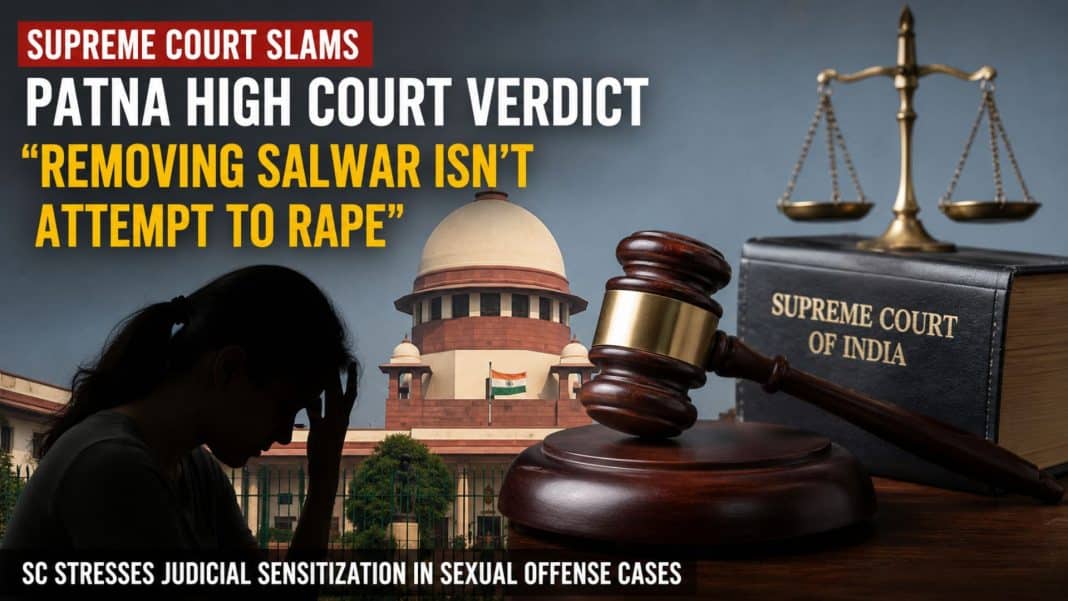

Patna High Court Verdict: In a significant development concerning judicial sensitivity in sexual offense cases, the Supreme Court of India has strongly criticized the Patna High Court for its recent controversial ruling.
The High Court had held that removing a woman’s salwar and pressing her chest did not constitute an “attempt to rape,” classifying the act instead as merely “outraging a woman’s modesty.”
Expressing deep dissatisfaction, a Supreme Court bench headed by Chief Justice of India (CJI) Surya Kant, along with Justices Joymalya Bagchi and V. Mohana, emphasized the urgent need for judicial sensitization.
The apex court indicated that it would soon pass a detailed, reasoned judgment addressing the ruling.
The Controversial Patna High Court Ruling
Patna High Court Verdict: The controversy stems from a July 9 judgment delivered by Justice Purnendu Singh of the Patna High Court.
According to media reports, the High Court set aside the conviction of a man, Himanshu Pathak (alias Mithia), who had been sentenced by a trial court in Banka district to three years of rigorous imprisonment for attempt to rape and wrongful confinement.
The case originated from a 2008 incident in the Amarpur police station area of Banka. The prosecution stated that a young woman had gone to a photography studio with her father.
The studio owner allegedly asked the father to wait outside under the pretext of showing his daughter the photograph on a computer.
Once inside, he bolted the door, attempted to remove her salwar, and physically molested her. Hearing her screams, the father rushed to the door, causing the accused to flee.
While reviewing the appeal, the Patna High Court observed that there was no medical evidence or proof of penetration to satisfy the legal ingredients of an attempt to rape under Section 376 read with Section 511 of the Indian Penal Code (IPC).
“In the absence of any evidence of penetration, even to the slightest extent, or any overt act unequivocally constituting an attempt to commit rape, the ingredients of Section 375 IPC are not attracted,” the High Court observed.
Instead, the High Court ruled that accepted allegations only established the offense of outraging a woman’s modesty under Section 354 of the IPC, which carries a significantly lower punishment.
Supreme Court Intervenes Over Lack of ‘Judicial Sensitivity’
Patna High Court Verdict: The issue was brought to the attention of the Supreme Court by senior advocate Shobha Gupta during a hearing.
She pointed out that despite previous directions from the apex court, high courts across the country continued to deliver insensitive judgments in sexual assault cases.
CJI Surya Kant, referring to the Patna High Court’s order, remarked on the apparent lack of research and application by the judicial staff.
“There is a duty cast on judges also to do some research. The staff is doing nothing,” the CJI observed.
The bench questioned whether the Supreme Court’s earlier directives on judicial sensitization had been cited before the Patna High Court during the arguments.
To address the recurring issue of insensitive judicial remarks, the Supreme Court has directed that the National Judicial Academy (NJA) Committee’s report on judicial sensitivity in sexual offense cases be immediately uploaded on the official websites of the Supreme Court and all high courts nationwide.
Furthermore, state governments have been instructed to issue guidelines to all local police stations to strictly follow the judicial handbook when registering First Information Reports (FIRs) and filing chargesheets.
Echoes of the Allahabad High Court Controversy
This is not the first time the apex court has had to intervene in such matters. The current proceedings emerged from a suo motu case initiated by the Supreme Court following a highly criticized order by the Allahabad High Court on March 17, 2025.
In that case, the Allahabad High Court had observed that pulling a minor girl’s pyjama string and grabbing her breasts did not amount to an “attempt to rape,” but rather fell under “aggravated sexual assault” under the POCSO Act.
The Supreme Court promptly stayed that order, terming it deeply insensitive, and tasked the National Judicial Academy with drafting comprehensive guidelines to sensitize judges handling sexual offenses.
Legal experts and human rights activists have welcomed the Supreme Court’s latest intervention.
They argue that parsing physical acts of sexual violence to reduce criminal charges undermines the trauma of survivors and weakens the legal battle against sexual violence in India.
The upcoming detailed judgment from the Supreme Court is expected to set a firm precedent on how lower courts interpret and adjudicate attempts of sexual assault.
Disclaimer: This report is based on the official courtroom proceedings and observations of the Supreme Court of India and the Patna High Court, as reported by mainstream media. The final reasoned judgment of the Supreme Court is awaited.
Also Read: Jharkhand Minor Rape Case: How a Panchayat Allegedly Settled a Horrific Crime for a Rs 1 Lakh Fine