


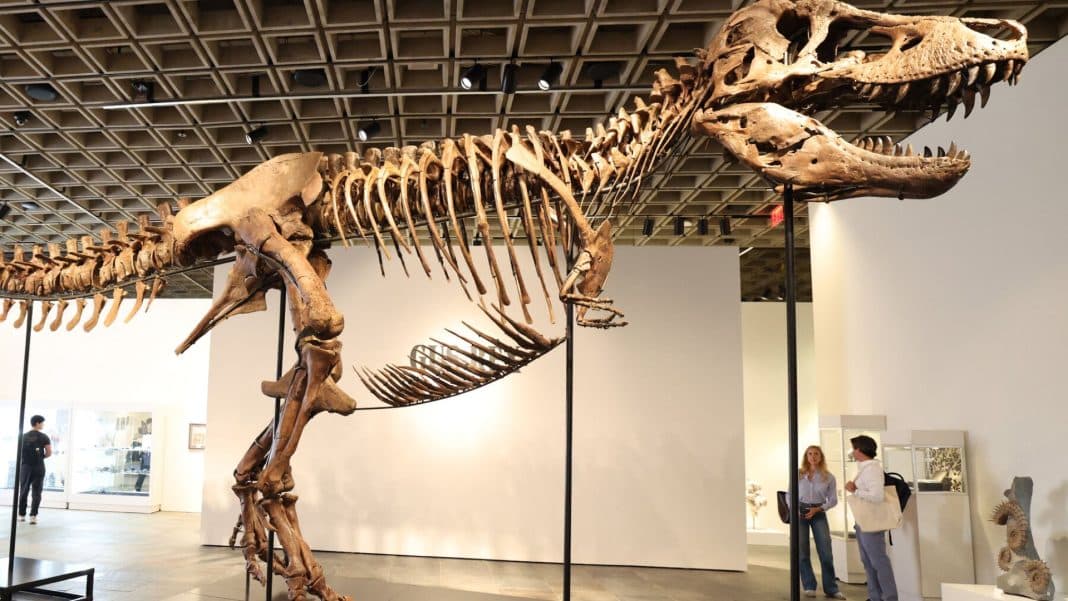

Million-Dollar Bones: The world of paleontology has just been rocked by a historic and deeply controversial auction. A terrifyingly pristine Tyrannosaurus rex fossil, affectionately nicknamed “Gus,” was sold at Sotheby’s in New York for a staggering $50.1 million (approximately ₹482.16 crore).
Bought by an anonymous bidder, the 38-foot-long fossilized giant has officially become the most valuable dinosaur fossil ever sold at an auction.
While the auction house celebrates a record-breaking corporate victory, the scientific community is absolute in its outrage. The multi-million-dollar sale has reignited a fierce global debate:
Should priceless fragments of Earth’s history be hoarded in private luxury collections, or do they belong in public museums for scientific research?
What Makes “Gus” a Once-in-a-Generation Scientific Discovery?
Million-Dollar Bones: To understand why scientists are losing their sleep over this sale, one must look at just how rare and intact this apex predator is.
The Discovery: Gus’s journey began five years ago in 2021, when an expert team of researchers stumbled upon a single dinosaur toe bone (metatarsal) sticking out of the dirt in Harding County, South Dakota.
The Excavation: Extracting the 67-million-year-old apex predator from the rock took half a decade of painstaking digging, geological mapping, and delicate laboratory restoration.
The Statistics: The final assembled skeleton stands at a massive 38 feet long. Crucially, it is 63% anatomically complete, representing an astonishing 75% to 80% of the dinosaur’s total body mass.
The T-Rex was named “Gus” to honor Gary Licking, the late American rancher who owned the private land where the prehistoric beast slept for millions of years.
Though Gary passed away before the project was completed, his family remained deeply involved in bringing the fossil to light, never imagining it would end up as the ultimate trophy asset for the ultra-wealthy.
Why Is This Record-Breaking Sale a Nightmare for Global Science?
Million-Dollar Bones: For top vertebrate paleontologists, the hammer falling at $50.1 million feels less like a celebration of history and more like a tragedy for human knowledge.
The Threat of “Dark Data”
Professor Richard Butler, a renowned vertebrate paleontologist at the University of Birmingham, expressed profound worry over the trend. He argues that treating prehistoric remains like rare art pieces transforms them into mere status symbols for billionaires.
More importantly, if a fossil is not preserved in a recognized, accredited public museum, it cannot be formally peer-reviewed or studied by the scientific community. For all practical purposes, Gus has disappeared from the world of science today.
“Fossils have been bought and sold for hundreds of years, but the market prices have now completely spiked out of reach for public universities and museums. This is a massive, irreplaceable loss for science,” Professor Butler warned.
The Problem with Private Ownership
Dr. Thomas Carr, an Associate Professor and paleontologist at Carthage College in Wisconsin, pointed out a critical systemic flaw. A public trust or state museum is legally bound to conserve, protect, and display its collection forever.
A private buyer faces no such rules. A billionaire can choose to lock the T-Rex away in a private penthouse, block access to researchers, or sell it off secretly years later.
Can Public Museums Ever Win Against Billionaire Wallets?
The legal reality of the situation highlights a major loophole in fossil preservation laws. Because Gus was discovered on privately owned ranch land in the United States, the landowner held full legal rights to sell the fossil to the highest bidder. While the auction itself was entirely legal, it exposes a deep ethical divide.
Professor Stephen Brusatte from the University of Edinburgh noted with dry humor that if he were a multi-billionaire, he too would jump at the chance to buy a T-Rex, but with one major ethical difference.
“If these incredible specimens sell for tens of millions of dollars, universities and local museums simply cannot compete. The only people who can afford them are the ultra-rich. If you buy it, put it in a museum where society can learn from it, rather than trapping it inside a billionaire’s living room,” Brusatte remarked.
Paleontologists around the world are holding onto a fragile hope that the anonymous buyer will eventually do the right thing and donate or loan Gus to a public research institute. Until then, one of the most complete and pristine predatory dinosaurs ever discovered remains locked away from human science, serving merely as the world’s most expensive piece of interior decor.
Also Read : The “Gold Standard” Shift: India-UK Free Trade Agreement Officially Takes Off Today