


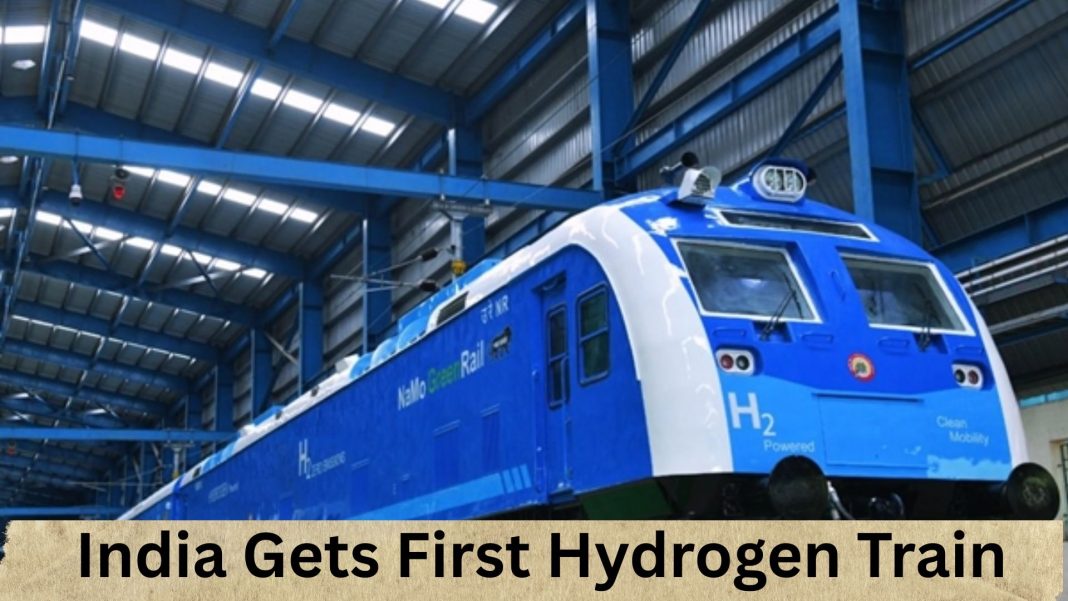

India Gets First Hydrogen Train: On July 17, 2026, Indian Railways officially entered a historic era of clean energy. Prime Minister Narendra Modi flagged off India’s very first hydrogen-powered passenger train from the Jind railway station in Haryana.
This pilot project marks a critical milestone for the nation’s transport sector, proving that next-generation green technology can be designed, integrated, and deployed domestically.
By operating on the 89-km Jind-Sonipat branch line, the train offers a zero-emission alternative to traditional diesel locomotives on non-electrified routes.
With this launch, India joins a highly exclusive global club including Germany, China, and Japan currently pioneering hydrogen-powered rail transport.
How It Works: A Power Plant On Wheels
India Gets First Hydrogen Train: According to officials from the Ministry of Railways, this train operates on a fundamentally different mechanism than typical locomotives.
Unlike diesel trains, there is no combustion of fuel. And unlike conventional electric trains, it does not rely on continuous overhead electric lines (OHE). Instead, the train generates its own electricity onboard.
The technology relies on a Proton Exchange Membrane Fuel Cell (PEMFC). Hydrogen stored in high-pressure cylinders on the train’s roof is combined with oxygen drawn from the surrounding atmosphere.
This electrochemical reaction produces electricity to run the train’s traction motors. Because there is no burning of fossil fuels, the only direct by-products are water vapour and heat, making it a true zero-tailpipe-emission system.
Energy Efficiency Tip: To maximize efficiency, the trainset uses a hybrid system combining fuel cells with Lithium Iron Phosphate (LFP) batteries.
During acceleration, both the fuel cells and batteries power the motors. During braking, a regenerative braking system captures kinetic energy and stores it back in the batteries.
Key Features and Technical Specifications
India Gets First Hydrogen Train: According to technical reports, India’s hydrogen train is one of the longest and most powerful hydrogen-powered passenger trainsets built on a broad-gauge platform globally.
Developed under the “Hydrogen for Heritage” initiative, the train boasts several advanced features:
Configuration: A 10-coach configuration consisting of 2 Hydrogen Driving Power Cars (DPCs) at either end and 8 passenger trailer coaches.
Capacity: Designed to comfortably accommodate approximately 2,600 passengers, making it ideal for regional routes.
Power Output: Equipped with a massive 2,400 kW (3,200 HP) propulsion system, split between two 1,200 kW power cars.
Speed: Approved for a maximum operational speed of 75 kmph, though it has been engineered with a design speed of 110 kmph.
Daily Operation: It will run daily as train number 74010/74009, covering two round trips (roughly 356 km) between Jind and Sonipat with 13 scheduled stops.
Setting Up the Ecosystem: The Jind Refuelling Facility
Building a hydrogen train is only half the challenge; the other half is creating a completely new fuel ecosystem. To support daily operations, Indian Railways has established the country’s largest railway hydrogen storage and refuelling facility at Jind, Haryana.
Media reports state that this indigenous facility is capable of storing up to 3,000 kg of hydrogen at a time. Because hydrogen is highly flammable and must be compressed to be stored efficiently, the facility compresses the gas to 500 bar.
During dispensing, a specialized chiller plant cools the gas to minus 15 degrees Celsius so it can be safely and rapidly pumped into the train’s cylinders at 350 bar. The facility has already received official licensing from the Petroleum and Explosives Safety Organisation (PESO).
Advanced “Defense-in-Depth” Safety Systems
Given the highly volatile nature of hydrogen fuel, safety has been designed as an absolute priority. Indian Railways utilized a “defense-in-depth” safety philosophy, ensuring multiple redundant layers of protection.
The train is fitted with continuous hydrogen leak detectors, active flame and heat sensors, and automatic shut-off valves. If any abnormality or leakage is detected, the system immediately isolates the hydrogen supply.
Additionally, non-stop ventilation prevents any gas from pooling inside the compartments. The train has also cleared a rigorous, independent third-party safety assessment conducted by Germany’s TÜV SÜD.
Why This Launch Matters for India
While over 99% of India’s broad-gauge rail network is already electrified, some remote branch lines and scenic heritage routes are difficult or economically unviable to electrify. Historically, these routes have relied heavily on loud, polluting diesel engines.
The deployment of hydrogen fuel cells offers the perfect middle ground. It provides clean, near-silent electric mobility without requiring the massive capital expenditure of building overhead wire infrastructure.
Ultimately, this pilot project aligns directly with India’s National Green Hydrogen Mission and its aggressive targets to achieve net-zero carbon emissions, proving that the future of Indian transit is green, quiet, and self-sustaining.
Also Read: Ladakh Governance Reform: UT Administration to Set Up Autonomous Hill Councils in All 7 Districts