
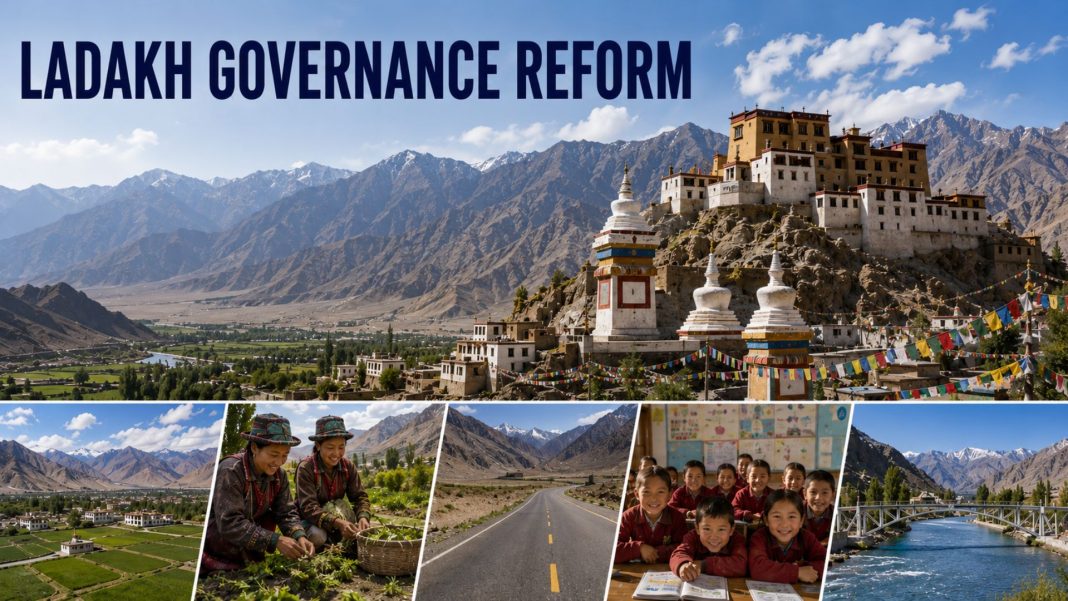

Ladakh Governance Reform: In a historic move toward democratic decentralization, the Ladakh administration has officially announced the establishment of Autonomous Hill Development Councils (AHDCs) across all seven districts of the Union Territory.
This sweeping structural reform aims to empower grassroots governance and fulfill a long-standing demand of local communities following the region’s administrative reorganization.
According to media reports, the decision comes in the wake of the Union Ministry of Home Affairs (MHA) and Ladakhi leaders agreeing in principle to extend special constitutional safeguards under Article 371 to the region.
By transitioning from a centralized system to a district-level elected governance model, the administration is preparing to grant unprecedented local autonomy to residents.
Expanding the Council System Beyond Leh and Kargil
Ladakh Governance Reform: For nearly three decades, local self-governance in Ladakh was strictly limited to the twin districts of Leh (established in 1995) and Kargil (established in 2003).
However, the administrative landscape of the Union Territory changed dramatically earlier in the year when the government officially increased the number of districts from two to seven.
The newly carved-out districts Sham, Nubra, Changthang, Zanskar, and Drass will now transition from purely bureaucratic rule to elected representative governance.
According to Ladakh Chief Secretary Ashish Kundra, the transition directly addresses the demands of residents in these newly created districts who sought autonomous local bodies immediately after the administrative split.
He emphasized that the administration is acting strictly in accordance with Section 3(1) of the Ladakh Autonomous Hill Development Council (LAHDC) Act, which empowers the government to establish a council in any district via an official gazette notification.
Equal Administrative and Financial Powers
Ladakh Governance Reform: A key highlight of this reform is that the five newly established hill councils will not operate under diminished authority. The administration has clarified that Sham, Nubra, Changthang, Zanskar, and Drass will enjoy the exact same statutory powers and privileges that Leh and Kargil have exercised for decades.
Under the LAHDC Act, these councils will hold significant jurisdiction over crucial sectors:
Land and Resource Ownership: The councils will have direct authority over land allocation, use, and ownership within their respective districts a critical factor for preserving local culture and preventing unplanned commercialization.
Local Employment: District-level councils will oversee the recruitment and promotion of district-cadre government employees, ensuring local youth have a direct say in public administration.
Financial Autonomy: Each district will manage its own dedicated Council Fund. Furthermore, the councils will possess the legal authority to levy local taxes, fees, and other charges to generate independent revenue.
Public Service Management: Key developmental sectors, including healthcare, primary education, tourism development, local infrastructure, and social welfare programs, will fall under the direct preview of the elected representatives.
Tailoring Development to Diverse Terrains
Administrators and experts believe that a one-size-fits-all development model cannot work for Ladakh’s vast and highly diverse 60,000 square kilometer terrain.
For instance, the challenges faced by the high-altitude nomadic pastoralists of Changthang are fundamentally different from the agricultural priorities of Sham, the tourism-driven economy of the Nubra Valley, or the heavy isolation of Zanskar.
By shifting planning and budget allocation powers to the district councils, local representatives can tailor development projects to the unique ecological, geographical, and cultural realities of their areas.
To support this decentralized setup, the administration is also restructuring its bureaucratic machinery.
The government has already ordered the creation of independent engineering wings for the Public Works Department (PWD), Rural Works, and Public Health Engineering (PHE) in every single district to fast-track local projects.
A Proposed Three-Tier Democratic Framework
According to official sources, the creation of these district councils is only the first step in a much larger constitutional blueprint being negotiated between the Centre and Ladakhi representatives.
The ongoing discussions contemplate a unique three-tier governance system:
The Grassroots Tier: Existing Panchayati Raj institutions (Gram Panchayats) will continue to function parallelly, managing village-level administration.
The District Tier: The newly expanded 7 Autonomous Hill Development Councils will govern district-level development, land, and resources.
The UT-Level Tier: A proposed Union Territory-level representative body under Article 371 of the Constitution, which would wield overarching legislative, executive, and financial powers.
The government has indicated that minor legislative amendments to the LAHDC Act and a comprehensive delimitation of electoral constituencies will be completed before the new district councils go to the polls.
Once finalized, this model is expected to provide Ladakh with one of the most robust, decentralized, and culturally protected governance frameworks in India.
Also Read: Swiggy HPCL LPG Delivery: How to Order Cooking Gas Cylinders via Instamart