


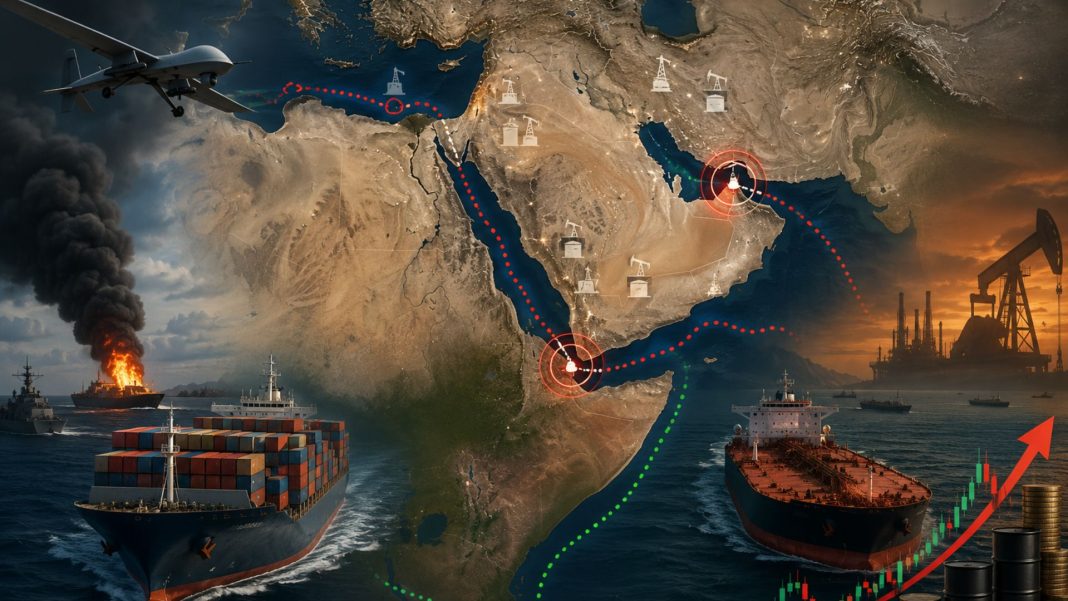

West Asia’s ‘Dual-Chokepoint’ Crisis : The fragile arteries of global commerce are facing their ultimate stress test. Already reeling from tensions in the Strait of Hormuz, the world is now bracing for a catastrophic “dual-chokepoint” shutdown.
Reports indicate that Tehran has instructed Yemen’s Houthi rebels to prepare for a complete blockade of the Bab el-Mandeb Strait, the southern gateway to the Red Sea.
If both corridors are strangled, the global economy will lose its two most critical transit routes simultaneously.
The Strait of Hormuz: The world’s premier energy corridor, connecting the oil-rich Persian Gulf to the Arabian Sea.
The Bab el-Mandeb Strait: The narrow, high-stakes passage between Yemen and the Horn of Africa, serving as the gateway to the Suez Canal, the shortest maritime shortcut between Asia and Europe.
Under normal conditions, this maritime highway keeps global inflation low and fuel flowing. Today, it is a geopolitical fuse waiting to be lit.
The Bypass is Blown: Why Saudi Arabia’s Fallback Route is in Jeopardy
West Asia’s ‘Dual-Chokepoint’ Crisis : When tensions boiled over following US and Israeli strikes on Iran on February 28, Tehran partially blocked the Strait of Hormuz. In response, global energy producers scrambled for a plan B.
Saudi Arabia led the charge, bypassing Hormuz by pumping crude across its landmass via the East-West pipeline to the Red Sea port of Yanbu.
The Shift to the Red Sea by the Numbers:
70% of Saudi Arabia’s normal crude exports were redirected to Yanbu.
4 million barrels per day (bpd) flowed through Yanbu recently, up from just 973,000 bpd during the same period last year.
7.4 million bpd (about 7% of global oil production) transited the Bab el-Mandeb Strait in June, nearly doubling last year’s 4.2 million bpd.
While this massive diversion prevented an immediate global energy crash, it has concentrated the world’s energy eggs in one highly vulnerable basket. If the Houthis act on warnings from Quds Force commander Esmaeil Qaani to choke off the Red Sea, Saudi Arabia’s fallback option vanishes entirely.
India’s $400 Billion Headache: A High-Stakes Exposure
West Asia’s ‘Dual-Chokepoint’ Crisis : Few countries have as much skin in the game as India. Maritime routes carry 95% of India’s trade by volume and 70% by value. The Red Sea corridor is the absolute backbone of this network.
The Scale of India’s Red Sea Dependency:
80% of India’s trade with Europe passes through the Red Sea and Suez Canal.
This trade is valued at a staggering Rs 35 lakh crore ($400 billion).
50% of India’s merchandise exports and 30% of its imports rely entirely on this route.
According to estimates by the Research and Information System for Developing Countries (RIS), a prolonged shutdown of the Red Sea could trigger export losses approaching $30 billion, a devastating 6.7% drop in India’s overall export capacity.
Hit Hard and Fast: The Export Sectors in the Line of Fire
With 95% of Indian cargo vessels already abandoning the Red Sea to sail the long way around Africa, the domestic impact is being felt across critical, low-margin sectors:
Seafood (Shrimp & Prawns): Between 50% and 60% of these highly perishable exports rely on the Red Sea. Delays threaten shelf-life and hand a competitive advantage to closer competitors.
Textiles & Apparel: 75% of India’s garment exports travel this path. Missing tight, seasonal fashion delivery windows in Europe ruins the value of entire shipments.
Basmati Rice: With 4.5 million tonnes exported annually, shipping delays have caused grain to pile up in domestic warehouses. This supply glut has dragged local prices down by 8%, squeezing farmers and processors.
Buffalo Meat: 60% of shipments destined for Russia and North Africa are stranded or delayed.
Tea & Spices: Logistics costs have surged by over 60%, wiping out profit margins in a highly price-sensitive market.
Chemicals & Agrochemicals: With 25% to 30% of industry revenue tied to European and North American markets, extended transit times are locking up precious working capital.
The Energy Tightrope: Can India Keep the Lights On?
Because India imports 85% to 90% of its crude oil, any spike in international prices sends a shockwave through the domestic economy.
While India’s strategic petroleum reserves offer a temporary safety net, they cannot replace normal commercial imports indefinitely. If the Bab el-Mandeb closes, Saudi Arabia can no longer ship oil from Yanbu.
India would be forced to source oil from far more distant suppliers, driving up freight costs and triggering domestic inflation on petrol, diesel, LPG, and daily consumer goods.
The Long Way Around: The Heavy Toll of the Cape of Good Hope
The only immediate alternative for ships bypassing the Red Sea is detour around Africa’s southern tip. This is not a painless swap; it is an economic penalty.
| Metric | Red Sea Route | Cape of Good Hope Detour | Impact / Penalty |
|---|---|---|---|
| Distance | Standard | +3,500 to 6,000 nautical miles | Massive fuel burn |
| Transit Time | Standard | +14 to 28 days | Stretched supply chains |
| Freight Rates | Standard | Up to 3× increase | Eroded profit margins |
On the import side, these delays threaten domestic industries. Crucial agricultural raw materials like fertilizers, along with European capital goods, automotive components, and electronics, are arriving weeks late. This forces Indian factories to hold costly buffer inventories or risk halting assembly lines altogether.
Dead Ends on the Diplomatic Highway: Why ‘Plan B’ is Not Ready
While India has championed grand geopolitical transit corridors, none of them can rescue the country from the immediate crisis:
The India-Middle East-Europe Corridor (IMEC): Designed to connect India to Europe via UAE, Saudi Arabia, Jordan, and Israel, this promising project has been effectively stalled by the ongoing West Asian conflict.
The International North-South Transport Corridor (INSTC): This route connects India to Russia via Iran’s Chabahar Port. While useful for Eurasian trade, it cannot serve as a pathway to Europe or North America because the very nation at the center of this route, Iran is the epicenter of the current crisis.
Air Freight & Multimodal Routes: While shifting cargo to roads across Saudi Arabia or flying high-value items (like electronics and pharmaceuticals) helps, these options are far too expensive and lack the capacity to handle bulk goods like rice, textiles, or chemicals.
New Delhi’s Defensive Shield: Escorts, Credit, and New Horizons
Faced with a bottleneck of historic proportions, India is taking aggressive steps to defend its economic interests:
Gunboat Diplomacy: The Indian Navy has drastically expanded Operation Sankalp, deploying more than a dozen warships to
secure shipping lanes, conduct anti-piracy patrols, and escort Indian-flagged commercial ships through hostile waters.
Financial Lifelines: The Ministry of Commerce and the Reserve Bank of India (RBI) are offering low-cost credit lines to micro, small, and medium enterprises (MSMEs) whose capital is locked up in delayed shipments.
Pivot to New Markets: Exporters are being actively encouraged to diversify their focus away from Europe and toward less volatile regions like ASEAN, East Asia, Australia, and Africa, where maritime trade lanes remain open and peaceful.
As the West Asian chessboard shifts, India’s economic resilience is being tested like never before. Securing these vital sea lanes is no longer just a matter of foreign policy, it is a battle to protect India’s economic growth, domestic inflation, and global competitiveness.
Also Read : Myanmar Boat Tragedy: 500+ Rohingya Feared Dead After Boats Sink Off Rakhine Coast