


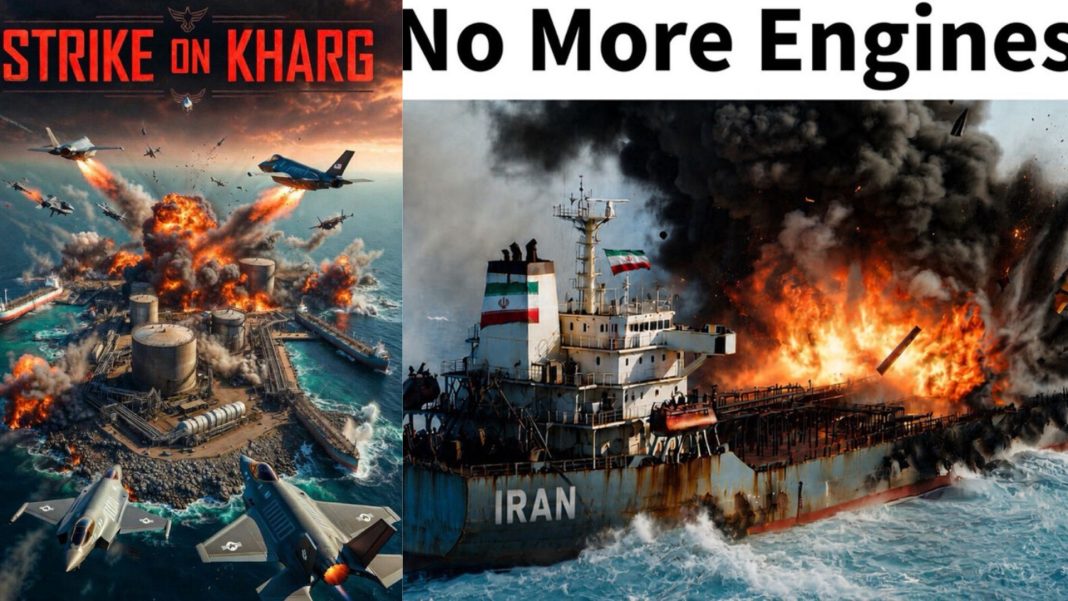

Digital War or Propaganda: As military tensions between the United States and Iran continue to simmer, U.S. President Donald Trump has adopted an unconventional wartime strategy.
Moving away from traditional White House press briefings and formal Pentagon statements, Trump is leveraging artificial intelligence (AI) to control the public narrative.
Through a steady stream of AI-generated images and videos on his platform, Truth Social, the President is projecting American military dominance, mocking political rivals, and recasting himself as a heroic wartime leader.
During a recent operational pause in the fighting, Trump engaged in a massive digital posting spree. In a single day, his Truth Social account was flooded with roughly 16 AI-generated or heavily edited posts.
Together, these visuals constructed an alternate digital reality tailored around his personal leadership style and political priorities.
Hollywood-Style Warfare: Captured Tankers and Cosmic Commands
Digital War or Propaganda: The core of Trump’s recent online offensive focused on dramatic, highly stylized depictions of U.S. military power directed at Iran:
The Oil Tanker Claim: Among the most shared graphics was an image showing Trump standing alongside U.S. troops aboard a captured Iranian oil tanker while holding an American flag. An aircraft carrier floated over an Iranian flag in the background, accompanied by the bold caption: “Now it’s our oil tanker!”
“Guardians of the World”: Another image depicted Trump standing in front of U.S. stealth fighter jets soaring over violent explosions marked with the name “Iran.”
“Strike on Kharg”: A cinematic graphic portrayed high-stakes airstrikes on Kharg Island, Iran’s primary oil export terminal, complete with massive fireballs and burning storage tanks.
Movie-Style Posters: Other AI creations cast the President as a movie protagonist in fictional film posters, including one titled “Cosmic Commander”, and dark horror-themed graphics featuring slogans like “Give the Enemy Nightmares” and “FAFO” (Fool Around and Find Out).
Naval Dominance: Additional visuals showed Trump dressed in ornate military attire surrounded by warships, as well as an image of him commanding a naval destroyer.
To reinforce his messaging, Trump also shared comparison graphics contrasting lengthy historical U.S. conflicts, such as Vietnam and Iraq, with the current Iran operation, framing the latter as a brief, highly successful campaign with minimal casualties.
Domestic Rivalries Take Center Stage in Online Spree
Digital War or Propaganda: Trump’s digital blitz was not limited to foreign enemies. The President regularly deployed AI imagery to settle personal grievances, taunt media figures, and target domestic political rivals:
Media Targets: The posting spree began shortly after 11:00 AM with an AI image depicting CNN anchor Kaitlan Collins as transgender influencer Dylan Mulvaney, a callback to a joke Trump made days earlier at the White House Correspondents’ Dinner.
Late-Night Host Mockery: Prominent late-night television hosts Stephen Colbert, Jimmy Kimmel, and Jimmy Fallon were depicted as struggling, washed-up street performers. Standing under graffiti reading “Late Night Show is Over”, the figures held signs stating: “Talentless, not funny, ex-comedians need money.”
Political Opponents: Mockery extended to musician Bruce Springsteen, former New Jersey Governor Chris Christie in a fictional boxing match against Congressman Jerry Nadler (dubbed the “Cheesecake Championship”), and actress Rosie O’Donnell relocating to Ireland.
Constitutional Debates: Multiple images promoted a future presidential campaign, showing Trump wearing “Trump 2028” hats, a visual that raised eyebrows given the U.S. Constitution’s two-term limit for presidents.
Historical Mashups: Bizarre viral graphics included a scene showing Trump saving George Washington from falling off a cliff, as well as an image of him alongside former President John F. Kennedy inside the White House.
Strategic Playbook: Why Trump Relies on “Slopaganda”
Military and media analysts note that Trump’s heavy reliance on generative AI marks a fundamental shift in presidential wartime communication. Instead of relying on policy speeches or diplomatic releases, his team utilizes fast-moving visual content designed for viral reach.
Observers highlight four primary drivers behind this communication strategy:
Psychological Deterrence: Projecting extreme military force to send warnings without actual deployment. Highlighting destruction or captured enemy assets allows a government to project maximum strength without executing the physical act.
Narrative Control: Capturing internet feeds and forcing news outlets to discuss Trump’s preferred topics. Flash-style AI visuals spread rapidly across social platforms, shaping television coverage and controlling the national conversation.
Brand Reinforcement: Feeding supporters a simplified story of decisive, larger-than-life leadership. Presenting Trump as a “Cosmic Commander” offers an aspirational narrative that resonates with his core audience.
Strategic Ambiguity: Blurring satire and official policy, allowing aides to dismiss controversial visuals as internet humor if legally or diplomatically challenged.
Industry commentators have dubbed this phenomenon “slopaganda”, mass-produced, low-cost AI content designed specifically to reinforce existing political beliefs and dominate digital feeds.
Escalating Tensions and Real-World Friction
The President’s flurry of online posts coincided with a delicate phase in the actual conflict. Following 13 days of direct military exchanges between U.S. and Iranian forces, operations hit an operational pause.
Reports indicate that behind the scenes, Pentagon officials raised serious concerns about a shrinking list of viable military targets and critical shortages of air defense interceptors, including Patriot missiles.
At home, the political and economic costs are mounting:
Rising Costs: Domestic gas and energy prices have spiked due to Middle East instability.
Casualties: The U.S. military death toll reached 18 after direct negotiations with Tehran collapsed earlier in the month.
Internal Concerns: Reports from The New York Times suggested aides viewed Trump’s behavior as increasingly unpredictable while the administration scrambled for an exit strategy to save face diplomatically.
The AI Counter-Offensive: How Iran Fights Back
The U.S.-Iran conflict demonstrates that AI-driven propaganda is no longer exclusive to Western political figures. Following an airstrike on an Iranian school, Iranian diplomatic channels and state-linked accounts launched their own generative AI campaign:
Diplomatic Channels: Iranian accounts circulated AI videos depicting victims alongside the U.S. pilots involved in the bombing runs.
Satirical Counter-Attacks: The Iranian Embassy in Tajikistan shared a modified version of an earlier AI photo of Trump dressed as Jesus, editing the graphic so that a biblical depiction of Jesus pushed Trump into hell.
Lego Propaganda: Other pro-Iran digital creators produced Lego-style animated AI videos satirizing Trump and key U.S. officials, mocking alleged wartime missteps through dark humor.
A New Era of Political Communication
President Donald Trump’s activity on Truth Social offers a vivid preview of how future conflicts will be communicated. As generative technology becomes faster, cheaper, and widely available, the battle for public perception is shifting away from official podiums and press releases. In this modern landscape, geopolitical warfare is fought simultaneously with real-world weaponry and stylized digital memes built to capture global attention.
Also Read : Trump tariffs: Trump Threatens “Salad” Tariffs on Mexico and “Smoke” Tariffs on Canada Amid Growing Crises