

UP Govansh Sahbhagita Yojana 2026: Stray cattle and unmanaged livestock have long posed significant challenges for agricultural communities across Uttar Pradesh.
Beyond damaging standing crops and causing severe economic losses for farmers, roaming livestock often leads to frequent road hazards in rural and urban areas alike.
To tackle these pressing issues while empowering local households, the Uttar Pradesh state government led by Chief Minister Yogi Adityanath established the Chief Minister Destitute/Stray Cattle Participation Scheme (Mukhyamantri Nirashrit/Besahara Govansh Sahbhagita Yojana).
Under this welfare initiative, the state hands over stray cattle registered at government-run shelters (Gaushalas) to eligible farmers, cattle rearers, and interested households.
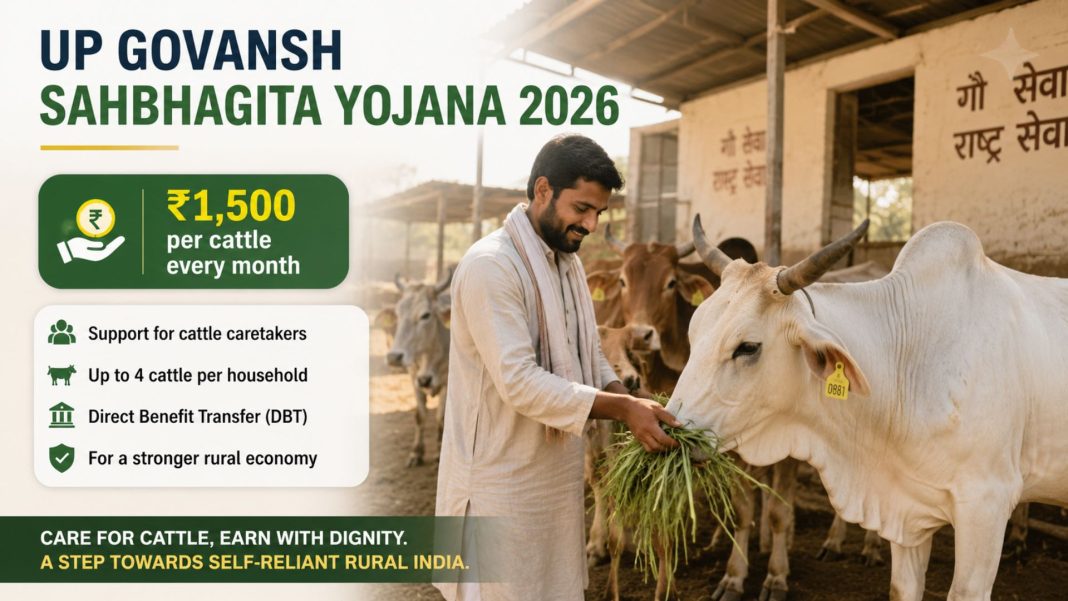
To offset the maintenance and fodder costs, the government directly transfers ₹1,500 per month (₹50 daily) per animal straight into the beneficiary’s bank account.
Key Highlights of the UP Govansh Sahbhagita Yojana
UP Govansh Sahbhagita Yojana 2026: According to official state guidelines, this livestock management program serves a dual purpose: preserving stray cattle and creating sustainable economic opportunities for rural families.
| Feature | Details |
|---|---|
| Scheme Name | Mukhyamantri Nirashrit/Besahara Govansh Sahbhagita Yojana |
| State/Jurisdiction | Uttar Pradesh |
| Financial Assistance | ₹1,500 per cattle per month (₹50 per day) |
| Maximum Limit | Up to 4 cattle per household (Maximum ₹6,000 per month) |
| Payment Mode | Direct Benefit Transfer (DBT) |
| Nodal Department | Department of Animal Husbandry, Uttar Pradesh |
| Helpline Numbers | 0522-2740482 / Toll-Free: 1800-180-5141 |
Core Objectives and Financial Benefits
According to state policy documents, the scheme delivers both direct financial assistance and broader social advantages:
Sustained Monthly Income: A single household adopting the maximum limit of four cattle receives up to ₹6,000 per month in state support.
Secondary Revenue Streams: Beneficiaries keeping milk-producing cattle can sell dairy products locally for additional earnings. Organic waste (cow dung) can also be converted into natural fertilizer to cut farming costs or sold commercially.
Nutritional Improvement: Priority distribution to families with malnourished children helps ensure easy access to fresh milk.
Crop and Road Safety: Transitioning stray animals into structured domestic care prevents crop destruction and reduces stray-related transit accidents.
Eligibility Criteria & Required Documents
To maintain animal welfare standards, the UP Animal Husbandry Department has outlined clear conditions for prospective caretakers:
Eligibility Rules
The applicant must be a permanent resident of Uttar Pradesh.
Must possess adequate, secure shelter (shed space) and sufficient resources to care for the animals.
Must have a valid bank account linked with Aadhaar for direct stipend transfers.
Priority is extended to marginal farmers, small landholders, trained Pashumitras, milk cooperative members, and identified malnourished households.
Strict Ban on Resale: Beneficiaries are legally prohibited from selling, abandoning, or commercially trading the allotted cattle.
Required Documentation
Applicants must present the following standard verification records:
Proof of Identity (Aadhaar Card)
Permanent Residence Certificate of Uttar Pradesh
Aadhaar-linked Bank Passbook
Recent Passport-size Photographs
Active Mobile Number
Self-declaration or proof regarding suitable animal shelter/land space
Application and Inspection Process
Currently, the application and allotment workflow is carried out offline through local administrative offices:
Submission of Application: Interested individuals can visit their nearest Government Veterinary Hospital, Block Development Office (BDO), or the office of the Chief Veterinary Officer (CVO) to obtain and submit the application form along with the necessary documentation.
Physical Verification: Officials from the Animal Husbandry Department perform an on-site inspection of the applicant’s residence to verify whether appropriate shelter and care infrastructure are available.
Ear-Tagging & Handover: Upon clearance, cattle are transferred from designated government shelters to the applicant. Each animal receives a official Ear Tag for unique digital identification and health tracking.
Disbursement of Funds: The monthly financial grant of ₹1,500 per animal is automatically disbursed to the beneficiary’s bank account via Direct Benefit Transfer (DBT).
Mandatory Rules for Caretakers
To ensure animal health and safety, participants must comply with operational guidelines:
No Abandonment: Animals cannot be turned loose or sold under any circumstances.
Medical Care: If an animal falls ill, the caretaker must immediately inform the local veterinary medical officer. Treatment facilities are provided through the district animal husbandry department.
Tag Preservation: The ear tag must remain attached at all times for official tracking and audit purposes.