


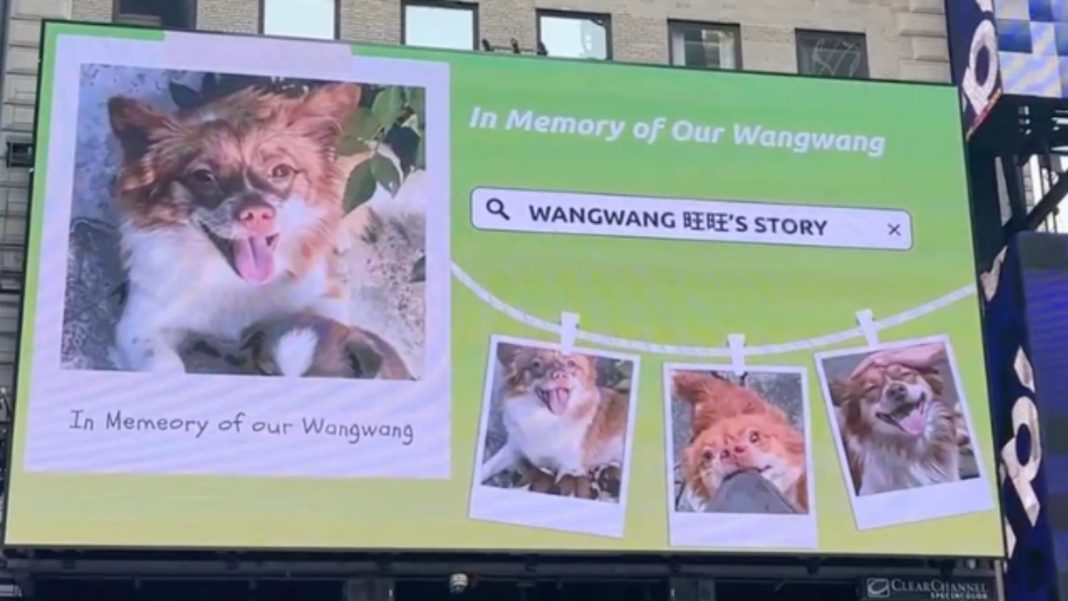

Wang Wang Dog: A horrific act of violence against a stray dog named Wang Wang and her three puppies has ignited a massive public outcry in China, evolving from local outrage into a worldwide movement against animal cruelty and strict state censorship.
The Tragedy: A Brutal Attack Captivated by Video
Wang Wang Dog: On June 28, a mother dog named Wang Wang and her three newborn puppies were brutally attacked in Jieyang, Guangdong province.
Four boys, all under the age of 14, filmed themselves torturing the animals, tying a wire around Wang Wang’s neck, dragging her across the ground, and setting her and her pups on fire with a flammable liquid.
The teenagers uploaded the video online, where their laughter during the horrific act was captured clearly. The video immediately sparked intense fury and distress across Chinese social media.
The Official Response: Minor Status and Muffled Language
Wang Wang Dog: Two days after the video surfaced, local authorities issued a official notice confirming the incident. Because the boys were under 14, the age of criminal responsibility in China, authorities announced they were sent to a specialized school for corrective education.
Crucially, the official statement avoided terms like “torture” or “cruelty.” Instead, authorities urged the public to refrain from sharing the video or discussing the case online:
“We urge the public not to disseminate related information, to reject cyberbullying, and to work together to create a good environment for the growth of minors.” , Local Official Statement
The Public Backlash: Demands for Animal Welfare Laws
The government’s lenient handling of the case, combined with the lack of comprehensive animal protection laws in mainland China, fueled widespread outrage.
In response, citizens, business owners, and public figures began organizing both online and offline:
Crowdfunded Tributes: Citizens raised funds to buy commercial LED advertising space in shopping districts across the country to display memorial graphics for Wang Wang.
Corporate Support: A domestic cosmetics brand paid for mall advertisements in Shenzhen with the message: “Resist animal cruelty; insist there be a law to rely on.”
Sports & Culture: At a football match in Dalian, a large animated cartoon depicting Wang Wang and her puppies was broadcast on a stadium screen before the game.
Celebrity Voices: High-profile celebrities, including mainland actor Du Jiang and Taiwanese actress Joe Chen, spoke out on platforms like Douyin and Weibo to condemn the act.
Censors Step In: Suppressing Memorials and Speech
As public momentum grew, China’s censorship apparatus began dismantling the movement. Posts by celebrities disappeared without explanation, and users reported restrictions on sharing content related to the case.
Physical tributes were targeted as well:
Mall Displays Removed: Management at the Wan Jia Li mall in Changsha was ordered to take down Wang Wang billboards.
Public Screens Cleared: In Guangzhou, digital screens along the busy Beijing Road pedestrian area had their memorial content removed under official direction.
Cross-Border Interference: In Hong Kong, where an adoption platform raised HK$95,000 to display Wang Wang’s image on a city tram, authorities also moved against physical displays.
On July 23, officials instructed a local building management team to remove a 5-meter banner outside a gym that read: “Being a minor does not mean cruelty can be lightly brushed aside.”
Going Global: Memorials Take over Times Square and Milan
Blocked from mourning and protesting domestically, activists shifted their campaign abroad, using global advertising platforms to keep the story alive.
Memorial displays featuring images of Wang Wang and her pups appeared on prominent billboards in major cities worldwide:
| Location | Notable Display Details |
|---|---|
| New York City, USA | A prominent Times Square billboard displayed the message: “She was loved. She wanted to live. She should still be here.” |
| Milan, Italy | Digital memorial screens were installed near the iconic Duomo di Milano. |
| Pisa, Italy | Memorial advertisements appeared in the vicinity of the Leaning Tower of Pisa. |
| Taipei, Taiwan | Digital tribute displays were showcased around the Taipei 101 tower. |
In total, activists successfully secured space on over 200 digital screens globally to call attention to animal welfare and protest censorship.
The Broader Context: Public Action in a Controlled Environment
The pushback surrounding Wang Wang’s case highlights a rare occurrence in China: organized public action scaling past strict state controls. Despite the systemic dismantling of independent civil society organizations over the past decade, animal welfare has emerged as a deeply unifying cause capable of mobilizing public sentiment both domestically and internationally.
Online commentary reflects a persistent refusal to remain silent:
“Constantly speaking up does not mean disturbing social order. to let more people see it and realise it’s such an important thing that we do not mistreat animals.” , Chinese Social Media User
While the government continues to restrict content surrounding the incident, the global campaign demonstrates how public grief and demands for legal accountability can transcend strict digital borders.
Also Read : Kremlin vs Telegram: Russia Puts Pavel Durov on International Wanted List Over Terrorism Charges