


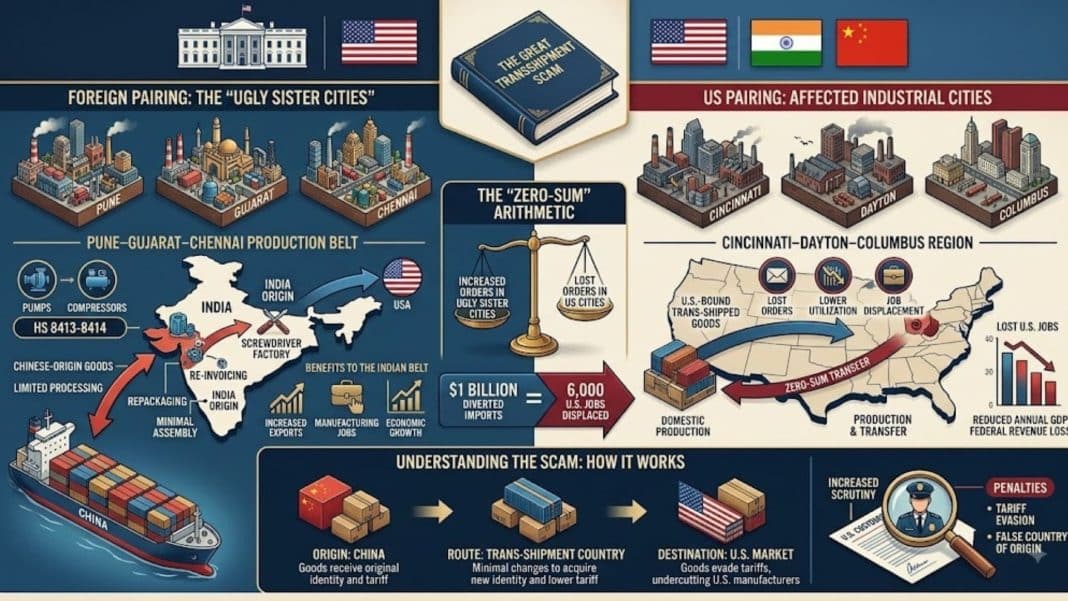

Ugly Sister Cities’: A newly released White House report has ignited intense debate over international trade routes, alleging that Chinese-manufactured goods are being rerouted through third-party Asian nations to bypass U.S. import tariffs.
Titled “The Great Transshipment Scam: Rise, Scope, and Costs,” the report outlines what Washington describes as a widespread, highly coordinated global trade network.
According to American officials, Chinese components and semi-finished goods are being moved into third countries to be processed, assembled, or simply relabeled before reaching their final destination: the United States market.
While the strategy aims to curb duty evasion and shield American workers, it raises sharp questions about the mechanics of modern global manufacturing, where supply chains naturally cross multiple international borders.
India’s Industrial Corridors in the Spotlight
Ugly Sister Cities’: Among the countries highlighted in the report, India occupies a prominent position. The study draws specific attention to an established industrial belt connecting Pune, Gujarat, and Chennai, a corridor renowned for its heavy engineering, automotive manufacturing, and technological production.
The Focus on Pumps and Compressors
The report homes in on specific machinery, primarily industrial pumps and compressors classified under HS Codes 8413 and 8414.
The White House Claim: U.S. officials assert that Indian factories are integrating Chinese-origin components into finished machinery, which is then exported to the United States stamped as “Made in India.” Washington argues this mechanism dilutes the impact of U.S. tariffs on Chinese imports and harms American domestic producers.
India’s Counterargument: Indian industry leaders and policy experts contend that the country’s booming export sector is driven by genuine domestic capacity, deep capital investments, and localized value addition. In an era of interconnected global production, using foreign inputs does not automatically equal tariff cheating.
What are ‘Ugly Sister Cities’? Decoding the White House Terminology
Ugly Sister Cities’: One of the most striking elements of the report is its use of unconventional phrasing, notably the concept of “Ugly Sister Cities.”
Contrary to what the name might suggest, the term has nothing to do with aesthetics or formal municipal twin-city arrangements. Instead, it serves as a stark economic metaphor linking foreign manufacturing hubs directly to the U.S. industrial communities affected by trade imbalances.
Linking Asian Factories to the American Rust Belt
To illustrate its point, the White House links the Pune-Gujarat-Chennai corridor to engineering communities in Cincinnati, Dayton, and Columbus, Ohio.
Washington argues that when tariff-bypassing goods enter the American market at lower prices, domestic factories face:
Reduced order volumes from long-standing clients.
Cutbacks in domestic manufacturing output.
Increasing pressure on local employment and wages.
Beyond India: A Wider Asian Network
The White House study emphasizes that transshipment is not isolated to a single country. It identifies several key industrial centers across Southeast Asia as integral parts of this broader supply chain movement:
Malaysia: The Penang-Kulim industrial zone is highlighted for its role in exporting processed plastics and synthetic materials.
Indonesia: Domestic production sites are cited regarding plastic packaging solutions.
Vietnam & Thailand: Both nations are scrutinized for their rapidly expanding electronics and printed circuit board (PCB) assembly industries.
The report estimates that goods at risk of transshipment globally run into billions of dollars annually, potentially threatening millions of manufacturing jobs across the U.S. However, analysts note that these job impact estimates are based on predictive economic modeling rather than direct, case-by-case tracking of job losses.
AI and Advanced Tech: How Washington Plans to Enforce Rules
In response to these perceived loopholes, the U.S. government is ramping up border enforcement and trade tracking systems.
To catch suspicious trade flows before goods enter American ports, the administration is pushing for:
Enhanced Data Analytics: Cross-referencing shipping manifests, vessel routes, and historical volume trends.
AI-Assisted Customs Screening: Artificial intelligence tools deployed by U.S. Customs and Border Protection (CBP) to automatically flag high-risk shipments requiring physical inspections and origin verification.
Stricter Value-Addition Audits: Requiring importers to prove significant transformation occurred within the exporting country.
The Broader Friction in U.S.-India Trade Relations
This investigation adds a fresh layer of complexity to the trade dynamic between Washington and New Delhi.
On one side, the U.S. is pushing global partners to address unfair trade practices and curb China’s dominant footprint in global manufacturing. On the other side, India is actively working to establish itself as a global manufacturing powerhouse, capturing supply chains that are diversifying away from China under the “China Plus One” strategy.
Where Trade Logic Collides
The core disagreement comes down to a fundamental policy clash:
The U.S. Perspective: Wants tight barriers against indirect Chinese imports to protect domestic industry and enforce trade remedies.
The Emerging Hub Perspective: Countries like India argue that globalized production relies on imported parts, and legitimate regional processing should not be reflexively penalized or mislabeled as illicit transshipment.
What Lies Ahead?
As the White House tightens its trade enforcement and deploys smarter inspection technology, global manufacturers face a tougher compliance landscape. For countries like India, Malaysia, and Vietnam, proving genuine local value addition will be critical to staying competitive while preserving strong trade ties with the United States.
This report marks the beginning of a heightened era of supply chain scrutiny, one where where a product is made, where its parts come from, and where it is put together matter more than ever before.