

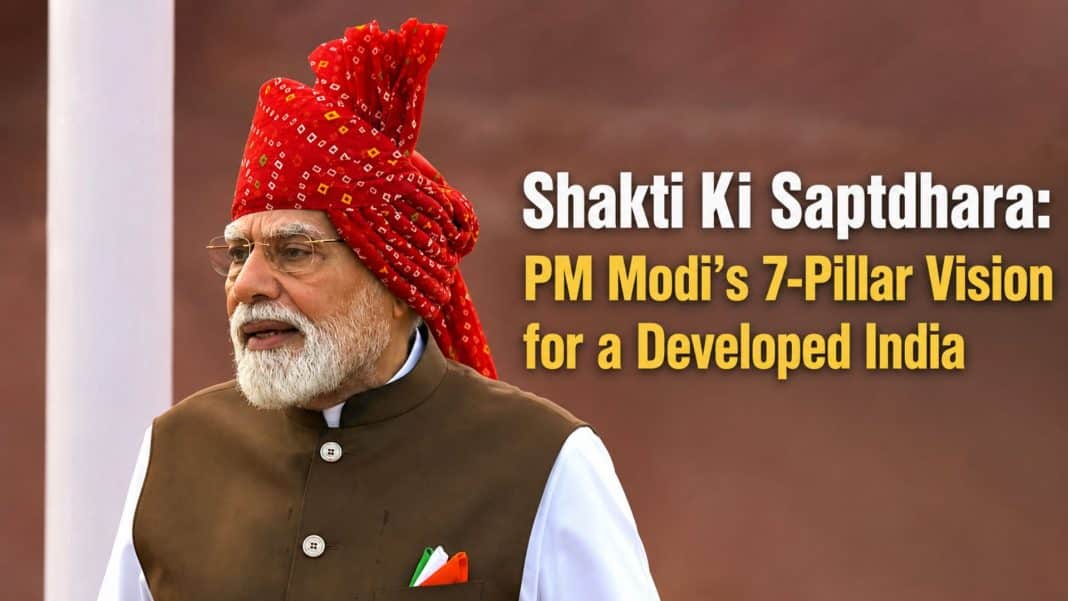

Shakti Ki Saptdhara: During his address to the nation from the ramparts of the Red Fort on the 80th Independence Day, Prime Minister Narendra Modi unveiled a comprehensive roadmap for transforming India into a fully developed nation (Viksit Bharat).
At the core of this ambitious roadmap lies ‘Shakti Ki Saptdhara’ a strategic integration of seven key national strengths designed to accelerate economic, technological, and strategic growth over the next decade.
Emphasizing that India is moving on a “Reform Express,” PM Modi stated that the country must now transition into “Next-Level Reforms.”
According to official media coverage of the address, achieving these milestones over the next 5 to 7 years will require structural shifts across government, industry, agriculture, and broader society.
Here is a detailed breakdown of the seven pillars defining India’s new growth paradigm.
1.Manufacturing Power: Focus on Cost, Quality, and Scale
Shakti Ki Saptdhara: India’s push toward becoming a global manufacturing hub forms the first stream of the vision. Beyond merely expanding output, the target is to build end-to-end value chains within the country from initial product design to final assembly.
As noted in news reports of the speech, PM Modi laid out three fundamental metrics for Indian industry: Cost, Quality, and Scale.
Zero Defect, Precision Manufacturing: Industry leaders, MSMEs, and entrepreneurs are urged to adopt zero-defect standards to establish global trust.
Global Supply Chains: The goal is to position India as a reliable alternative in global supply architecture through competitive pricing and superior packaging.
2.Agriculture and Food Production: Linking Farms to Global Markets
Shakti Ki Saptdhara: The second pillar links rural production to international commerce. With expanded access through various trade agreements, the strategy shifts agriculture from basic cultivation to advanced food processing and direct exports.
Global Standards: Indian agricultural products ranging from traditional grains and spices to fruits and millets are being aligned with global quality parameters.
Chemical-Free Farming: Highlighting the rising global demand for organic produce, the roadmap encourages chemical-free agricultural practices to unlock premium export markets.
3.Technology and Innovation: Moving from Consumer to Creator
The third stream centers on emerging technologies, emphasizing that India must not remain just a consumption market for foreign products, but a global hub for innovation.
Next-Gen Tech: Focus areas include Artificial Intelligence (AI), quantum computing, robotics, space exploration, and data center infrastructure.
Digital Public Infrastructure (DPI): Building on the success of UPI, India aims to export its digital public frameworks globally while leading the push toward nationwide deployment of “Made in India 6G” communications.
4.Gati Shakti: Seamless Multimodal Infrastructure
The fourth pillar focuses on domestic connectivity to lower logistics costs and accelerate transit speeds across urban and industrial corridors.
Integrated Networks: Plans involve connecting major population centers through high-speed rail, modernized highway networks, inland waterways, and expanded airport infrastructure.
Port-Led Development: Maritime ports are designated to evolve beyond cargo handling hubs into centers for broader regional economic growth and industrial clustering.
5.Defense Power: Achieving Strategic Autonomy
The fifth stream addresses national security and indigenous defense manufacturing. As highlighted by media outlets reporting on the speech, India aims to eliminate reliance on defense imports by developing next-generation technologies domestically.
Next-Gen Systems: Priorities include the development of autonomous drone capabilities, counter-drone systems, and hypersonic defense networks.
Cybersecurity: Utilizing domestic technical talent to safeguard critical digital infrastructure while emerging as a global supplier of defense hardware.
6.Green and Blue Economy: Sustainable Growth Platforms
The sixth pillar addresses environmental sustainability alongside ocean-based economic expansion, driving the creation of “green jobs.”
Green Economy: Accelerating investments in green hydrogen, renewable energy storage, clean mobility, and sustainable manufacturing practices.
Blue Economy: Leveraging India’s coastline to expand marine fisheries, ocean technology deployment, and sustainable coastal tourism.
7.Soft Power: Culture, Creativity, and Tourism
The final stream leverages India’s cultural assets, creative industries, and holistic health traditions to strengthen global influence and drive services trade.
Heal in India: Promoting wellness tourism through Ayurveda, traditional medicine, and yoga.
Creative Industries: Harnessing capabilities in digital content, animation, visual effects (VFX), gaming, and media platforms such as the World Audio Visual and Entertainment Summit (WAVES).
Tourism and Events: Expanding infrastructure to boost international tourism across India’s national parks and heritage sites, while positioning the country as a destination for global sports and live entertainment events.
How ‘Shakti Ki Saptdhara’ Transforms India’s Growth Trajectory
The underlying concept of Shakti Ki Saptdhara is a holistic, interconnected model rather than isolated sectoral initiatives.
| Sector Pillar | Primary Operational Focus | Broader Economic Impact |
|---|---|---|
| Manufacturing | Cost, Quality, Scale & Precision | Deepens domestic value chains and builds export trust |
| Agriculture | Food Processing & Chemical-Free Farming | Connects rural farmers directly to global markets |
| Technology | AI, DPI & Made-in-India 6G | Shifts India from a tech consumer to a global innovator |
| Gati Shakti | Multimodal Logistics & Port-Led Growth | Reduces supply-chain costs and accelerates transit |
| Defense | Hypersonics, Drones & Cybersecurity | Builds strategic autonomy and defense-export capacity |
| Green & Blue | Renewable Energy & Marine Resources | Drives sustainable job creation and the clean-energy transition |
| Soft Power | Cultural Exports, VFX & Medical Tourism | Expands global outreach and boosts services-sector revenues |
By integrating these seven streams, the initiative aims to build domestic capacity, expand export capabilities, foster high-tech employment for youth, and establish a self-reliant economy equipped for long-term global competitiveness.