


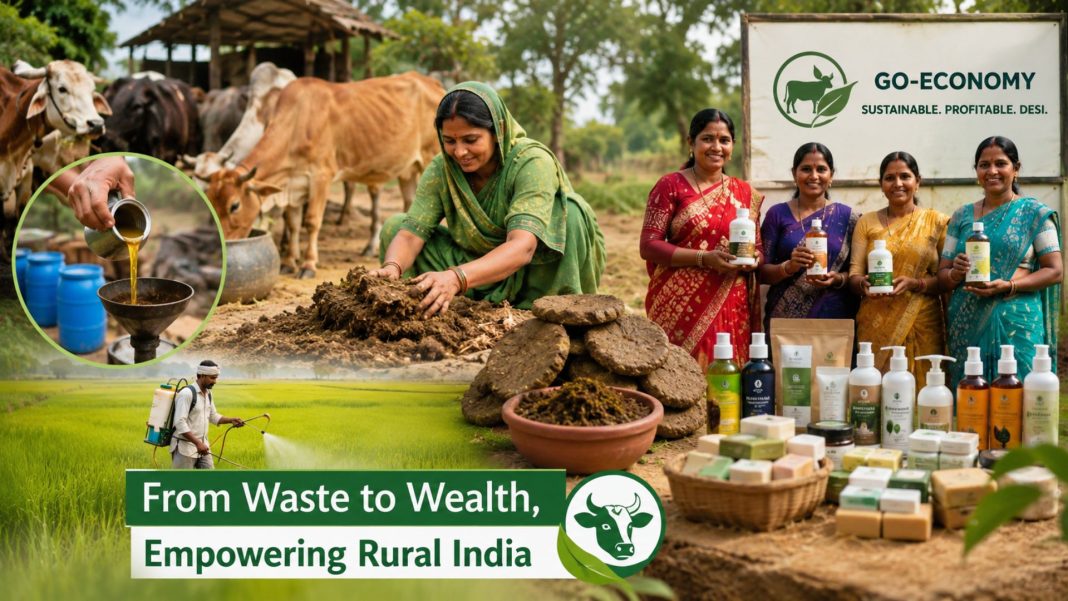

UP’s Booming ‘Go-Economy’: For years, conversations around indigenous cattle, cow dung, and cow urine were frequently met with skepticism or dismissive humor.
However, ground-level developments in northern India are painting a completely different picture one centered on financial self-reliance, green manufacturing, and sustainable agriculture.
According to media reports, Uttar Pradesh is witnessing a rapid expansion of its “Go-Economy.” Rather than viewing cattle maintenance as a financial strain, smallholders and rural entrepreneurs are converting livestock byproducts into a multi-product eco-industry.
From organic fertilizers and biopesticides to personal care items like soaps, shampoos, and distilled extracts (ark), indigenous cattle are increasingly serving as a catalyst for economic empowerment across the state.
The 200-Product Eco-Engine: Beyond Dairy Income
UP’s Booming ‘Go-Economy’: Historically, livestock rearing focused almost exclusively on milk yields. When milk production dipped or ceased, holding onto non-lactating cattle often became financially unviable for small-scale farmers.
As per media reports, indigenous cows are now being repurposed as a comprehensive economic asset:
Dairy Profits: Daily revenue generated from milk sales remains the primary baseline income.
Fertilizer Offsetting: Farm-made compost and cow-dung-based organic fertilizers drastically reduce and in many cases eliminate the need for expensive chemical fertilizers like urea and DAP.
Liquid Cash Flow from Byproducts: Raw cow urine, previously discarded, is now sourced directly at the village level, introducing a brand-new daily stream of cash for farmers.
Industry observers note that micro-enterprises across Uttar Pradesh are currently manufacturing nearly 200 distinct commercial products using cow dung and urine.
These eco-friendly products are finding receptive markets not only across Indian urban hubs, where demand for chemical-free personal care items is surging, but also within growing international organic markets.
The Bulandshahr FPO Model: A Blueprint for Micro-Entrepreneurship
UP’s Booming ‘Go-Economy’: The practical viability of this model is best illustrated by recent grassroots initiatives in western Uttar Pradesh.
According to media reports, a successful Farmer Producer Organization (FPO) setup operating across 15 villages in the Bulandshahr district has built a structured procurement supply chain:
Local Collection Units: Micro-collection centers equipped with 200-liter storage tanks have been set up across participating villages.
Direct Purchasing Power: Raw cow urine is purchased directly from farmers at an established rate of ₹10 per liter, providing immediate financial returns.
Women-Led Operations: Approximately 300 local women are actively integrated into this logistics and processing network. They earn a direct commission of ₹2 per liter while also holding equity shares in the FPO itself.
This decentralized framework ensures that value addition occurs at the rural level rather than being siphoned off entirely by urban intermediaries.
Powering the Organic Food Industry and Restoring Soil Health
Beyond personal care products, cow urine and dung serve as the foundational inputs for bio-inputs such as Jeevamrut and Beejamrut natural liquid fertilizers and pest repellents essential to clean agriculture.
The premium organic produce sold in commercial supermarkets relies heavily on these natural soil conditioners.
Synthetic pesticides and chemical fertilizers have degraded soil microbial health across major agricultural belts over recent decades.
By shifting back to natural bio-pesticides derived from cow urine, farmers report improved soil moisture retention, restored earthworm activity, and reduced input costs.
The resulting produce meets strict chemical-residue standards, allowing farmers to command higher retail prices.
Redefining Rural Entrepreneurship and Environmental Resilience
The rapid rise of Uttar Pradesh’s Go-Economy challenges traditional assumptions about rural resource utilization.
What was once dismissed as agricultural waste has been transformed into a dependable income engine that protects topsoil, empowers local women through equity ownership, and lowers the barrier to entry for organic farming.
As media reports indicate, scaling the Bulandshahr FPO model to other districts across Uttar Pradesh could provide a resilient template for rural economic revival turning sustainable waste management into long-term financial security for millions of farming families.
Also Read: Pakistan Hospital Fire: AC Compressor Blast Kills 15 Newborns at PIMS Islamabad