


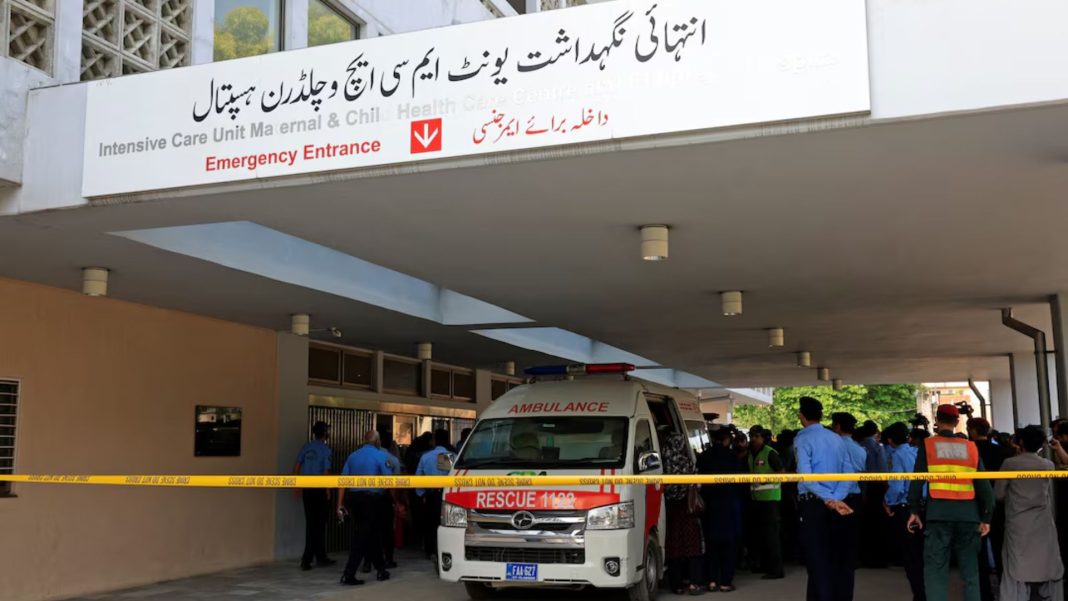

Pakistan Hospital Fire: Imagine sending your newborn into a hospital room hoping for a safe, healthy start to life, only to receive news of an unimaginable catastrophe. This horrific reality struck Islamabad on Wednesday when a devastating fire broke out in the neonatal nursery of the Pakistan Institute of Medical Sciences (PIMS).
The tragedy, triggered by an air conditioner compressor blast, claimed the lives of 15 newborn babies, leaving behind shattered families, grieving parents, and a nation in deep shock.
Out of the 16 innocent infants inside the ward at the time of the incident, only a single child managed to survive. This heart-wrenching disaster has instantly put the spotlight back on hospital safety protocols, infrastructure maintenance, and the urgent need to protect our most vulnerable.
What Exactly Happened at PIMS?
Pakistan Hospital Fire: According to hospital administrators, the fatal incident occurred in the gynecology ward’s nursery unit. The room was designated for intensive newborn care, hosting 16 fragile infants who required constant monitoring and environmental control.
Rescue officials on the scene confirmed that the disaster began when the air conditioner’s compressor exploded. The resulting blast ignited an immediate fire that spread rapidly across the confined ward. Because neonates are completely dependent on medical staff for evacuation, the speed at which the flames traveled left little time for a full rescue operation.
Emergency response teams rushed to the location upon receiving alerts, managing to bring the blaze under control and rescue just one newborn. The sole survivor is currently receiving intensive medical observation. However, the loss of 15 young lives has plunged the entire hospital community and the capital city into mourning.
Why Do AC Compressors Explode? Understanding the Technical Risks
Pakistan Hospital Fire: Air conditioning units are everyday appliances, yet heavy industrial or commercial environments put immense stress on them. Experts point to several core mechanical failures that can turn a cooling unit into a ticking time bomb:
Severe Compressor Overheating: AC outdoor units operate under rigorous thermal conditions. If they run continuously without adequate ventilation or airflow, the internal pressure can spike dramatically, causing the compressor casing to fail or rupture.
Refrigerant Gas Leaks: Modern cooling systems rely on pressurized chemical refrigerants. If corrosion or wear causes a pipe or valve to crack, gas can leak. When exposed to electrical sparks or extreme heat, certain conditions can heighten fire risks.
Electrical Short Circuits & Poor Wiring: Overloaded electrical sockets, aging or frayed wiring, and loose terminal connections frequently trigger sudden short circuits. During peak summer months, running multiple high-power appliances simultaneously pushes local grids and internal panels to dangerous limits.
Neglected Routine Maintenance: Skipping periodic servicing allows dust and grime to clog filters and coils. Restricted airflow forces the internal fan and motor to work twice as hard, pushing internal temperatures up and creating prime conditions for system failures.
Anatomy of PIMS: Islamabad’s Largest Healthcare Facility
The sheer scale of the institution involved makes this tragedy even more staggering. The Pakistan Institute of Medical Sciences (PIMS) is widely recognized as Islamabad’s premier and largest healthcare establishment.
Massive Infrastructure: Spanning roughly 140 acres, the facility houses around 1,300 beds and offers specialized treatments across more than 27 medical disciplines.
Specialized Centers: PIMS integrates several prominent medical wings, including the Islamabad Hospital, the Children’s Hospital, the Burn Care Center, the Cardiac Center, and the Mother and Child Health Center.
The Vulnerable Zone: The specific unit affected, the nursery under the Mother and Child Health wing, is meant to be a secure sanctuary for mothers and infants. Instead, it became the site of a profound failure in safety assurance.
Official Response: Investigation and Accountability
In the wake of the disaster, local administrative authorities moved quickly to initiate an official inquiry.
District management announced the formation of a high-level investigation committee headed by an Additional Deputy Commissioner. The primary mandate of this committee is to inspect the gutted nursery, interview surviving staff, review maintenance logs, and determine the exact sequence of events that led to the compressor blast.
Officials stated that comprehensive accountability will depend entirely on the committee’s findings. The report aims to uncover whether negligence, delayed servicing, or substandard electrical fittings played a part in the accident.
Questions That Demand Answers
Beyond the technical failure of an air conditioning unit, this tragedy raises deep, uncomfortable questions about institutional preparedness:
Where were the fire safety safeguards? In a sensitive zone housing helpless newborns, smoke detectors, automatic sprinkler systems, and fire alarms should have triggered immediately to contain the hazard.
Why wasn’t the electrical or HVAC risk caught earlier? Routine safety audits in pediatric and neonatal wards are non-negotiable. Was the AC unit subjected to regular technical checkups?
How can patient safety be radically overhauled? Families entrust hospitals with their most precious treasures. Incidents like this shatter public confidence and demand strict, uncompromised structural overhauls across public healthcare institutions.
A Wake-Up Call for Healthcare Safety
The heartbreaking loss of 15 innocent infants at PIMS Islamabad is not just a localized accident; it is a profound human tragedy that echoes across borders. As families mourn children who never got a chance to experience the world, the administration faces immense pressure to move past routine inquiries and enforce strict, life-saving safety protocols. Protecting the future generation starts with ensuring that the walls meant to heal them are structurally safe, secure, and rigorously maintained.