



Controversial UN Report on Dawood’s D-Company: In a sharp diplomatic escalation at the United Nations, India has strongly rejected a recent UN report that incorrectly designated the notorious underworld syndicate ‘D-Company’ as an organized crime group operating inside India.
Expressing deep disappointment, Indian representatives emphasized that such glaring inaccuracies undermine the credibility of international bodies and create a misleading narrative about global terrorism networks.
What Triggered India’s Strong Response?
Controversial UN Report on Dawood’s D-Company: The controversy stems from a document drafted by Ben Saul, the UN Special Rapporteur on the promotion and protection of human rights and fundamental freedoms while countering terrorism.
Submitted during the 81st session of the UN General Assembly (UNGA), the report touched upon cross-border crime networks and counter-terrorism measures.
However, a specific passage sparked outrage in New Delhi:
The Claim: The report suggested that the UN Security Council placed the chief of “India-based D-Company” on its sanctions list in 2003 due to ties with Al-Qaeda.
India’s Counter: Indian officials pointed out that labeling D-Company as an “India-based” outfit ignores basic historical facts, most notably, that its leader, Dawood Ibrahim, fled India decades ago to escape justice.
“A Total Distortion of Facts”: India Sets the Record Straight
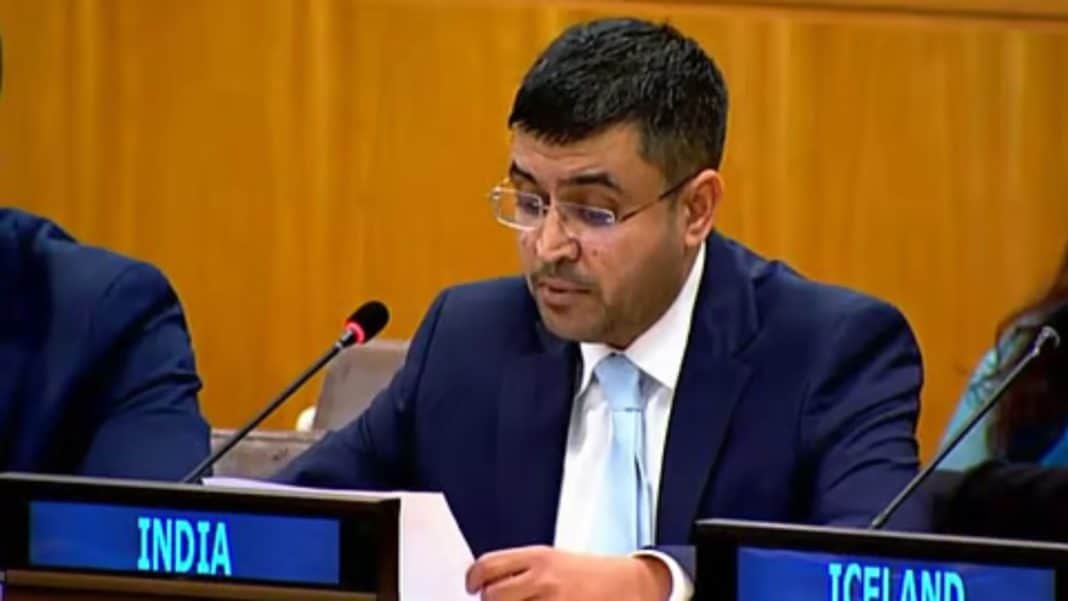
Controversial UN Report on Dawood’s D-Company: Speaking at the UN General Assembly’s Third Committee meeting, Indian representative Raghu Puri delivered a point-by-point rebuttal. He stressed that presenting D-Company as an entity inside India paints a completely false picture for the global community.
Key Historical Facts Highlighted by India:
Wanted Since 1993: Dawood Ibrahim and his criminal network have been wanted in India for their direct role in the 1993 Mumbai serial bomb blasts.
Fled Long Ago: Ibrahim escaped India long before the UN Security Council added him to its sanctions list in 2003.
Al-Qaeda Links Abroad: His designation on the UN sanction list was due to illicit activities and terrorism linkages established while operating from overseas safe havens, not from within India.
Puri noted that omitting these vital details reflects a careless approach to reporting, which ultimately harms the reputation of the United Nations.
The Subtle Jab: Pointing Toward Pakistan
While addressing the gathering, the Indian envoy did not shy away from calling out the actual whereabouts of the underworld don.
India highlighted that official UN sanction lists themselves contain location details pointing directly to the country where former Al-Qaeda chief Osama bin Laden was found and neutralized by U.S. forces in 2011, a clear reference to Pakistan.
India reiterated that terrorist kingpins have long enjoyed state patronage across the border, making claims of D-Company operating out of India not just factually wrong, but absurd.
Allegations of Funding and Conflict of Interest
The dispute has also drawn renewed attention to the author of the report, Professor Ben Saul, an international law expert from the University of Sydney, Australia.
Concerns regarding potential bias and funding sources have surfaced:
UN Watch Findings: In May 2026, watchdog organization UN Watch released a report alleging that the Chinese government provided $150,000 in funding to Ben Saul in 2024.
Questions Over Neutrality: The revelation that Beijing was listed as a primary financial backer has raised eyebrows among diplomats, prompting questions about accountability and objectivity in UN reporting mechanisms.
Human Rights Cannot Be a Shield for Terror: India’s Broader Warning
Beyond the factual errors, India used the platform to deliver a broader warning against the weaponization of human rights narratives by state sponsors of terrorism.
Key Takeaways from India’s Address:
Misusing Norms: Countries that shelter and promote terror networks are increasingly hiding behind human rights frameworks and counter-terrorism regulations to legitimize their actions.
Protecting Extremists: Human rights mechanisms must never be abused to shield radicalizers, financiers, or perpetrators of violent extremism.
Lack of Accountability: Special Rapporteurs frequently issue reports based on unchecked or biased inputs without facing consequences, leaving affected member states with little room to correct damaging narratives once published.
Why This Matters
This diplomatic friction highlights a recurring challenge faced by international institutions: balancing high-level reporting with strict factual verification.
For India, allowing inaccurate descriptions of top terror suspects to slide risks diluting years of global counter-terrorism efforts. By calling out these errors publicly, New Delhi has sent a firm message, misinformation in international reports will not go unchallenged, especially when it involves fugitives responsible for mass civilian casualties.
Also Read : Gen Z Uprising Hits Indonesia: Youth Surge on Streets Over Skyrocketing Living Costs and Forest Fire Crisis