

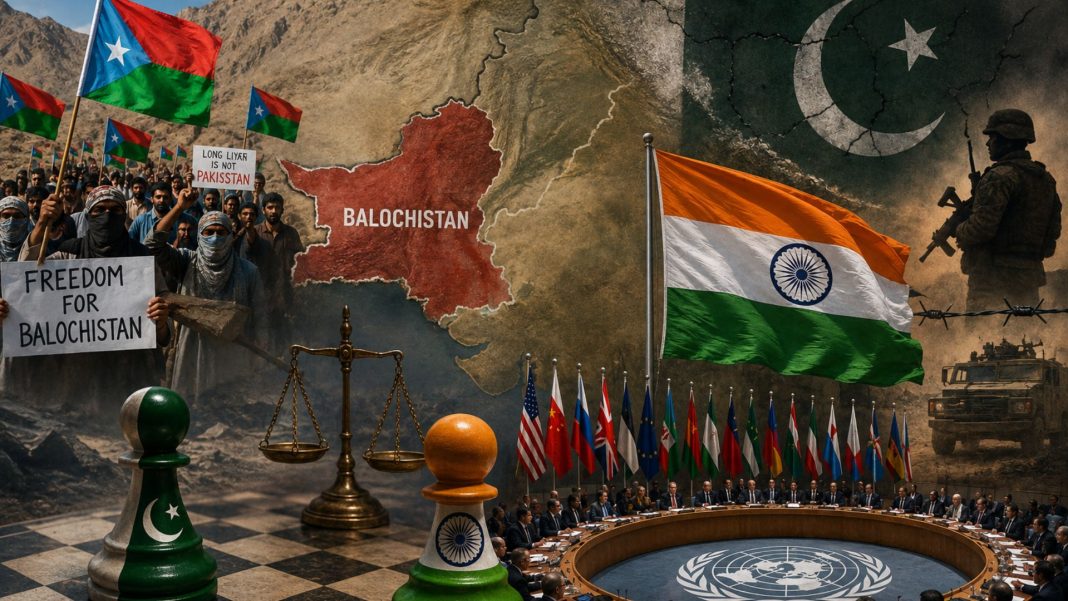

Balochistan’s Independence Claim: In a dramatic escalation that has sent shockwaves through South Asia’s geopolitical landscape, an online declaration has proclaimed the independence of Balochistan from Pakistan.
The announcement, emerging from a suspected compromise or high-impact post on the X handle of self-proclaimed representative Mir Yar Baloch, asserts that the newly declared “Republic of Balochistan” has severed all ties with Islamabad.
While neither international bodies nor the Pakistani government have formally verified the operational ground reality of these claims, the development has instantly refueled an intense global conversation regarding Pakistan’s internal stability, its controversial deep-sea partnerships with China, and the delicate diplomatic tightrope that neighboring India must now walk.
THE BREAKAWAY CLAIM: Flag, Anthem, Currency, and 85% Territory Control
Balochistan’s Independence Claim: The viral document issued by the self-proclaimed administration outlines an astonishingly swift restructuring of the province. According to the statements published online, the transition is already fully operational on the ground.
STATE PROFILE: THE PROCLAIMED “REPUBLIC OF BALOCHISTAN”
- Territory Control: Claims over 85% of Balochistan’s geographic landmass
- National Anthem: “Ma Chuken Balochani” formally adopted
- National Currency: “Balochi Falus” established for local commerce
- National Flag: Newly minted design released online
The letters circulating across digital networks claim that local defense and security forces loyal to the Baloch movement have successfully secured the vast majority of the province. More strikingly, the text alleges that substantial numbers of ethnic Baloch personnel within Pakistan’s military, intelligence, and civil services have resigned their posts to join the ranks of the new administration.
Despite acknowledging a severe lack of heavy military hardware, such as combat aircraft, attack helicopters, tanks, and heavy artillery, the self-proclaimed government maintains it holds absolute structural control over its land. The document boldly states that a force of 500,000 personnel, spanning a newly formed army, navy, air force, and civil bureaucracy, stands fully prepared to permanently evict what it terms “Pakistani occupying forces.”
ECONOMIC TAKE-OVER: Securing the Riches of a Deprived Province
Beyond the political rhetoric, the core of the declaration focuses heavily on resource sovereignty. The new authorities have declared absolute control over Balochistan’s immense natural wealth, which includes:
The Reko Diq & Saindak Mines: World-class deposits of gold, copper, diamonds, and silver.
Sui Gas Fields: The foundational natural gas hubs that have powered Pakistani industries for decades.
Extensive Coal Reserves: Crucial energy assets scattered across the rugged provincial terrain.
For decades, the extraction of these resources has been the focal point of local grievance. Representing nearly 44 percent of Pakistan’s total landmass but housing a mere 6 percent of its population, Balochistan has historically remained the country’s most impoverished zone.
Local Baloch nationalist factions have long argued that consecutive federal governments in Islamabad systematically exploited their mineral wealth while reinvesting virtually nothing into local infrastructure, health, or education.
THE CHINESE FACTOR: CPEC and the Battle for Gwadar Port
A major catalyst behind the timing and intensity of this modern independence push is the multi-billion-dollar China-Pakistan Economic Corridor (CPEC). As the crown jewel of Chinese President Xi Jinping’s global Belt and Road Initiative (BRI), CPEC finds its strategic terminus at the deep-sea port of Gwadar, located along Balochistan’s Arabian Sea coast.
Beijing’s massive investments in Gwadar, which include state-of-the-art naval outposts, specialized mining complexes, and a massive new international airport, have deeply alienated the local populace.
The native Baloch population views these mega-projects not as economic development, but as an aggressive joint exploitation of their ancestral lands by Islamabad and Beijing.
Frequent fears have been voiced that an uncontrolled influx of Chinese engineers, managers, and external Pakistani laborers will permanently turn the indigenous Baloch people into a demographic and economic minority inside their own homeland.
AN APPEAL TO INDIA: “Do Not Call Us Pakistan’s Own People”
In a highly calculated move, the digital declaration contained an explicit, emotionally charged appeal directed squarely at the citizens, mainstream media, and strategic community of India.
The Direct Message to Indian Media and Intellectuals:
“Dear Indian patriotic media, YouTube peers, and intellectuals fighting for the defense of India, please refrain from calling the Balochs ‘Pakistan’s own people.‘ We are not Pakistanis; we are Balochistanis. Pakistan’s own people are the Punjabis, who have never faced aerial bombings, enforced disappearances, and genocide.”
This public plea attempts to separate the Baloch identity entirely from the Pakistani state narrative, relying heavily on historical grievances concerning human rights violations, structural marginalization, and the controversial military campaigns conducted by the Pakistani armed forces in the region since the forced accession of the princely state of Kalat in 1948.
THE DIPLOMATIC DILEMMA: Why New Delhi Must Tread Carefully
While the appeal to India has gained massive traction across social platforms, foreign policy experts and geopolitical analysts urge absolute caution for New Delhi. Embracing or recognizing a breakaway Baloch state presents a minefield of severe strategic risks for India:
- The Kashmir Equivalency Trap
Formally recognizing Balochistan would immediately allow Islamabad to accuse New Delhi of directly interfering in the sovereign internal affairs of a neighbor. Geopolitical strategists warn this would give Pakistan the perfect leverage to create a false equivalency with the Kashmir issue on international forums, muddying India’s long-standing legal and diplomatic positions.
- Destabilizing the Fragile Sino-Indian Thaw
Following the highly volatile 2020 Galwan Valley military clash, India and China have only recently begun stabilizing their diplomatic and trade relations. Actively supporting a movement that explicitly threatens China’s prized CPEC infrastructure in Gwadar would inevitably trigger severe retaliation from Beijing, potentially reigniting active hostilities along the Line of Actual Control (LAC).
- Fraying Ties with Iran
The wider geographic region of Balochistan spans across international borders into neighboring Iran. The Islamic Republic faces its own internal challenges regarding Baloch militancy and has strictly warned against any external support for Baloch separatism. India, which has invested heavily in Iran’s Chabahar Port to secure an economic gateway to Central Asia, cannot afford to alienate Tehran by backing an unpredictable ethno-nationalist state movement next door.
PROGNOSIS: A Waiting Game Amid Deepening Instability
As the dust settles on this digital declaration of independence, the immediate future of the region remains highly volatile. The Pakistani military establishment has historically responded to provincial dissent with immense kinetic force, meaning any perceived escalation on the ground will likely result in an intensification of security sweeps, lockdowns, and counter-insurgency operations throughout the southwest.
For the international community, the situation demands watchful waiting. Until tangible territorial control is visibly demonstrated outside of digital declarations, the “Republic of Balochistan” remains a profound, highly combustible ideological challenge to the borders of South Asia, one that threatens to rewrite the security dynamic between Pakistan, China, and India.
Also Read : Hormuz Crisis: Will Global Oil Trade Grind to a Full Halt After US Airstrikes and Iranian Retaliation?