


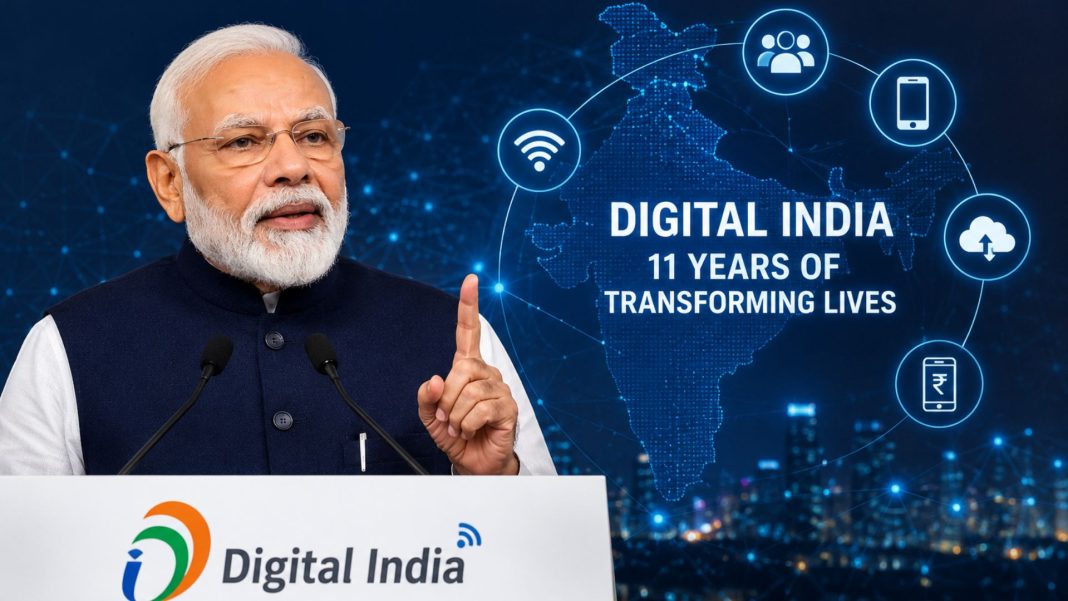

Digital India Completes 11 Years: India’s flagship Digital India programme has completed 11 years, marking a significant milestone in the country’s digital transformation journey.
On the occasion, Prime Minister Narendra Modi said the initiative has gone beyond making technology convenient and has become a powerful tool for empowering millions of citizens.
Launched on July 1, 2015, the Digital India programme aims to improve digital infrastructure, expand internet access, promote digital governance, and make government services more accessible to people across the country.
Over the past decade, the initiative has played a major role in expanding digital payments, online public services, and internet connectivity, particularly in rural and semi-urban areas.
Highlighting the programme’s achievements, the Prime Minister said Digital India has changed the way citizens interact with government services while creating new opportunities for innovation, entrepreneurship, and economic growth.
PM Modi Highlights 11 Years of Digital Progress
Digital India Completes 11 Years: In a series of posts on social media platform X, Prime Minister Modi described Digital India as a strong foundation for building a developed and self-reliant India.
He said the initiative has redefined governance by making public services more transparent, efficient, and accessible.
According to the Prime Minister, technology is no longer limited to providing convenience but has become a means of empowering ordinary citizens.
He also noted that services such as digital payments, Direct Benefit Transfer (DBT), and Digital Public Infrastructure have significantly improved the ease of living for people across the country.
According to the Prime Minister, Digital India has helped reduce paperwork, improved transparency in government schemes, and enabled citizens to access several public services without visiting government offices.
How Digital India Has Changed Everyday Life
Digital India Completes 11 Years: Over the last 11 years, Digital India has introduced several digital platforms and services that have become part of daily life for millions of Indians.
Today, citizens use smartphones and internet-based platforms for banking, utility payments, education, healthcare appointments, document verification, and accessing government welfare schemes.
The rapid growth of the Unified Payments Interface (UPI) has been one of the programme’s most visible achievements. Digital payment systems have become widely accepted by businesses of all sizes, from large retailers to neighbourhood shops and street vendors.
The expansion of digital services has also helped improve financial inclusion by allowing more people to access banking services through mobile devices.
Government initiatives such as DigiLocker, CoWIN, Aadhaar-enabled services, and various online citizen portals have further simplified access to public services.
Focus on Rural Connectivity and Digital Inclusion
One of the key objectives of Digital India has been to bridge the digital divide between urban and rural India.
According to government information, the programme has expanded broadband connectivity through optical fibre networks while increasing internet access in villages.
As digital infrastructure has improved, more citizens in rural areas have started using online services for education, healthcare, agriculture, banking, and government benefits.
The Prime Minister said Digital India has ensured that innovation is no longer limited to metropolitan cities. According to him, entrepreneurs, startups, and innovators from Tier-2, Tier-3 cities and rural regions are increasingly contributing to India’s digital economy.
Boost for Startups, Innovation and Emerging Technologies
PM Modi also highlighted the programme’s role in strengthening India’s startup ecosystem.
According to him, Digital India has encouraged innovation by providing young entrepreneurs with better access to technology, digital platforms, and new business opportunities.
He said India’s progress in digital infrastructure has also strengthened the country’s position in emerging technologies, including Artificial Intelligence (AI), semiconductors, and quantum computing.
The Prime Minister expressed confidence that continued investment in digital innovation would create new employment opportunities while supporting India’s long-term economic development.
Government Says Digital Governance Has Improved Transparency
According to the government, Digital India has made governance faster and more transparent by shifting many public services to online platforms.
Digital delivery of welfare schemes, electronic documentation, online grievance systems, and direct transfer of benefits into beneficiaries’ bank accounts have reduced delays and improved accountability.
Officials also say that the growing use of Digital Public Infrastructure has helped streamline service delivery while reducing dependence on physical paperwork.
The Road Ahead
As Digital India enters its second decade, the government plans to further strengthen digital infrastructure while expanding the use of advanced technologies across different sectors.
According to the Prime Minister, future efforts will focus on ensuring that technology continues to improve the quality of life for citizens while supporting inclusive and sustainable development.
He said India’s digital journey will continue to encourage innovation, create new opportunities for young people, and strengthen the country’s position as one of the world’s leading digital economies.
While the long-term impact of Digital India will continue to evolve, the programme has become one of the government’s most significant digital initiatives, influencing governance, financial services, education, healthcare, and entrepreneurship over the past 11 years.
As India moves toward greater adoption of Artificial Intelligence, secure digital infrastructure, and next-generation technologies, Digital India is expected to remain a central pillar of the country’s digital development strategy.
“According to government data and official statements, Digital India has expanded digital access and public service delivery. Independent experts, however, note that challenges such as digital literacy, cybersecurity, internet accessibility in remote areas, and data privacy continue to require sustained attention.”
Also Read: Indian Sailor’s Body Returned from Venezuela: Family Alleges Missing Vital Organs, FSUI Seeks Probe