



New Military Crisis in Asia: The volatile 2,600-kilometer Durand Line dividing Pakistan and Afghanistan has officially transformed from a site of seasonal border skirmishes into a full-scale, active conventional military conflict.
Years of deep-seated distrust, counter-terrorism disputes, and historical territorial denials have finally pushed Islamabad and the Taliban administration in Kabul past the point of diplomatic return.
With both nations launching cross-border drone strikes, precision aerial bombings, and heavy artillery barrages hitting cities deep within each other’s territories, international observers warn that South Asia is staring at an uncontained regional crisis.
The July Escalation: Drones, Denials, and Deadly Cross-Border Strikes
New Military Crisis in Asia: The latest flare-up escalated into a major military confrontation following coordinated actions by both the Pakistani Armed Forces and the Afghan Taliban’s newly operationalized defense units.
Sky Warfare in Balochistan
The Pakistani military confirmed that its integrated air defense networks intercepted and shot down four surveillance and combat drones traversing the southwestern province of Balochistan from Afghan airspace. In the Saranan district, the debris from a neutralized drone struck near a local government school, injuring two civilians and causing widespread panic.
Kabul’s Audacious Airstrikes
In an unprecedented military response, the Afghan Taliban’s Ministry of Defense announced it had carried out retaliatory airstrikes inside Pakistani territory. Kabul claimed its operations successfully targeted an active Islamic State (ISIS) operational hub in Saranan, Balochistan, while simultaneously striking coordinates across the volatile Khyber Pakhtunkhwa (KPK) province.
Under current operational tactics, the previous reliance on standard border guards has shifted. The Taliban is using its expanding fleet of drones and legacy aircraft to target areas in Balochistan and KPK, while the Pakistani military deploys advanced air defense systems and fighter jets to hit targets in eastern Afghan provinces like Paktia, Paktika, and Kunar.
The Asymmetric Air Force
While Afghanistan lacks a modern, Western-style conventional fighter jet fleet, data compiled by the London-based International Institute for Strategic Studies (IISS) reveals the Taliban has built a functional air wing. Reconstructed from hardware abandoned during the 2021 U.S. withdrawal, Kabul commands at least six fixed-wing aircraft and 23 military helicopters. This fleet is heavily augmented by an expanding stockpile of low-cost, weaponized commercial and military drones.
Retaliation for Karachi: How ‘Operation Ghazab-lil-Haq’ Shattered the Peace
New Military Crisis in Asia: The current phase of open hostility was triggered by a high-profile insurgent attack in Pakistan’s economic capital, Karachi, which shattered an already fragile, internationally brokered ceasefire.
The Rangers Headquarters Attack
On June 27, heavily armed insurgents launched a coordinated assault using suicide vests, automatic weapons, and hand grenades against the paramilitary Sindh Rangers Headquarters in Karachi. The attack left three paramilitary personnel dead and four others critically wounded.
The TTP Connection
Islamabad directly blamed the strike on Jamaat-ul-Ahrar, an aggressive faction operating under the umbrella of the TTP (Tehrik-e-Taliban Pakistan). Pakistani intelligence asserted that the logistics and commands for the Karachi operation originated directly from sanctuaries inside eastern Afghanistan.
Pakistan’s Fierce Response
In immediate retaliation, Pakistan launched a massive combined air and ground offensive targeting Afghanistan’s eastern border belt, focusing heavily on Paktia, Paktika, and Kunar provinces.
Federal Information Minister Attaullah Tarar announced that security forces neutralized 25 heavily armed insurgents and systematically demolished major ammunition depots during precision strikes.
Concurrently, a sweeping ground operation in Pakistan’s border district of Bajaur led to the elimination of four senior Jamaat-ul-Ahrar operatives. The TTP later confirmed that a prominent regional commander, Khan Firosh (known as Jabul), was killed during the fighting.
The Human Toll: Rising Civilian Casualties and UN Warnings
As the conflict spreads past isolated border checkpoints into populated rural villages, the humanitarian cost of the escalation is drawing sharp criticism from international monitors.
Conflicting Casualty Figures
While Pakistan maintains that its operations exclusively target active terrorist training camps, the United Nations Assistance Mission in Afghanistan (UNAMA) issued a grim assessment. UNAMA confirmed that airstrikes have killed at least 28 civilians and wounded 49 others, noting that the death toll is expected to rise as local hospitals run out of emergency medical supplies.
Afghan government spokesperson Hamdullah Fitrat provided a much higher casualty count, stating that the ongoing bombardments resulted in the martyrdom of 38 Afghan citizens alongside 163 individuals wounded, a significant majority of whom are women and children.
The Trapped Rescuers of Paktia
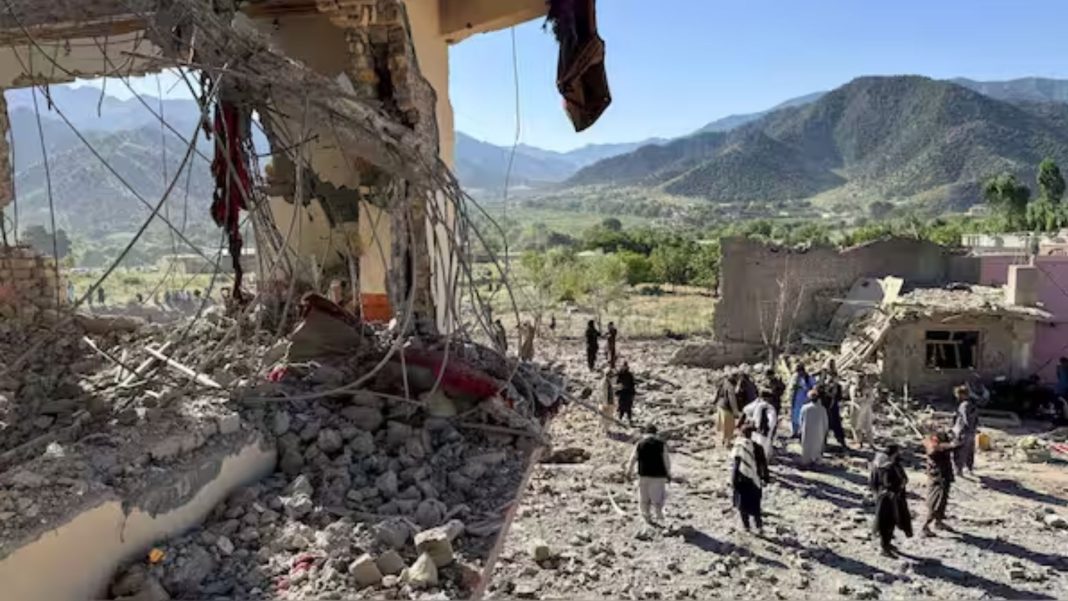
Local administrative officials in Paktia province reported that a heavy airstrike leveled a multi-family residential compound, trapping dozens of people beneath the rubble.
According to local reports, a secondary strike targeted the site shortly after, hitting local villagers who had rushed to the scene to dig out survivors from the first blast. In response, Afghanistan’s Deputy Information Minister Mohajir Farahi issued a televised warning, stating that this specific attack will undoubtedly be avenged at an appropriate time and place.
The Roots of Rage: TTP Sanctuaries and the Unresolved Colonial Border
To understand why these two neighbors are locked in a combat spiral, one must examine the deep structural disputes that have plagued their relationship for decades.
The TTP Threat Matrix
Pakistan’s primary national security threat is the TTP, an ideologically driven insurgent group committed to overthrowing Islamabad’s democratic and military structure to establish a hardline Islamic state. While the Afghan Taliban and the TTP operate as separate administrative entities, they share deep tribal, historical, and ideological roots.
Pakistan argues that Kabul provides tactical depth and safe havens to TTP fighters, who launch cross-border attacks into Pakistan and then retreat to safety. The scale of this threat is reflected in Pakistan’s internal security data from 2025, which shows that TTP-linked attacks claimed the lives of more than 660 member of the security forces and over 580 civilians. Kabul firmly rejects these accusations, labeling the TTP insurgency as an internal Pakistani security failure that has nothing to do with Afghan soil.
The Durand Line Friction
The underlying geopolitical issue is the Durand Line, a 2,600-kilometer boundary drawn in 1893 by British colonial administrator Sir Mortimer Durand. Pakistan views this line as its definitive, internationally recognized sovereign border. However, no Afghan government in history, including the current Taliban regime, has ever legally recognized it.
Kabul contends that the colonial border artificially cuts through the historic Pashtun tribal homeland. Pakistan’s multi-million-dollar project to install heavy chain-link fencing and fortified border towers along the line has led to regular, direct firefights between the two standing armies.
Failed Mediations: Why Regional Diplomatic Efforts are Collapsing
The breakdown of multiple international peace initiatives shows just how deeply entrenched both sides have become.
The Collapse of the Ceasefire
Last October, border clashes escalated to a point where Pakistan executed long-range airstrikes deep into Afghanistan, prompting an emergency diplomatic intervention led by Qatar.
While high-level talks in Doha and Istanbul managed to secure a temporary ceasefire, the peace was fundamentally flawed. Pakistan demanded the unconditional handover of active TTP commanders, while the Taliban refused to acknowledge their presence, causing the truce to fall apart completely.
The Modern Theatre of War
Following a wave of suicide bombings inside Pakistan, Islamabad permanently abandoned the ceasefire in February, declaring a state of “Open War” and launching Operation Ghazab-lil-Haq.
Initially, the fighting remained limited to isolated skirmishes at mountain outposts. It quickly evolved into heavy artillery exchanges across major border towns.
By March, the war reached a critical stage when Pakistani aircraft struck targets as deep as Kabul, Kandahar, and Bagram Airfield, which Afghan forces answered by using drones to strike military zones near Rawalpindi and Quetta.
Even global powers are struggling to contain the fallout. Following the latest round of strikes, Russia’s Ministry of Foreign Affairs issued an urgent appeal for restraint, calling the escalation a tragic development and urging both sides to return to political and diplomatic channels before the crisis destabilizes the wider Central Asian region.
The Strategic Outlook: Full-Scale Invasion or Endless Attrition?
Despite the alarming rhetoric and deep-penetration airstrikes, military analysts believe a total ground invasion remains unlikely due to severe structural constraints on both sides.
Pakistan’s Economic Gridlock
Pakistan is currently navigating an intense economic crisis marked by high inflation and tight fiscal deficits. Launching a full-scale conventional ground invasion and attempting to hold territory inside Afghanistan would be an unsustainably expensive military campaign that Islamabad’s treasury cannot afford.
Taliban’s Material Limitations
On the other side, while the Taliban excels at cross-border insurgent warfare, drone operations, and targeted artillery strikes, it lacks the heavy mechanized armor, logistics chains, and advanced air supremacy required to capture and hold major cities inside a nuclear-armed state like Pakistan.
The New Normal of Border Warfare
Instead of large-scale troop movements across the border, the conflict is settling into a dangerous pattern of high-tech attrition. The true danger lies in the expansion of the target zones; urban centers like Karachi, Rawalpindi, Kabul, and Kandahar, once completely insulated from border tensions, are now active targets.
As long as Islamabad views the eradication of the TTP as a non-negotiable national security objective, and Kabul refuses to alter its stance on the Durand Line, the border will remain an active combat zone. For now, South Asia must brace itself for a prolonged, volatile war of attrition along one of the world’s most dangerous geopolitical fault lines.
Also Read : India-Japan Summit 2026: Why is the World Watching This Historic Meeting?