


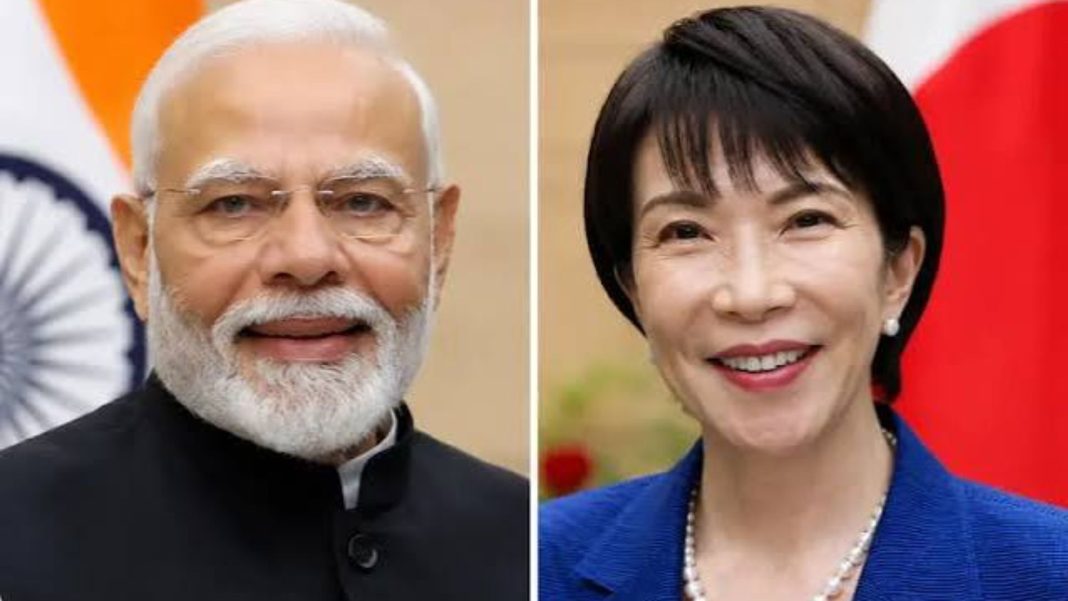

India-Japan Summit 2026: The arrival of Japanese Prime Minister Sanae Takaichi in New Delhi on July 1, 2026, marks a pivotal moment in Asian geopolitics. Choosing India as her first official bilateral destination after taking office underscores the profound strategic weight Tokyo places on New Delhi.
Occurring less than a year after Indian Prime Minister Narendra Modi’s visit to Tokyo, where Japan committed to doubling its investment target in India to over $61 billion, this summit transitions a historical friendship into a hard-hitting economic and security alliance.
The Tech Hegemony: Why AI and Silicon Form the Summit’s Core
India-Japan Summit 2026: For both New Delhi and Tokyo, Artificial Intelligence (AI) and advanced technology are no longer just commercial sectors; they are the bedrock of future national sovereignty and economic competitiveness.
From Algorithms to Economic Security
The most anticipated outcome of this summit is a Joint Statement on AI Cooperation, paired with a Joint Declaration on Economic Security Cooperation. This reveals a major paradigm shift: technology is now officially viewed through the lens of national security.
The two nations are moving away from consumer-grade software toward Industrial AI systems designed to safeguard critical infrastructure and automate advanced manufacturing.
Fortifying the Semiconductor Shield
The global supply chain shocks of recent years highlighted deep vulnerabilities in the microchip ecosystem. Semiconductors are the lifeblood of everything from everyday smartphones to high-tech missile defense systems.
The Goal: Accelerate the long-term technology roadmap established last year.
The Strategy: Diversify the raw material pipeline and co-develop robust semiconductor manufacturing hubs in India, insulating both nations from geopolitical choke points.
The Rare Earth Elements (REE) Factor: The summit places heavy emphasis on breaking the monopoly over rare minerals. These materials are non-negotiable for electric vehicles (EVs), renewable energy grids, and defense hardware.
De-Dollarizing Bilateral Trade: The Yen-Rupee Mechanism
Perhaps the most radical structural shift on the table is the proposed framework for direct trade settlement in Japanese Yen and Indian Rupees, bypassing the traditional intermediary, the US Dollar
The High Cost of the Greenback
Currently, when a Japanese firm exports automotive parts to India, a double-currency conversion occurs. First, the Japanese exporter converts Yen to Dollars. Then, the Indian importer buys those Dollars with Rupees to finalize the transaction.While giant multinationals can absorb these conversion fees and hedge against currency volatility, Small and Medium Enterprises (SMEs) find these extra steps financially prohibitive.
Direct Settlement Infrastructure
Under the new framework, Japanese non-resident entities will be permitted to open direct accounts in Indian commercial banks. This allows cross-border invoices to be settled instantly in Yen and Rupees, entirely removing the need for a US Dollar intermediary.
This move aligns with a growing global trend toward local-currency trade. It builds upon an existing $75 billion bilateral currency swap agreement (extended to 2026), which acts as a liquidity safety net during financial crises. To solidify this, Japan’s Finance Ministry is actively working with the Reserve Bank of India (RBI) on a formal Memorandum of Cooperation.
The Trade Imbalance: Navigating the $15 Billion Deficit
While political ties are at an all-time high, the commercial balance sheet reveals a structural asymmetry that both leaders are eager to address.
The Numbers Game
In the 2025–2026 fiscal year, bilateral trade reached $27.47 billion. However, the scale heavily favors Japan. India’s exports to Japan stood at $6.04 billion, while Japan’s exports to India reached $21.43 billion, resulting in a $15.39 billion trade deficit for India.
This structural gap exists because India primarily exports lower-margin commodities and components, such as organic chemicals, marine products, aluminum, and basic auto parts. In contrast, Japan exports high-value, high-margin industrial goods, including heavy machinery, nuclear reactor components, electrical equipment, and advanced steel.
Breaking Down Non-Tariff Barriers
The Comprehensive Economic Partnership Agreement (CEPA), active since 2011, eliminated duties on over 94% of traded goods. Yet, Indian exporters still struggle with Japan’s notoriously strict non-tariff barriers, particularly stringent phytosanitary (plant health) standards that limit Indian agricultural and marine exports. Resolving these bureaucratic roadblocks is a top priority for Indian negotiators.
Corporate Footprints: The Evolution of Japanese Investment
The nature of Japanese money entering India has fundamentally shifted from public development aid to aggressive private sector expansion. Following the successful completion of a 5-trillion-yen investment target, the nations have set a massive new goal: 10 trillion yen (approximately $67–68 billion) over the next decade via private sector investments.
The Corporate Delegation
Prime Minister Takaichi did not arrive alone. She is accompanied by a powerful corporate delegation led by Toshihiro Suzuki, President of Suzuki Motor Corporation, alongside 50 major executives and startup founders. Suzuki is anchoring the India-Japan Business Forum to ensure diplomatic promises translate directly into factory floors.
Overcoming Ground-Level Hurdles
Despite the success of eight dedicated Japan Industrial Townships (JITs), like Neemrana in Rajasthan and Sri City in Andhra Pradesh, Japanese firms are raising critical concerns.
Administrative delays remain a challenge, specifically slow land acquisition and multi-layered state-level approvals. Business leaders are lobbying hard for a unified, simplified single-window clearance mechanism.
Intellectual property protection is another area of concern. Japanese pharmaceutical and electronics firms have expressed unease over the length of Indian patent litigations, which can drag on for four to six years. This delay makes firms hesitant to transfer their most advanced proprietary technologies to Indian subsidiaries.
Beyond Automobiles: New Frontiers in Finance and Infrastructure
While the Suzuki-Maruti partnership remains the historic symbol of this alliance, the economic relationship is diversifying rapidly into banking, clean energy, and bullet trains.
The Banking Boom
In a striking departure from traditional infrastructure lending, Japanese financial titans are buying directly into the Indian banking sector. A prime example is the recent $1.6 billion strategic transaction, where a prominent Japanese financial group acquired a 20% stake in Yes Bank, signaling immense confidence in India’s consumer credit market.
Infrastructure and the Northeast Connection
The Japan International Cooperation Agency (JICA) continues to bankroll India’s mega-projects. The marquee Mumbai-Ahmedabad High-Speed Rail Corridor (the Bullet Train project) remains a flagship symbol of Japanese engineering in India.
Simultaneously, Japan is investing heavily in India’s strategically sensitive Northeast region. By funding critical road networks and the massive Dhubri-Phulbari bridge over the Brahmaputra River, destined to be one of India’s longest river bridges, Tokyo is directly helping New Delhi counter regional isolation and boost cross-border commerce with Southeast Asia.
The Clean Energy Transition
Under the bilateral Clean Energy Partnership (CEP), automotive giants like Toyota and Suzuki are partnering with Indian firms to build domestic supply chains for electric vehicles (EVs), next-generation hybrid battery technologies, and green hydrogen production.
Solving Japan’s Demographic Crisis with Indian Talent
One of the most elegant aspects of the India-Japan alliance is the perfect intersection of their contrasting demographic profiles. Japan is facing an unprecedented aging crisis, while India possesses the world’s largest youth bulge.
Japan’s shrinking, aging workforce is projected to create a shortage of roughly 790,000 IT and software professionals by 2030. Conversely, India produces 1.5 million engineering graduates per year and needs high-skill global employment avenues for its youth.
Tech Alliances and Global Capability Centers (GCCs)
Indian tech giants like TCS, Infosys, and Wipro have scaled up their operations inside Japan to plug the software talent gap. Concurrently, Japanese corporations are rushing to set up Global Capability Centers (GCCs) in India for R&D, software development, and advanced engineering. There are now roughly 60 Japanese GCCs operating in India, marking a staggering 130% increase over the last four years.
The Human Resource Exchange Action Plan
The two governments have operationalized an ambitious plan to facilitate the exchange of 500,000 personnel over five years, focusing on engineers, skilled blue-collar workers, and tech professionals. To bridge the cultural divide, the Japan-India Institute for Manufacturing (JIM) is actively training 30,000 Indian professionals in Japanese language skills and corporate work culture.
The Indo-Pacific Chessboard: Navigating Maritime Tensions
While economics dominate the headlines, the undercurrent of the summit is undeniably maritime security and regional containment.
The New FOIP Strategy
Prime Minister Takaichi brought Japan’s updated Free and Open Indo-Pacific (FOIP) strategy to the table, which was revised just months ago in May.
The previous iteration focused heavily on the Bay of Bengal, but the updated framework shifts significant attention toward the Western Pacific. This directly reflects the escalating maritime frictions and security re-alignments observed late last year.
As core members of the Quad alongside the US and Australia, both nations are tightening their naval coordination, intelligence sharing, and cyber-defense standards to preserve a rules-based order in vital sea lanes.
A Logistic Consolidation
Interestingly, the summit was originally slated to take place in Guwahati, Assam, highlighting Japan’s deep involvement in India’s Northeast. However, due to tight parliamentary schedules and domestic legislative commitments within the Japanese Diet, the entire itinerary was consolidated into a high-powered, focused program in New Delhi.
The Verdict
The 2026 India-Japan Summit demonstrates that the alliance has matured past romantic rhetoric about shared democratic values. It is now a pragmatic, deeply integrated partnership.
By binding together Japan’s financial muscle and technological precision with India’s massive market, demographic vitality, and manufacturing ambitions, Modi and Takaichi are constructing an indispensable economic and security pillar capable of reshaping the modern Indo-Pacific.
Also Read : MOSCOW UNDER FIRE: Russia Claims 419 Ukrainian Drones Downed in Massive Overnight Blitz