


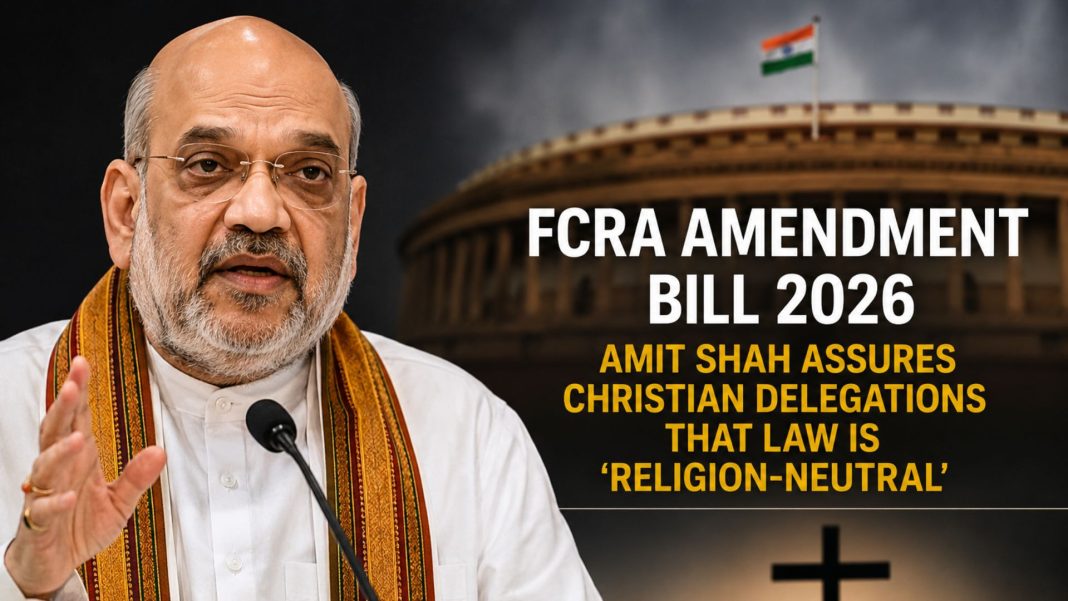

FCRA Amendment Bill 2026: In an effort to address growing apprehensions among minority institutions, non-governmental organisations (NGOs), and faith-based groups regarding the proposed Foreign Contribution (Regulation) Amendment Bill, 2026, Union Home Minister Amit Shah held high-level discussions with representatives of various Christian denominations and civil society delegations.
During the meeting held at the Parliament House complex, the Home Minister offered firm assurances that the upcoming legislation is entirely “religion-neutral” and aimed strictly at enforcing legal compliance and financial transparency across all organisations receiving overseas donations.
According to media reports, the Home Minister clarified that the Centre has no intention of harassing any religious community or impeding genuine philanthropic operations.
The legislative proposal, which is slated to be taken up for detailed discussion in Parliament on August 12, 2026, has stirred widespread debate between policymakers advocating for national security safeguards and critics highlighting potential administrative overreach.
Key Assurances Issued by the Home Minister
Has the FCRA Amendment Bill 2026 passed? As reported by media sources, the interaction involved an 18-member delegation representing major Christian traditions including Catholic, Protestant, and Orthodox churches under the aegis of the Joint Action Forum on Minorities.
Mizoram Chief Minister Lalduhoma also separately accompanied a delegation of church leaders to discuss the legislative provisions with the Centre.
During the hour-long deliberation, Union Home Minister Amit Shah provided several key clarifications to allay fears within the community:
No Retrospective Application: The provisions of the FCRA Amendment Bill, 2026 will be applied prospectively and will not retroactively affect past transactions or historical land acquisitions made by registered entities.
Universal Enforcement: The Home Minister emphasized that the law targets individuals or bodies that violate statutory rules regarding foreign contribution usage, irrespective of their faith or ideological affiliation.
Commitment to Natural Justice: Addressing fears over arbitrary actions, the ministry assured delegations that formal procedures and notices would precede any regulatory action regarding registration or asset management.
Core Concerns Raised by Delegations and Civil Society
Despite the government’s stance, civil society actors and leaders from various Christian missions submitted detailed representations outlining specific legal and operational concerns regarding the draft bill.
According to media reports, the primary contentious points center on the following aspects:
1.Appointment of a ‘Designated Authority’
The Bill proposes creating a state-appointed designated vesting authority with powers akin to a civil court.
This authority would be empowered to take over, manage, or dispose of assets and properties built using foreign funds in cases where an NGO’s FCRA registration expires, is surrendered, or is canceled.
Delegations expressed deep anxiety that this could lead to government interference in schools, healthcare facilities, and orphanages established by charitable trusts.
2.Deemed Cessation of Assets
Delegates flagged clauses related to the “deemed cessation” of registration certificates. They raised concerns over scenarios where an entity’s FCRA status lapses automatically due to administrative delays or pending renewal applications, potentially risking the immediate takeover of charitable infrastructure without adequate judicial oversight.
3.Alternative Demand for JPC Referral
Given the extensive ramifications for educational and social welfare organizations, minority representatives urged the Union Government either to withdraw the controversial clauses or to refer the FCRA Amendment Bill, 2026 to a Joint Parliamentary Committee (JPC) for broader stakeholder consultations.
Balancing National Security and Constitutional Guarantees
The Foreign Contribution (Regulation) Act has historically undergone periodic amendments to streamline overseas money inflows and prevent money laundering, illegal conversions, or foreign interference in domestic politics.
Advocates of the 2026 Amendment argue that tighter regulations are necessary to plug administrative loopholes, monitor the end-use of funds, and establish clear operational norms for interim asset management when an organization ceases to hold a valid license.
Conversely, opposition leaders and church bodies contend that stringent provisions risk infringing upon fundamental rights guaranteed under Articles 25 and 26 of the Constitution, which protect the right to manage religious affairs and establish institutions.
Next Steps in Parliament
According to media reports, the FCRA Amendment Bill, 2026 is expected to be placed before Parliament on August 12, just ahead of the conclusion of the Monsoon Session.
Opposition parties are reportedly preparing a coordinated stance to seek greater scrutiny, while the Ministry of Home Affairs has invited further documentation from minority forums regarding specific cases of grievance.
The upcoming parliamentary debate will determine whether additional safeguards or modifications will be incorporated into the final statutory framework.