


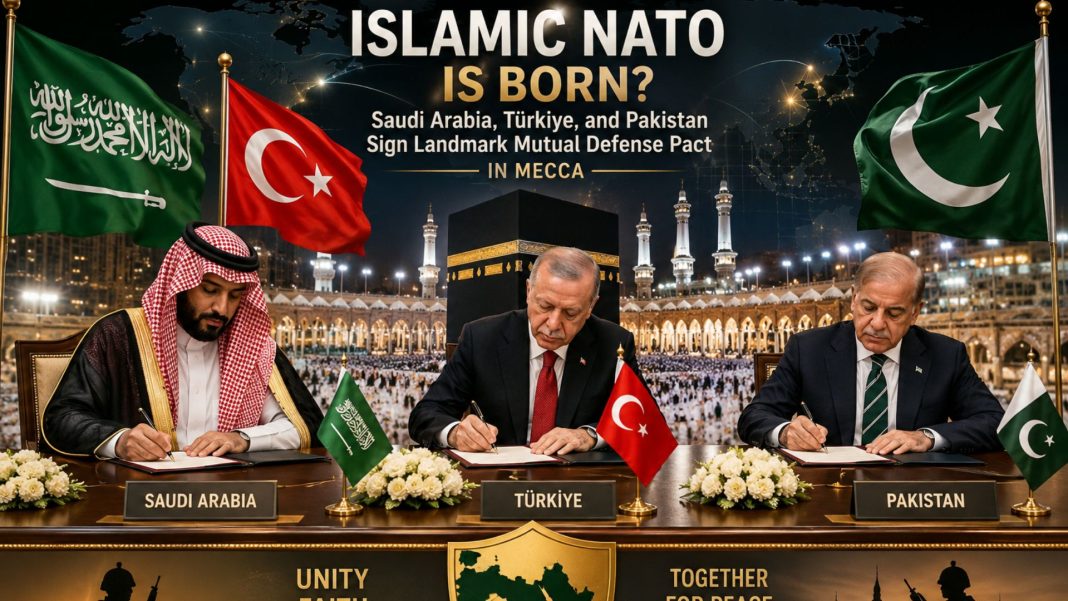

ISLAMIC NATO IS BORN? Against the backdrop of escalating conflict in West Asia, Saudi Arabia, Türkiye, and Pakistan have officially signed a historic Joint Defense Agreement at the Al-Safa Palace in Mecca.
The defense alliance, being hailed by geopolitical analysts as a emerging “Islamic NATO,” establishes a collective security framework among the three nations. Under the terms of the treaty, an attack on any one signatory will be treated as an attack on all three.
The high-profile ceremony was attended by Saudi Arabia’s Crown Prince Mohammed bin Salman, Turkish President Recep Tayyip Erdogan, and Pakistani Prime Minister Shehbaz Sharif.
The Golden Triangle: Wealth, Firepower, and Nuclear Power
ISLAMIC NATO IS BORN?: This tripartite alliance brings together three distinct regional superpowers, each contributing a unique military or economic advantage:
Pakistan: The coalition’s sole nuclear-armed state, bringing strategic deterrence and extensive infantry experience.
Türkiye: Armed with advanced military technology, defense manufacturing capabilities, and the second-largest standing army in NATO after the United States.
Saudi Arabia: The economic powerhouse of the region, capable of funding large-scale defense modernization and procurement.
This agreement builds upon a bilateral defense pact signed between Pakistan and Saudi Arabia in September of last year, expanding it into a multi-nation strategic alliance.
Core Highlights of the Defense Treaty
ISLAMIC NATO IS BORN?: The agreement focuses heavily on collective defense, joint deterrence, and technology sharing.
Key Pillars of the Pact
Collective Defense Clause: A armed attack on one member state is recognized as an attack on all three.
Deterrence Strategy: Strengthening joint capabilities to resist external military aggression.
Defense Tech & Training: Comprehensive cooperation on military technology transfer, joint military drills, personnel training, and intelligence sharing.
A Complex Web of Regional Adversaries
While the agreement aims to unify defense efforts, all three nations operate in drastically different security environments with distinct regional adversaries:
| Country | Primary Regional Concerns / Adversaries |
|---|---|
| Saudi Arabia | Iran, Yemen’s Houthis, and Iran-aligned Iraqi militias |
| Türkiye | Greece, Cyprus, and Israel |
| Pakistan | India and Afghanistan |
How Regional Powers and Global Neighbors Are Reacting
India: “Monitoring the Security Impact”
India’s Ministry of External Affairs (MEA) reacted cautiously, stating that New Delhi is keeping a close watch on the developments. Official sources noted that India will thoroughly analyze the implications of this trilateral treaty on both regional stability and India’s national security interests.
Iran: “A Paper Pact Won’t Grant Security”
Tehran delivered a sharp response to the signing ceremony in Mecca. Ebrahim Rezaei, a prominent member of the Iranian Parliament’s National Security Commission, took to social media platform X to criticize the deal.
“Saudi Arabia must understand that a paper agreement with Türkiye and Pakistan cannot buy true security. If Saudi Arabia reforms its foreign policies, it won’t need to beg for security elsewhere,” Rezaei stated.
What Lies Ahead
The creation of this defense bloc marks a dramatic shift in West Asian and South Asian geopolitics. While the alliance promises unprecedented military and technological cooperation among the three key Muslim-majority nations, diplomatic analysts warn that navigating the individual foreign policy conflicts of each member state will prove to be a massive diplomatic challenge.
Also Read : ‘No Standard System Exists’: MEA Slams ‘Arbitrary’ Global Passport Rankings in Parliament