


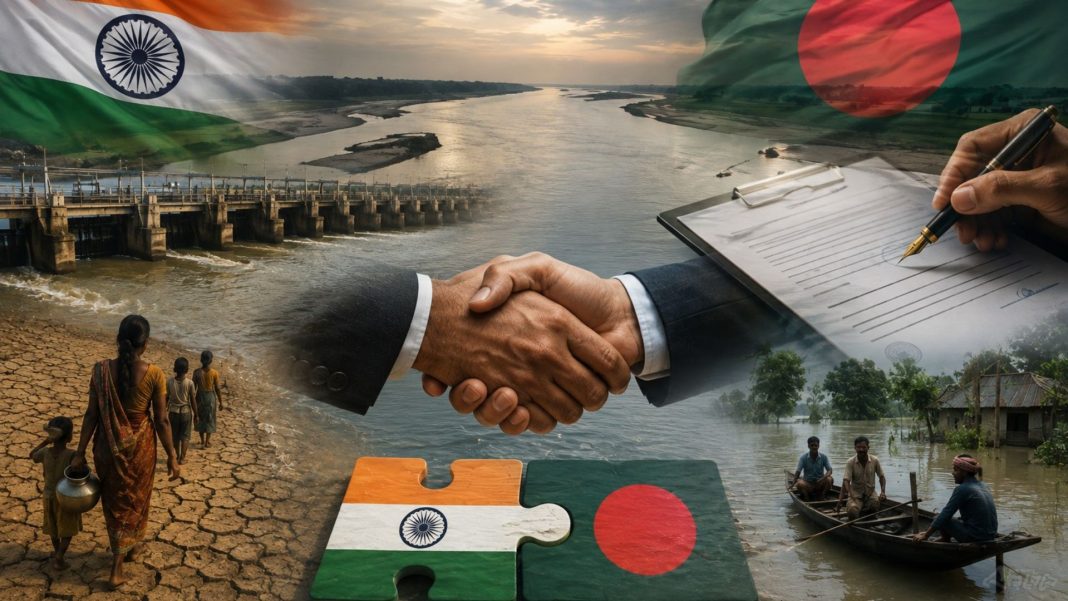

Ganga Water Treaty 2026: The long-standing water-sharing arrangement between India and Bangladesh is once again in the spotlight. With the historic 1996 Ganga Water Treaty set to expire in December 2026, diplomatic tensions are quietly simmering.
Bangladesh’s Water Resources Minister, Shahiduddin Chowdhury Annie, recently stated in Dhaka that Bangladesh wants a strict ‘Guarantee Clause’ included in the renewed treaty.
If their demands for a guaranteed minimum water flow are not met, Dhaka has hinted at the possibility of approaching international platforms. This upcoming deadline has brought decades-old geographical and political debates back to the forefront.
What is the 1996 Ganga Water Treaty and How Does It Work?
Ganga Water Treaty 2026: Signed for a tenure of 30 years, the current agreement dictates how the waters of the Ganga are shared during the lean dry season, which runs annually from January 1 to May 31. During these months, the water level in the river naturally drops significantly.
The current 1996 sharing formula is structured around a 10-day period availability at Farakka:
70,000 cusecs or less: Both India and Bangladesh share the water equally (50-50%).
70,000 to 75,000 cusecs: Bangladesh receives a fixed 35,000 cusecs, and the remaining water goes to India.
75,000 cusecs or more: India receives a fixed 40,000 cusecs, and the rest goes to Bangladesh.
While this formula looks precise on paper, Bangladesh argues that it fails to protect their interests during exceptionally dry years when the actual volume of water drops drastically.
Why is Bangladesh Demanding a ‘Guarantee Clause’?
Ganga Water Treaty 2026: At the heart of Dhaka’s new demand is a simple argument: a sharing formula is not enough without a legal safety net.
Bangladesh points out that while the 1996 treaty has a sharing mechanism, it lacks a binding guarantee that ensures a minimum quantity of water will reach the lower riparian nation regardless of upstream shortages.
Predictability and Security: A guarantee clause ensures that even if upstream availability drops, downstream communities still receive a pre-determined bare minimum volume.
Accountability: Bangladesh wants clear protocols written into the text detailing responsibilities and immediate legal or operational remedies if water flows fall short or if the treaty’s terms are breached.
Historical Precedent: Bangladesh frequently references the 1977 Ganga Water Agreement, which did feature a guarantee clause ensuring a minimum flow. However, that agreement was short-lived (lasting only five years), and subsequent arrangements in 1982, 1985, and crucially the 1996 treaty omitted it.
Dhaka maintains that without this clause, they are left vulnerable whenever upstream water levels plummet.
The Root of the Dispute: The Farakka Barrage Story
To understand why water is such an emotive political issue between the two neighbors, we have to look back to the 1970s.
In an effort to save the crucial Kolkata Port, the Indian government constructed the Farakka Barrage in West Bengal close to the international border. Over the years, massive amounts of silt, mud, and debris had begun accumulating in the Hooghly River, drastically reducing its depth. This heavy siltation posed an existential threat to the port, risking its closure.
To fix this, the Farakka Barrage was built to divert a portion of the Ganga’s water into the Hooghly River, flushing out the silt and maintaining navigability.
However, because the Ganga flows from India into Bangladesh, diverting water upstream directly impacted the volume crossing the border. This triggered deep-seated concerns in Bangladesh over several environmental and economic issues:
Agricultural Crisis: A severe shortage of water for irrigation during the dry crop seasons.
Ecological Degradation: Shrinking fish populations and severe disruptions to local aquatic life.
Salinity Intrusion: Reduced freshwater flow allows saline sea water to push further upstream, ruining coastal soil fertility and drinking water sources.
Siltation Downstream: Paradoxically, reduced flow also caused heavy siltation problems inside Bangladesh.
India’s Perspective: Balancing Domestic Needs and Diplomacy
As the 2026 expiration date approaches, India is adopting a cautious, calculated approach. New Delhi has clarified that formal negotiations for the treaty’s renewal have not yet officially commenced.
However, groundwork is well underway. The Indian government is actively consulting key domestic stakeholders, particularly the state governments of West Bengal and Bihar, whose livelihoods, agriculture, and water security are directly tied to the Ganga.
When formulating its stance on the new treaty, India is prioritizing:
Modern Hydrological Data: Factoring in updated water flow measurements rather than relying purely on decades-old data.
Climate Change Realities: Accounting for unpredictable monsoons, glacial melting patterns, and shifting weather cycles.
National and Regional Interests: Ensuring that India’s own soaring domestic agricultural, industrial, and drinking water requirements, especially in densely populated eastern states, are fully protected.
The Road Ahead: Diplomacy Over Confrontation
The push by Bangladesh for a guarantee clause sets up a delicate diplomatic challenge for late 2026. While Dhaka is under intense domestic pressure to secure a watertight deal that safeguards its farming communities, New Delhi must balance bilateral goodwill with critical regional and ecological realities at home.
Whether both nations can bridge their differences through bilateral dialogue before the current treaty lapses remains one of South Asia’s most crucial environmental and diplomatic tests.