


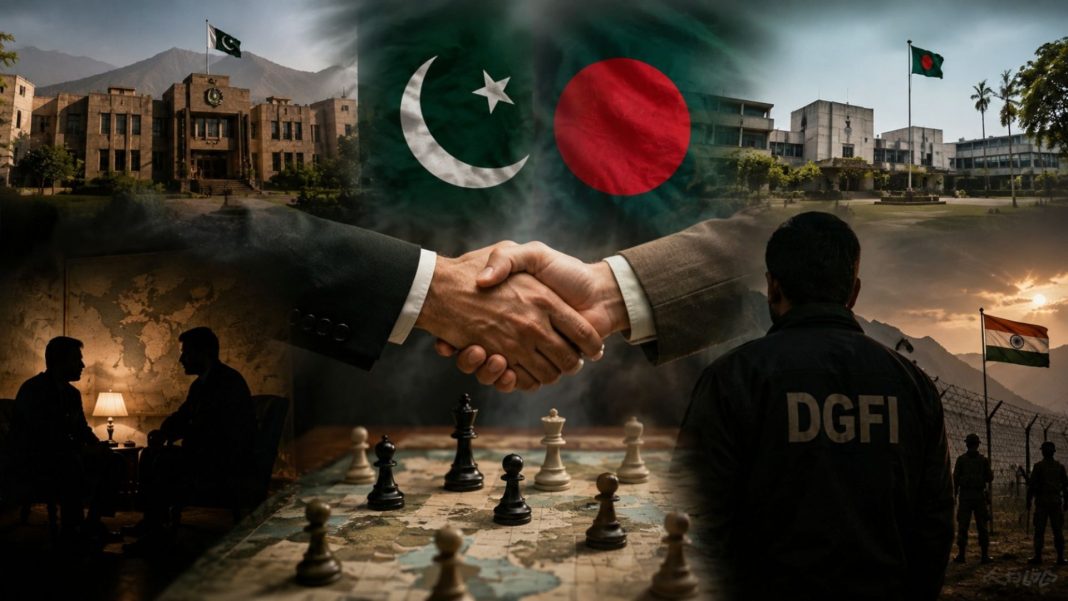

Bangladesh DGFI Pakistan visit: Recent developments in South Asia are signaling a subtle yet significant shift in geopolitical alignments. A high-level six-member delegation from Bangladesh’s Directorate General of Forces Intelligence (DGFI) recently visited Pakistan to deepen security and intelligence cooperation between Dhaka and Islamabad.
Led by Colonel Magfuz-ul-bari, the delegation included senior officials such as Wing Commander Imrul Qais, Mohiuddin Mohammad Asif, Squadron Leader Rehan Mohammad Chowdhury, Murad Hossain Tushar, and Khandoker Ariful Islam.
This visit is not an isolated event; rather, it forms part of a rapidly evolving pattern of military and intelligence exchanges that has caught the attention of regional observers, particularly in New Delhi.
The Changing Dynamics: From Dhaka to Islamabad
Bangladesh DGFI Pakistan visit: The timing of this visit is politically significant. Bangladesh is navigating a crucial transitional phase following the dramatic political upheaval of August 2024, which saw the ouster of Sheikh Hasina.
In the wake of these internal changes, Islamabad has moved quickly to expand political, military, and intelligence ties with Dhaka. This latest DGFI trip follows closely on the heels of DGFI Director General Major General Kaiser Rashid Chowdhury’s visit to Islamabad in April 2026, undertaken barely a month after he assumed office. Reports also indicate that high-level security dialogues and delegation exchanges have steadily increased over the past year.
According to former Indian Ambassador Anil Trigunayat, Pakistan’s military and the Inter-Services Intelligence (ISI) have historically maintained deep roots in the region, gaining “extraordinary access” during the interim administration led by Muhammad Yunus.
Today, this security apparatus is actively institutionalizing its footprint in Dhaka, moving beyond routine intelligence sharing toward tangible defense partnerships.
Beyond Intelligence: The JF-17 Fighter Jet Talks and Defense Ambitions
Bangladesh DGFI Pakistan visit: Pakistan’s outreach to Bangladesh is not limited to back-channel intelligence cooperation. It extends deep into the realm of hard defense procurement and military hardware.
Earlier this year, the air chiefs of Pakistan and Islamabad held discussions regarding a potential deal for the sale of Pakistan’s JF-17 Thunder fighter jets to Bangladesh.
For Islamabad, securing defense contracts with Dhaka represents a major strategic victory, allowing it to project influence into India’s immediate eastern neighborhood.
For Bangladesh, diversifying its defense acquisitions provides tactical flexibility, allowing the nation to reduce singular dependencies and explore alternative suppliers for military equipment and training.
Analysts also point to broader frameworks, such as cooperative security architectures tied to Middle Eastern dialogues, where Pakistan plays a prominent role, further expanding Dhaka’s diplomatic orbit.
Is Dhaka Using Islamabad as Leverage Against New Delhi?
The central question arising from these developments is whether Dhaka is intentionally recalibrating its foreign policy to pressure India.
Despite an invitation from New Delhi, Bangladesh remains outside the BRICS bloc, and uncertainty surrounds potential high-level participation in upcoming global summits.
With bilateral ties between New Delhi and Dhaka experiencing visible friction, experts suggest that Bangladesh is utilizing closer ties with Pakistan and China as diplomatic leverage.
Ambassador Trigunayat notes that while geography dictates that India remains an indispensable economic and security partner for Bangladesh, Dhaka may believe that engaging with Islamabad provides extra bargaining power.
Economic and Geographic Realities: India and Bangladesh share a massive border, deep-rooted trade ties, and vital security dependencies. A complete pivot away from India is neither practical nor economically viable for Dhaka.
Strategic Hedging: By cultivating warmer relations with Pakistan, Bangladesh is successfully hedging its bets, ensuring that it is not overly reliant on any single regional power.
A New Strategic Equation for New Delhi
For India, this evolving entente cordiale between Bangladesh and Pakistan presents a complex strategic puzzle.
While these developments do not necessarily mean Bangladesh is entering a formal anti-India coalition, New Delhi cannot afford to ignore the rising footprint of Pakistani intelligence institutions in its eastern backyard.
The institutionalization of intelligence sharing, combined with potential arms sales, marks a distinct departure from the status quo observed during the Hasina era.
Ultimately, Bangladesh is keeping its diplomatic options wide open. As Dhaka maneuvers to maximize its national interests through a multi-aligned foreign policy, regional stability in South Asia will heavily depend on how deftly New Delhi and Dhaka manage their bilateral sensitivities amidst these shifting geopolitical winds.