


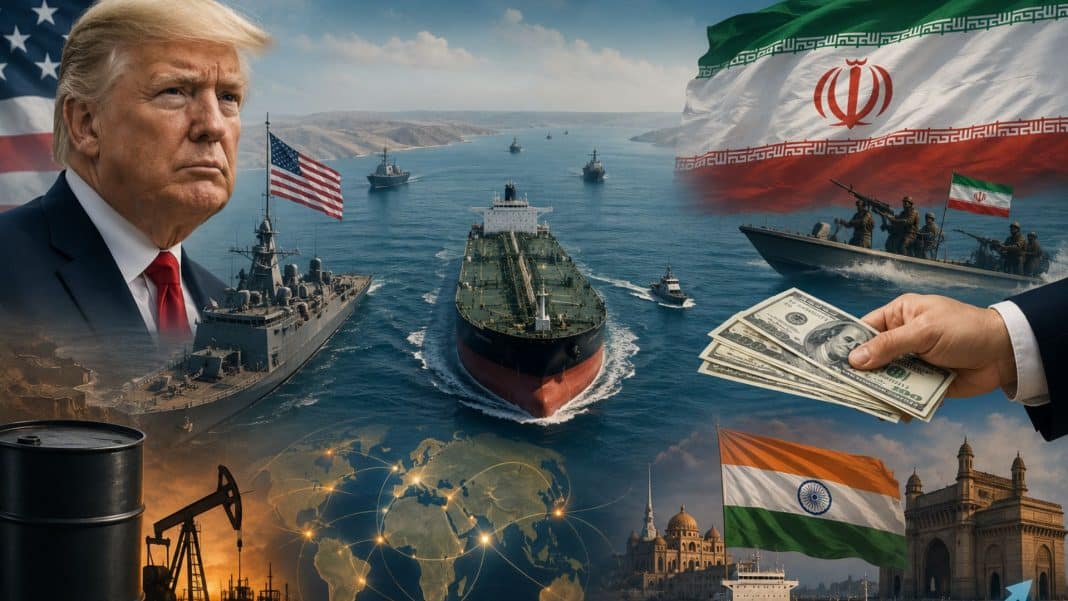

Hormuz Strait Control: The fragile peace in the Middle East has shattered. Following a lethal missile attack on commercial tankers in the Gulf of Oman, US President Donald Trump has announced the reinstatement of a full naval blockade on Iran and a highly controversial 20% “protection fee” on all ships transiting the Strait of Hormuz.
Escalation in the Gulf: Tankers Struck, Indian Seafarer Killed
Hormuz Strait Control: The latest crisis erupted when two UAE-flagged supertankers, the Mombasa and Al Bahiyah, operated by ADNOC Logistics & Services, were targeted by Iranian cruise missiles while transiting the southern shipping corridor within Omani territorial waters.
The attack resulted in the death of one Indian crew member aboard the Mombasa and left eight other sailors wounded, including six Indian nationals and two Ukrainians.
The Scene: Blazes broke out on both Very Large Crude Carriers (VLCCs) before being brought under control by emergency crews.
The Reaction: The UAE Ministry of Defence condemned the strikes as a “blatant violation of international law” and declared that it reserves the full right to respond firmly.
Meanwhile, Iran’s Islamic Revolutionary Guard Corps (IRGC) claimed they targeted “offending” tankers that ignored warnings and disabled their tracking systems.
This fatal exchange marks the complete collapse of the fragile, US-negotiated June interim ceasefire.
The Trump Directive: Reinstating the Blockade & Demanding a 20% Toll
Hormuz Strait Control: Responding to the escalation, President Trump announced that the US Navy will enforce a strict blockade covering all of Iran’s ports, oil terminals, and coastlines, effective July 14, 2026.
While asserting that neutral commercial vessels heading to non-Iranian destinations will still have “fair and open use” of the passage, Trump declared that the US must be compensated for maintaining security in the region.
At a White House press briefing, President Trump stated: “We’re going to keep the strait, and we’ll probably run it… We’ll become the guardian of the strait. Maybe we’ll call it the guardian angel of the strait. And we should be reimbursed for that.”
Under the White House’s proposed payment structure, the US intends to levy a 20% tariff on the value of all cargo transiting through the Strait of Hormuz to offset military costs.
Legal and Practical Roadblocks: Can the US Actually Control the Strait?
Maritime legal experts, international bodies, and defense analysts have quickly pointed out massive hurdles to Trump’s plan.
- The Legal Defense: UNCLOS and the IMO
The 1982 United Nations Convention on the Law of the Sea (UNCLOS) guarantees all nations the right of “transit passage” through international straits for continuous and expeditious navigation.
No Tolls Allowed: The International Maritime Organization (IMO) has consistently stood firm against charging arbitrary transit fees in international straits.
Sovereign Waters: The shipping lanes of the Strait lie within the territorial waters of Oman and Iran, meaning an external power has no legal authority to impose a unilateral toll system.
- The Asymmetric Threat
Enforcing a physical check-and-collect system on thousands of massive commercial vessels passing through a narrow chokepoint (only 21 to 24 miles wide at its tightest) is a logistical nightmare.
The narrow geography makes shipping highly vulnerable to Iran’s array of asymmetric capabilities:
Shore-based anti-ship cruise missiles
Fast-attack swarm boats
Loitering munitions (kamikaze drones)
Naval sea mines
A forced slowdown of ships to register, inspect, or process 20% toll payments would create massive bottleneck “sitting ducks” for hostile strikes.
The Global Economic Toll: A $16 per Barrel Premium
The immediate financial consequence of a 20% cargo levy is staggering. On a single supertanker carrying raw crude oil valued at $100 million, a 20% fee translates to a massive $20 million surcharge before adding freight, fuel, and labor. This extra cost would ultimately be passed directly to importers and consumers.
Analysts estimate that if implemented, this tariff would immediately add roughly $16 per barrel to the price of oil. Furthermore, if the Strait becomes an active conflict zone, insurers will spike war-risk premiums or withdraw coverage altogether, grinding global maritime trade to a halt.
Key Impacts of the Proposed Toll and Conflict:
Crude Oil Price Shock: An estimated increase of more than $16 per barrel.
Typical Supertanker Cost: Up to $32 million in single-transit surcharges.
Global Energy Volume: Prior to the war, roughly 20% of global oil and LNG passed through this route.
Insurance Impact: Skyrocketing war-risk premiums or complete coverage denial.
Why India is Watching the Gulf with Extreme Concern
No country is feeling the anxiety of this escalation quite like India. For New Delhi, the situation presents a direct threat to national security, economic stability, and human lives.
- Severe Energy Vulnerability
India imports more than 85% of its crude oil requirements. Major suppliers like Iraq, Saudi Arabia, the UAE, Kuwait, and Qatar all ship their cargo through the Strait of Hormuz. It is also the exclusive pathway for Qatar’s massive Liquefied Natural Gas (LNG) exports to Indian ports.
If shipping costs surge by 20%, or if supplies are choked, the economic shockwaves will hit Indian consumers directly:
A widening Current Account Deficit (CAD) as oil import bills balloon.
Upward pressure on domestic inflation and transportation costs.
Massive cash-flow pressure on public sector oil marketing giants like IOCL, BPCL, and HPCL.
- Limits of the ‘Russian Buffer’
While India successfully diversified its oil basket over the last few years by buying discounted Russian crude shipped via safer European routes, experts warn this is only a partial shield. The sheer volume of Gulf oil and gas cannot be easily replaced, and any global price spike will affect all crude benchmarks, including Russian grades.
- The Human Cost to Indian Seafarers
Indian nationals make up a massive percentage of global merchant navy crews operating in the Middle East. The tragic death of an Indian seafarer on the Mombasa, along with injuries to six other Indian crew members, has brought home the terrifying reality of the human cost. As the waters become heavily militarized, Indian sailors are increasingly trapped in the crossfire of geopolitical brinkmanship.
Iran Strikes Back: “We Are the True Guardians”
Tehran has aggressively dismissed Donald Trump’s “Guardian of the Strait” branding. Iranian Foreign Minister Seyed Abbas Araghchi took to social media with a sharp, sarcastic response to Trump’s compensation demand, writing that the US President is absolutely right that whoever provides safe passage for commercial ships in the Strait of Hormuz should be compensated for this service.
He added that Iran has always been and will always be the guardian of the Strait, cheekily noting that 20% is definitely too much and that Iran would be fairer.
On a more dangerous note, Iranian military commander Brigadier General Ibrahim Zolfagari warned that any nation providing logistical or operational assistance to enforce Trump’s unilateral US blockade or toll system would be treated as an active participant in war against Iranian sovereignty.
A Highly Volatile Horizon
With the US Navy actively positioning its assets to enforce the blockade, and Iran retaliating across the region, including recent missile strikes targeting US military infrastructure in Bahrain, the Strait of Hormuz has transformed into a geopolitical powder keg.
Whether Trump’s 20% toll is a high-stakes negotiating tactic or a literal policy directive, the mere threat of it has already disrupted global markets, elevated shipping risks, and left energy-dependent nations like India bracing for a highly turbulent economic winter.
Also Read : PENTAGON REALITY CHECK: Can A U.S. President Activate A ‘Dead Man’s Switch’ Against Iran?