


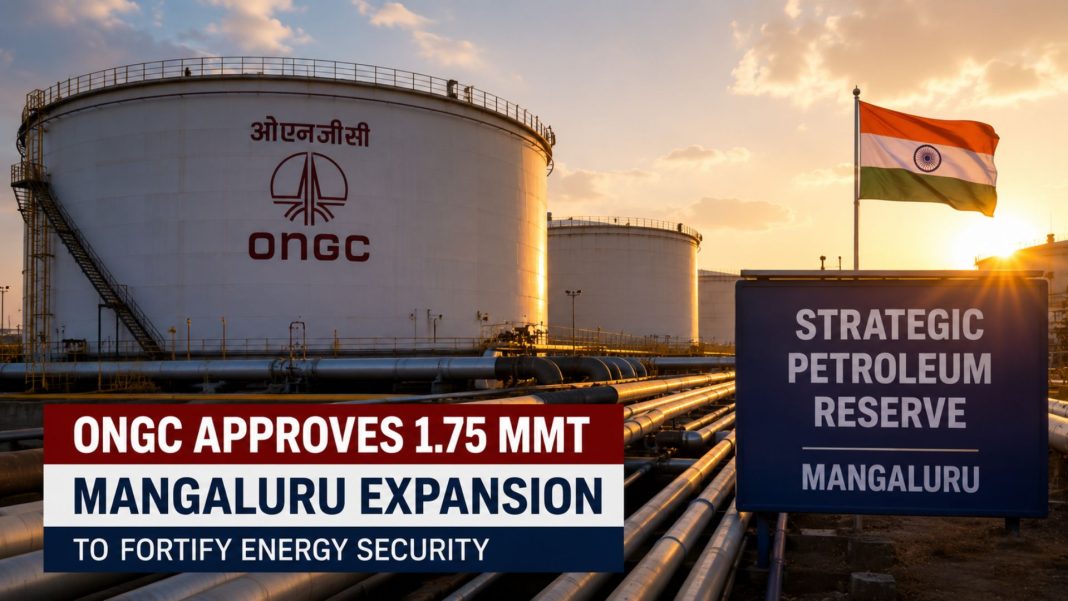

India Strategic Petroleum Reserve: According to recent media reports, India has taken a major step forward in safeguarding its economic and energy interests against global supply chain vulnerabilities.
In a significant development, the state-run Oil and Natural Gas Corporation (ONGC) has reportedly approved the development of a new 1.75 million metric tonne (MMT) expansion project at the strategic petroleum reserve (SPR) in Mangaluru, Karnataka.
As per industry sources, this decision marks a historical shift, as it is the first time the country’s largest oil and gas explorer will directly fund the creation of an emergency strategic crude storage facility.
Industry insiders note that this decision comes in the wake of recent geopolitical conflicts in West Asia, which briefly disrupted maritime traffic through the Strait of Hormuz.
Given that nearly one-fifth of the world’s global oil supplies pass through this critical chokepoint, the disruption highlighted the urgent need for import-dependent nations to build robust local buffers.
Currently, India relies on overseas shipments to satisfy more than 85 percent of its crude oil requirements, making its economy highly sensitive to international price shocks and logistical blockades.
Understanding the ONGC Mangaluru Expansion Plan
India Strategic Petroleum Reserve: According to a regulatory filing cited by media networks, the board of ONGC has granted in-principle approval for the Phase-I expansion of the Mangaluru strategic petroleum reserve project.
The expansion, along with its associated operational facilities, is being executed in line with the strategic directions issued by the Ministry of Petroleum and Natural Gas.
Once completed, the project will add 1.75 MMT of secure storage capacity to the existing national grid.
Reports also indicate that ONGC intends to seek formal clearance from the central government to commercially utilize the proposed storage facility under a “national interest” framework.
This commercial-strategic hybrid model is designed to offset development costs while keeping the reserves fully available for national emergencies.
Current Status of the India Strategic Petroleum Reserve Network
India Strategic Petroleum Reserve: According to official government data, India’s existing underground strategic crude storage capacity stands at 5.33 million metric tonnes.
These emergency stockpiles are securely managed across three key underground rock caverns managed by the Indian Strategic Petroleum Reserves Ltd. (ISPRL):
Visakhapatnam (Andhra Pradesh)
Mangaluru (Karnataka)
Padur (Karnataka)
As per historical consumption patterns recorded during 2019-20, media sources highlight that the current 5.33 MMT inventory is capable of sustaining India’s nationwide crude requirements for approximately 9.5 days.
Financial and energy analysts state that while this offers a short-term cushion, expanding the capacity is absolutely critical to withstand prolonged international blockades.
Commercial Viability and the Mangaluru Energy Hub
Mangaluru has steadily evolved into one of India’s most vital energy epicenters. According to industry reports, an ONGC subsidiary, Mangalore Refinery and Petrochemicals Limited (MRPL), already operates a massive 300,000-barrel-per-day refinery at this location.
The existing 1.5 MMT storage facility at Mangaluru is already functioning under a highly successful mixed-use model.
Media reports state that half of this capacity has been leased directly to MRPL for its daily refining operations, while the remaining half has been leased to the Abu Dhabi National Oil Company (ADNOC).
This arrangement allows the facility to consistently generate commercial returns while remaining legally bound to release stocks to the Indian government during unexpected geopolitical crises.
Future Roadmap: Overseas Reserves and Upcoming Projects
According to media reports, the Mangaluru expansion is part of a broader, multi-layered blueprint orchestrated by New Delhi to counter global energy volatility. India is currently developing two additional major facilities:
A 4 million metric tonne facility at Chandikhol in Odisha.
A 2.5 million metric tonne facility at Padur in Karnataka.
Furthermore, India is looking beyond its borders to build an external safety net. Reports from earlier this year indicate that during Prime Minister Narendra Modi’s state visit to the United Arab Emirates, ADNOC announced intentions to expand its crude oil storage capacities within India to up to 30 million barrels.
Additionally, both nations are exploring the possibility of storing a portion of the India Strategic Petroleum Reserve at Fujairah in the UAE, establishing a unique overseas defensive component to India’s energy preservation strategy.
A Critical Shield Against Volatility
As per energy experts, the rapid lessons learned from recent global conflicts emphasize how quickly political friction can translate into severe market volatility.
For India, standing as the world’s third-largest consumer and importer of crude oil, expanding the India Strategic Petroleum Reserve is no longer just an infrastructure upgrade it is treated as an essential national safeguard.
Media reports conclude that these proactive expansions will offer the country necessary operational flexibility, stabilize domestic fuel prices, and ensure uninterrupted economic momentum during global emergencies.